How FDA Approval Timing Ties to Big Pharma Lobbying and Drug Costs?
Analysis reveals 6 key thematic connections.
Key Findings
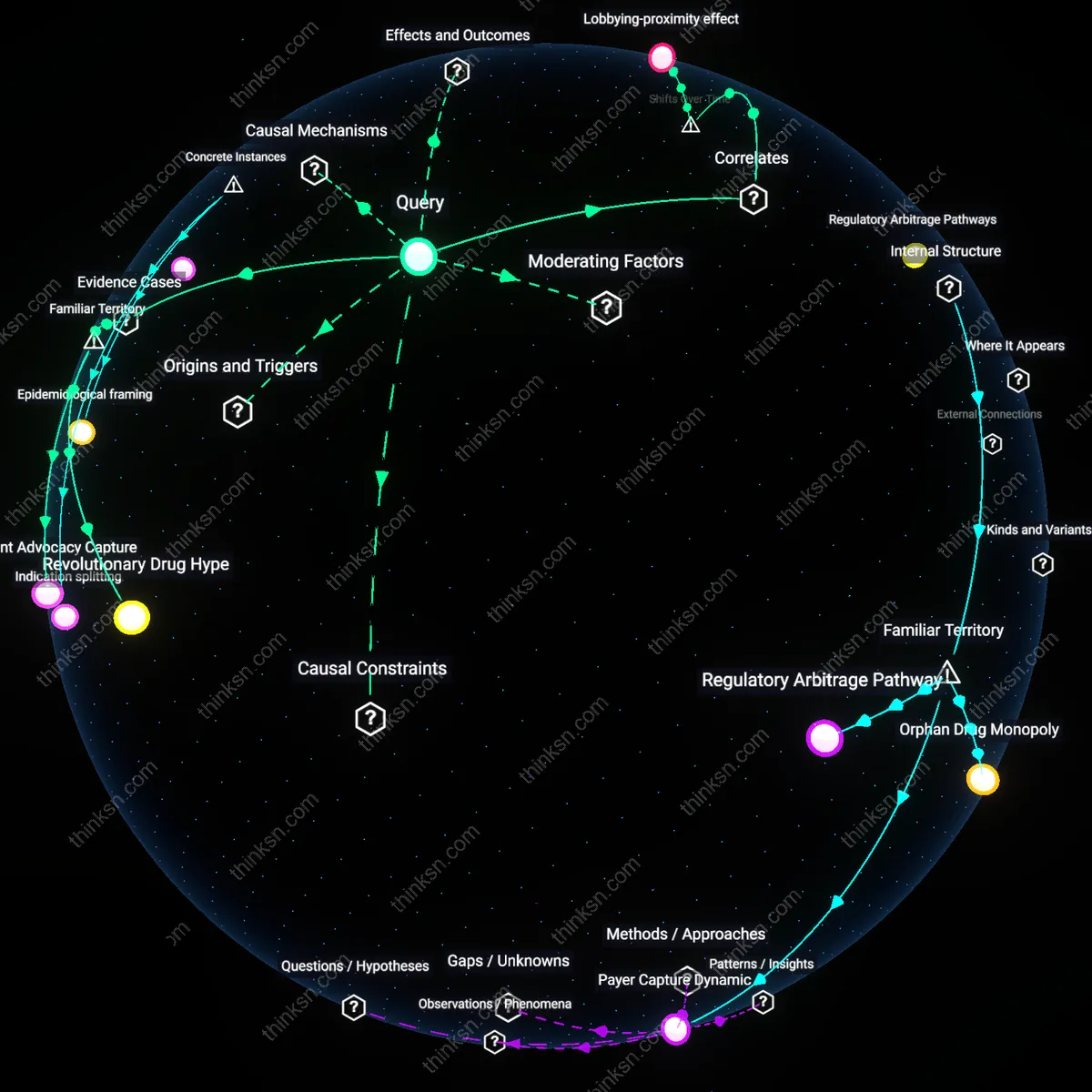
Lobbying-proximity effect
Pharmaceutical lobbying firms intensified their interactions with the FDA during the 1992 Prescription Drug User Fee Act (PDUFA) era, correlating with faster approval times for drugs that faced heavy marketing efforts post-approval — yet this co-occurrence does not establish that lobbying directly shortened review timelines. The mechanism operates through synchronized increases in pre-submission consultations, priority review requests, and post-meeting correspondence, primarily involving brand-name biologics manufacturers and FDA division heads, creating a statistical association between high-revenue drug classes and shorter regulatory review durations. However, this relationship obscures whether speed results from regulatory capture, organizational learning, or market incentives amplified by user fee dependence, making the temporal shift from pre-1992 volunteer-review models to fee-driven timelines analytically critical for misattributing causality to lobbying. This reveals that proximity in regulatory access can be mistaken for influence when it may instead reflect procedural path dependency within a restructured approval economy.
Post-approval price inflation
Drug pricing spikes following FDA approval have grown markedly since the early 2000s, coinciding with expanded off-label promotion rights and weakened federal price negotiation capacities, but these increases correlate more strongly with patent-thickening strategies and Medicare Part D coverage gaps than direct lobbying on approval pace. The critical shift occurred between 2003 and 2010, when pharmaceutical firms pivoted from seeking rapid market entry to maximizing post-approval revenue extraction under revised reimbursement frameworks, leveraging data exclusivity extensions and REMS programs to delay generic competition without requiring additional lobbying to accelerate initial FDA review. This decoupling of approval speed from pricing behavior reveals that consumer cost impacts are back-loaded phenomena, driven not by faster evaluation but by downstream policy vacuums — exposing how temporal disjunctions in regulatory control produce pricing dynamics falsely attributed to upstream lobbying effects.
Orphan drug paradox
The explosive growth in orphan drug approvals after the 2000s, rising alongside increased lobbying by specialty pharma firms, correlates with disproportionate price-setting power but was primarily triggered by the 1983 Orphan Drug Act’s market exclusivity provisions rather than later advocacy pressures — a shift that redefined therapeutic 'rareness' as a profitable regulatory category rather than a public health designation. Lobbying intensified not to shorten review timelines, but to broaden disease definitions and extend exclusivity through legislative tweaks like the 2012 FDASIA, exploiting a historical pivot where innovation incentives became financially untethered from patient population size. This transformation turned statutory exceptions into scalable business models, revealing how a mid-1980s policy experiment evolved into a pricing engine through delayed regulatory arbitrage, not real-time influence on approval duration.
Revolutionary Drug Hype
Pharmaceutical lobbying accelerates FDA approval timelines for high-profile drugs by shaping clinical trial benchmarks and regulatory expectations, as seen in the case of Vertex Pharmaceuticals’ cystic fibrosis drug Trikafta, where intense lobbying preceded its expedited review and approval. The company leveraged patient advocacy partnerships and congressional outreach to frame the drug as medically urgent, thereby influencing FDA’s risk tolerance and timeline commitments. This demonstrates how lobbying doesn’t only operate through direct regulatory capture but by shifting what counts as a public health priority in the collective imagination—a mechanism that feels familiar because we often associate ‘breakthrough’ drugs with moral imperatives rather than pricing strategies. The non-obvious insight is that faster approval becomes a lobbying proxy, where speed itself disguises downstream pricing inescapability.
Orphan Drug Paradox
Biogen’s lobbying efforts surrounding the Alzheimer’s drug Aduhelm directly impacted both FDA approval and consumer pricing by exploiting the Orphan Drug Act framework, which incentivizes development for rare diseases but has been extended to broader conditions through strategic reclassification. The company secured accelerated approval based on surrogate markers rather than clinical outcomes, a pathway made politically viable through sustained lobbying of congressional health committees and FDA advisory influence. This case is emblematic of the familiar public narrative that ‘rare disease drugs deserve faster access,’ yet the underappreciated consequence is how this moral logic is hijacked to justify exorbitant pricing under the guise of high development costs and small markets. The real mechanism is not corruption per se, but category manipulation—using socially respected exceptions to rewrite standard cost-benefit norms.
Patient Advocacy Capture
Pharmaceutical companies like Gilead Sciences have used disease-specific patient advocacy groups as lobbying conduits to influence FDA timelines and deter price regulation, notably in the case of Hepatitis C drug Sovaldi, which was rapidly approved and launched at $84,000 per course. Gilead funded and partnered with groups such as the National Viral Hepatitis Roundtable, embedding its pricing rationale within patient narratives of access and urgency, thereby pressuring the FDA and state Medicaid programs simultaneously. This reflects the familiar trope that ‘patients are the heart of healthcare,’ but the unseen shift is that patient voices are structurally amplified only when they align with corporate timelines and price points. The resulting dynamic turns authentic advocacy into a regulatory instrument, where public support becomes a pre-emptive shield against pricing scrutiny.