High Drug Prices: Innovation Cost or Excessive Profit?
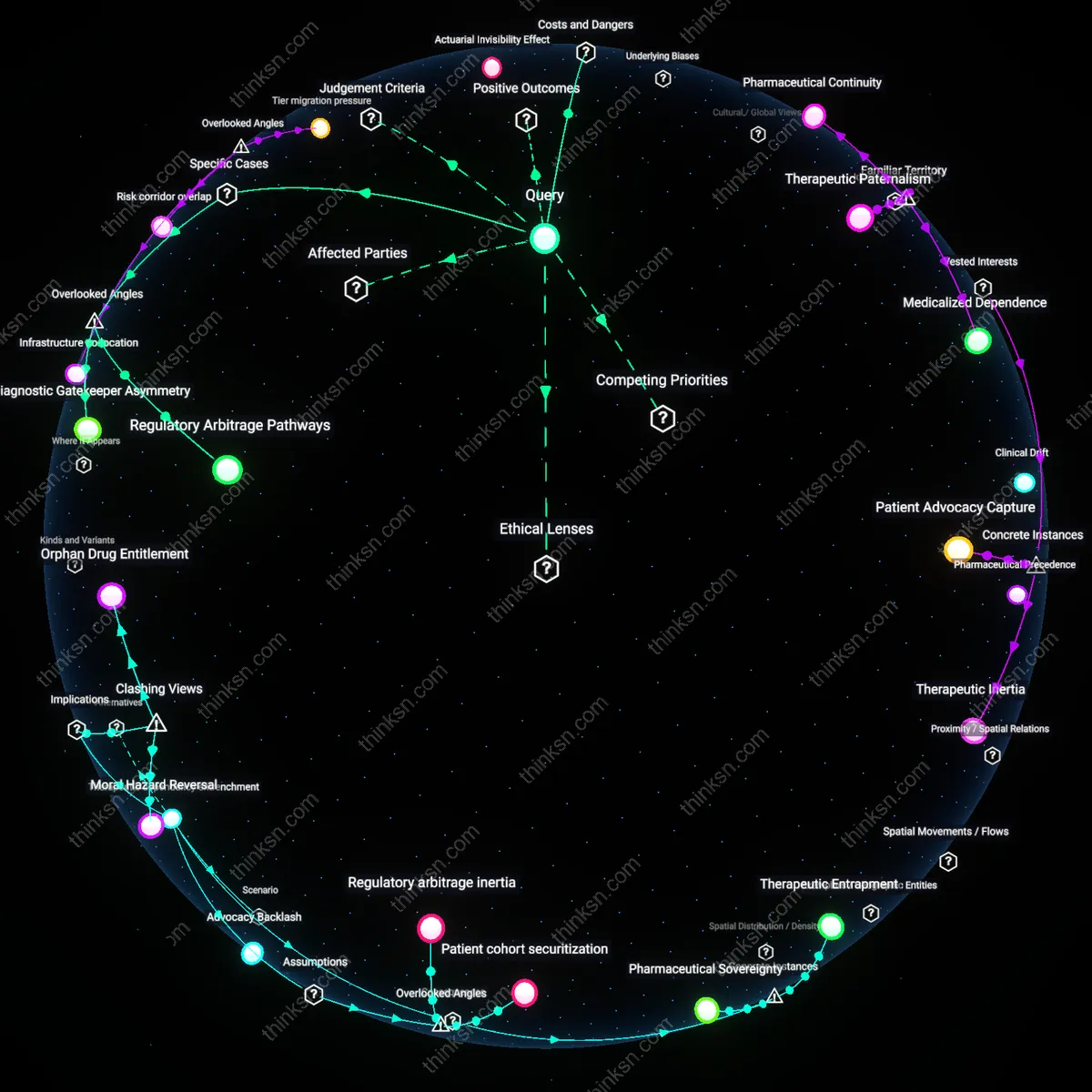
Analysis reveals 12 key thematic connections.
Key Findings
Innovation Theater
High drug prices justified by R&D costs should be rejected when clinical gains are marginal because the pharmaceutical industry increasingly operates under a regime of innovation theater, where regulatory approval and investor confidence are prioritized over therapeutic advancement through narrowly tailored clinical trials that measure surrogate endpoints rather than patient outcomes. This mechanism functions through FDA pathways like accelerated approval and orphan drug designations, which allow premium pricing based on biomarker changes instead of survival or quality-of-life improvements, thereby decoupling price from medical value. The non-obvious reality is that the system rewards the appearance of innovation more reliably than actual health gains, exposing a performative logic in drug development.
Capitalized Suffering
The justification of high drug prices for R&D must be subordinated to the principle of distributive justice because pricing detached from therapeutic benefit effectively monetizes patient vulnerability, transforming medical need into a revenue stream under monopolistic patent regimes. This operates through a biosocial contract in which public investment in basic science—via NIH-funded research—is privatized at the point of commercialization, allowing firms to extract rents from collectively produced knowledge while restricting access through price. The dissonance lies in recognizing that high prices are less a reward for risk than a mechanism of capital accumulation predicated on the compulsory purchase of incremental drugs by public and private insurers alike.
Therapeutic Arbitrage
Pharmaceutical pricing should be regulated according to therapeutic arbitrage, where reimbursement is indexed to the magnitude of clinical improvement relative to existing standards of care, because the current system enables firms to capture windfall profits from drugs with negligible added benefit by exploiting misaligned incentives in health technology assessment and payer formulary design. This occurs through a global pricing cascade, where U.S. list prices set a benchmark for less regulated markets, even when clinical data do not support tiered differentiation, making marginal innovations de facto premium products. The underappreciated dynamic is that payers inadvertently subsidize R&D across a portfolio by overpaying for low-value drugs, effectively socializing costs while privatizing gains.
Innovation Incentive Loops
Sustaining high drug prices funds continuous R&D reinvestment, enabling pharmaceutical firms to recover costs and finance pipelines that might otherwise collapse under market pressures. This mechanism operates through the interplay of shareholder expectations, FDA approval timelines, and competitive positioning in biotech markets, where the threat of pipeline gaps forces firms to prioritize monetization of existing blockbusters to justify future R&D bets. What is underappreciated is that even marginally improving drugs serve as financial anchors that stabilize entire portfolios, ensuring downstream investment in potentially breakthrough therapies that could not be justified by immediate therapeutic gain alone.
Regulatory Arbitrage Pathways
High drug prices are sustained not primarily by therapeutic novelty but by exploiting regulatory frameworks that reward approval milestones over clinical superiority, allowing manufacturers to secure market exclusivity for drugs with incremental benefits. This dynamic arises from the alignment of patent offices, clinical trial design rules, and payer reimbursement protocols—especially in the U.S. context—where demonstrating statistical efficacy, not comparative effectiveness, unlocks pricing power. The non-obvious consequence is that the system incentivizes molecular tweaking over transformative innovation, turning regulatory compliance into a profit engine that indirectly funds broader R&D but distorts therapeutic priorities.
Risk Capital Magnetism
Elevated drug prices act as a signal to attract venture capital and institutional investment into high-risk biopharmaceutical startups, particularly in oncology and rare diseases, where trial failure rates exceed 90%. The promise of premium pricing post-approval creates a financial ecosystem in which limited therapeutic improvements in late-stage drugs still justify earlier-stage bets via portfolio logic, enabling systemic risk-sharing across investors, CROs, and academic labs. The overlooked dynamic is that payers and public health systems, by tolerating high prices for marginal drugs, inadvertently subsidize a broader innovation infrastructure that eventually yields occasional transformative therapies, despite inefficient intermediaries.
Innovation Debt
High prices for Sovaldi were justified by Gilead as necessary to recoup hepatitis C drug development costs, yet its marginal improvement over prior treatments—combined with a price five times higher than projected manufacturing cost—revealed that R&D recovery is often leveraged not to fund discrete innovation but to amortize broader corporate portfolios. This dynamic, institutionalized through U.S. Medicare Part D’s non-negotiation clause, shifts societal cost burdens to public health systems while capturing value away from therapeutic impact, exposing how pricing mechanisms can become detached from clinical advance when regulatory systems permit cost externalization at scale. The non-obvious insight is that R&D justification functions as a systemic subsidy mechanism, not a transparent cost-recovery ledger.
Therapeutic Inertia
AstraZeneca’s annual price increases for Nexium during its ‘patent cliff’ period—while introducing no new clinical benefits over generic omeprazole—demonstrate how pharmaceutical firms exploit regulatory acceptance of molecular tweaks to prolong revenue extraction under the rhetorical cover of R&D investment. This practice, enabled by the Food and Drug Administration’s approval pathway for enantiomer drugs, sustains high prices not through breakthrough science but through strategic IP extension, thereby freezing therapeutic progress in chronic disease categories where better alternatives are shelved to protect incumbent blockbusters. The overlooked mechanism is that regulatory permissiveness around incremental compounds incentivizes stagnation, not innovation.
Value Arbitrage
Vertex Pharmaceuticals’ pricing of Trikafta for cystic fibrosis at over $300,000 per year—while representing a genuine advance for 90% of patients—exposes how even transformative drugs become sites of zero-sum allocation when R&D costs are socialized and returns are privatized, forcing national health systems like the U.K.’s NHS into protracted negotiations that delay access while the company reports 70% profit margins. The pricing here does not reflect cost or even value delivered but the asymmetric bargaining power granted by orphan drug legislation and patent exclusivity, revealing that high prices function less as R&D compensation and more as arbitrage against public health imperatives. The underappreciated reality is that pricing exploits the irreversibility of health need, not the irreversibility of investment.
Patent Tollbooth
Pharmaceutical companies like Turing Pharmaceuticals justify extreme price hikes by claiming reinvestment in R&D, yet the mechanism functions less as a direct recovery of costs and more as a rent-seeking operation enabled by patent monopolies. Martin Shkreli’s 2015 price surge of Daraprim—from $13.50 to $750 per tablet—exposed how a drug with nearly zero marginal production cost could be leveraged for profit under patent protection, despite no therapeutic improvement. This reveals that the patent system, originally designed to incentivize innovation, has been repurposed into a toll collection point on essential medicine access, where the causal link between R&D and pricing is rhetorically invoked but operationally broken. The non-obvious insight is that the public associates high prices with innovation costs, but the real driver in such cases is the absence of competitive alternatives due to legal exclusivity, not R&D expenditure.
Blockbuster Mimicry
Large pharmaceutical firms such as Pfizer or Merck routinely justify high drug prices by pointing to the failure rate of their broader R&D pipelines, but this argument masks a strategic pattern of developing 'me-too' drugs that offer negligible clinical advantages over existing treatments. Drugs like Celgene’s Revlimid—priced at over $200,000 annually—were structurally similar to older, cheaper thalidomide derivatives but extended through minor molecular tweaks to secure new patents and maintain revenue streams. The blockbuster model conditions the industry to prioritize market exclusivity and incremental innovation over therapeutic breakthroughs, framing R&D cost recovery as a moral imperative even when the resulting product does not advance patient outcomes. The familiar link between 'drug cost and innovation' overlooks how much of the R&D defense serves to legitimize the replication of existing therapies under new intellectual property claims.
Orphan Drug Paradox
Companies such as BioMarin Pharmaceutical set extremely high prices for treatments like Vimizim—costing over $350,000 annually—by invoking R&D recovery for ultra-rare diseases, where patient pools are small and development costs appear disproportionately high. The Orphan Drug Act incentivizes such development through tax credits and extended market exclusivity, but this framework enables pricing that severs the link between therapeutic value and accessibility, as the same drug may offer only marginal life extension or functional improvement. This creates a policy-driven feedback loop where public incentives for innovation are exploited to justify prices that would be indefensible in larger markets, even when clinical gains are minimal. The irony, obscured by the moral weight of treating rare conditions, is that the very mechanisms meant to encourage high-risk innovation instead subsidize premium pricing for marginal benefits.