Screen Time Limits for Sensitive Kids: Cognitive Gain or Social Loss?
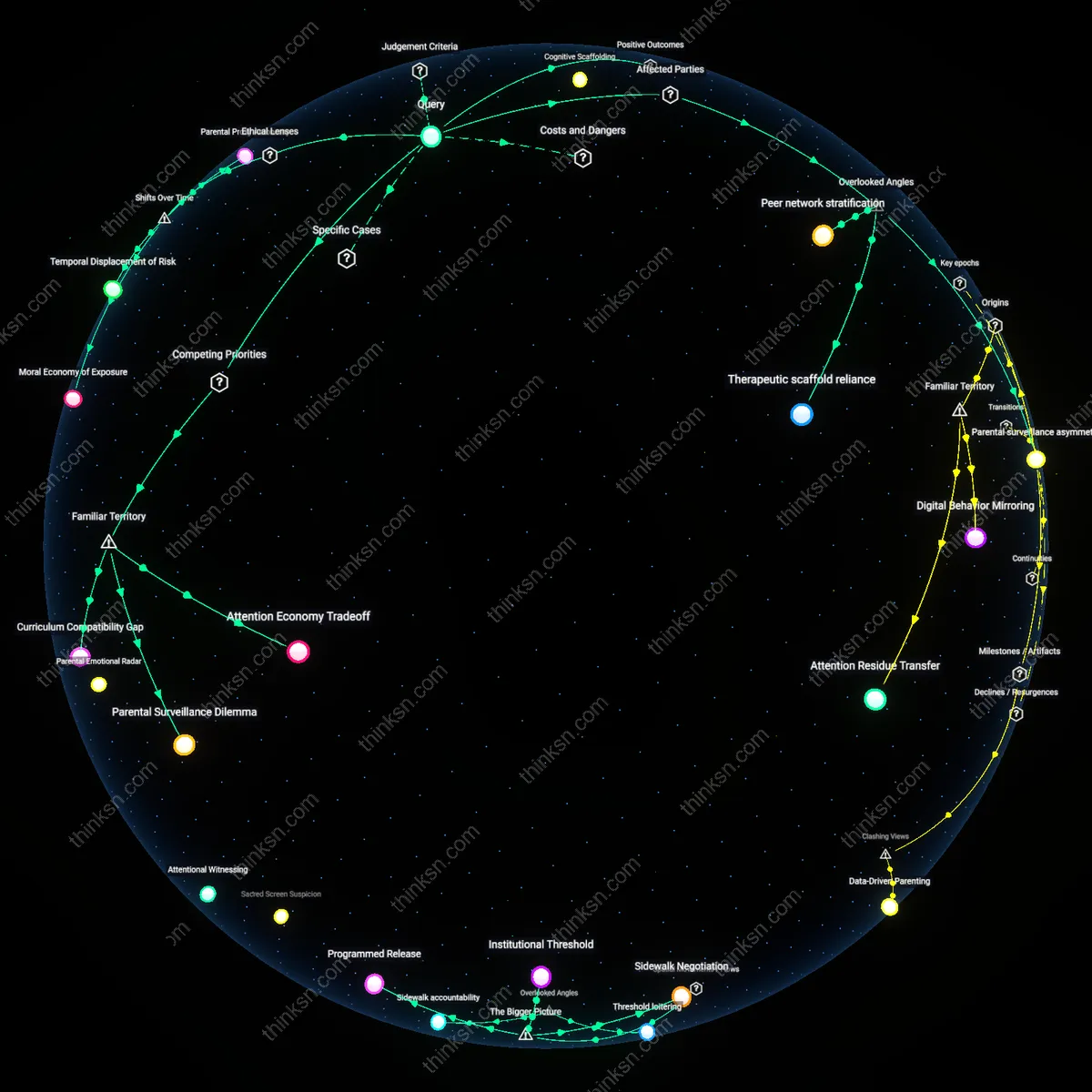
Analysis reveals 12 key thematic connections.
Key Findings
Therapeutic scaffold reliance
Limiting screen time risks destabilizing the emotional regulation of highly sensitive children who depend on predictable digital routines to manage school-induced stress. These children often use controlled exposure to familiar shows, games, or apps as a form of self-designed therapeutic scaffolding—an informal but essential mechanism for transitioning between overstimulating academic environments and home life. Most screen time debates center on content or duration, ignoring how the structure of repetitive, low-arousal screen use functions as a neurobehavioral buffer, particularly for those with sensory processing sensitivity. This shifts the implication from a trade-off between cognition and socialization to a question of whether schools are outsourcing emotional regulation to screens due to insufficient embedded support systems.
Parental surveillance asymmetry
Screen limits increase the invisible labor of parental surveillance for highly sensitive children, disproportionately affecting mothers in dual-income or single-parent households who must compensate for lost monitoring cues previously provided by device usage patterns. When screens are restricted, parents lose access to digital footprints—timing of app use, duration, messaging frequency—that serve as proxy indicators of emotional state, peer integration, and anxiety levels. This creates an asymmetry where more privileged families can replace screens with private counseling or structured activities, while others face heightened anxiety and monitoring burdens without alternatives. The overlooked issue is not screen use itself, but how it functions as a low-cost diagnostic tool in the absence of formal mental health infrastructure for children.
Peer network stratification
Reducing screen time inadvertently reinforces social hierarchies by privileging children with access to physical third spaces—like after-school clubs, neighborhood play, or sports—while marginalizing those whose social belonging is sustained exclusively through online peer ecosystems. For highly sensitive children in rural or socially fragmented communities, digital platforms aren't just social substitutes but the only viable arena for peer validation, where they can control interaction pacing and avoid sensory overload. Standard analyses frame social drawbacks as inherent to screen use, but the deeper issue is urban design and community infrastructure failure, which forces vulnerable children to outsource social development to digital environments that are then stigmatized when limited. The consequence is exclusion masked as protection.
Cognitive Scaffolding
Limiting screen time enhances executive function development in highly sensitive children by increasing opportunities for self-regulated play and face-to-face interaction, which are critical for neural maturation in prefrontal cortex regions. This effect emerges because schools and families—responding to overstimulation risks specific to sensitive phenotypes—create low-arousal environments that prioritize downtime and structured social routines, counteracting the attentional fragmentation caused by algorithmic content delivery. The non-obvious systemic leverage lies in how regulatory timing (i.e., circadian and developmental windows) aligns with reduced digital interference, enabling endogenous cognitive rhythms to stabilize—a mechanism often overlooked in policy debates fixated on content rather than temporal architecture.
Social Equity Compression
Curbing screen access redistributes social participation bandwidth in classroom ecosystems, allowing highly sensitive children to engage in peer dynamics without sensory overload, thereby increasing their inclusion in collaborative learning episodes. This shift occurs because teachers, adapting instructional design to accommodate neurodiverse students, reconfigure group work to emphasize turn-taking and low-volume communication modes—changes that persistently benefit not only sensitive children but also quieter peers who are otherwise marginalized in high-noise environments. The underappreciated systemic consequence is that this pedagogical recalibration compresses social status hierarchies, reducing dominance by vocal or fast-reacting students and elevating reflective contributors, which reorders classroom influence structures in ways that enhance collective cognitive diversity.
Digital Detox Feedback Loop
Screen time limits generate positive reinforcement cycles in family units by making emotional regulation more visible and manageable for parents of highly sensitive children, who then reinforce non-digital coping strategies like journaling or outdoor activity. This occurs because reduced exposure to fast-paced digital stimuli lowers baseline arousal, enabling both parents and children to detect early signs of emotional escalation and apply co-regulation techniques before dysregulation sets in—particularly in suburban middle-class households where pediatric mental health resources are accessible but overburdened. The overlooked systemic mechanism is that intermittent digital deprivation functions as a diagnostic tool, heightening parental attunement and shifting family habits toward preventive mental health practices, thereby reducing downstream clinical load on school counseling systems.
Attention Economy Tradeoff
Limiting screen time for highly sensitive children prioritizes cognitive focus at the expense of peer-group integration, because schools and parents act as gatekeepers who must choose between minimizing sensory overload and enabling digital social participation. This tradeoff manifests in middle-class households where teachers observe sharper attention spans in low-screen students but also their growing isolation from classroom chat rooted in shared media experiences like viral games or memes. The non-obvious insight is that attention and belonging are being bid against each other in the same household decisions, revealing screen time as a currency in a hidden economy where cognitive health and social fluency cannot both be maximized.
Parental Surveillance Dilemma
Restricting screen access increases parental control over stimulation but reduces opportunities for children to navigate social autonomy through monitored online interactions, as home environments replace unsupervised digital spaces with tightly managed offline routines. In suburban family life, this plays out when parents of sensitive kids disable group chats to prevent emotional overwhelm, inadvertently blocking low-stakes peer negotiation that builds resilience. The underappreciated reality is that withdrawal from digital socializing doesn’t eliminate risk—it merely shifts it from public platforms to the private sphere, where overprotection can stunt emotional calibration under the guise of care.
Curriculum Compatibility Gap
Schools that encourage limited screen use for sensitive students create friction with digital-first teaching models, forcing educators to choose between differentiated accommodation and collective tech-integrated lessons. In districts using platforms like Google Classroom or interactive apps, reduced screen time isolates these children from real-time collaboration, turning sensory protection into academic disengagement. What’s rarely acknowledged is that the classroom itself becomes a site of competing mandates—where inclusion through technology undermines sensory wellness, and sensory wellness undermines technological inclusion—making equity and accessibility mutually elusive.
Moral Economy of Exposure
Limiting screen time for highly sensitive school-age children reflects a shift from industrial-era child protection laws—rooted in utilitarian safeguards against labor and vice—to late-20th-century psychological governance that treats cognitive development as an individual moral responsibility managed through expert-guided exposure. This transition, anchored in the 1980s expansion of developmental psychology into education policy, recast screens not merely as tools or threats but as ethically calibrated inputs, where restraint became a mark of good parenting and pedagogical care. The non-obvious consequence is that screen limitation now functions less as a collective legal boundary than as a distributed ethical practice, creating a new residual category of moral status based on regulated exposure.
Temporal Displacement of Risk
The practice of restricting screen time emerged significantly after the 2007 smartphone proliferation, marking a shift from earlier preoccupations with television’s passive influence to an anxiety over real-time, interactive digital engagement disrupting neurodivergent development. Unlike mid-century media regulation that focused on content morality through doctrines like the Fairness Doctrine, contemporary limitations operate through a precautionary bioethical framework—championed by pediatric associations—that treats time itself as a neuroprotective resource. What is underappreciated is that this temporal regulation displaces broader systemic failures in school mental health support onto individualized time budgets, naturalizing social deficits as personal developmental risks.
Parental Proxy Autonomy
Screen time limits for sensitive children crystallized as a normative expectation during the 2010s, coinciding with the rise of neoliberal education reforms that transferred responsibility for psychological resilience from public institutions to families, particularly mothers acting as proxies for state welfare functions. Grounded in liberal autonomy discourse yet implemented through asymmetric domestic power, this practice allows the state to outsource the management of neurodivergence while upholding the fiction of parental choice—despite structured constraints from algorithmic content design and school digital mandates. The overlooked mechanism is that proxy autonomy masks systemic withdrawal under the guise of empowerment, producing compliance with minimal structural support.