How Much Does Facebook Cost Your Close Relationships?
Analysis reveals 11 key thematic connections.
Key Findings
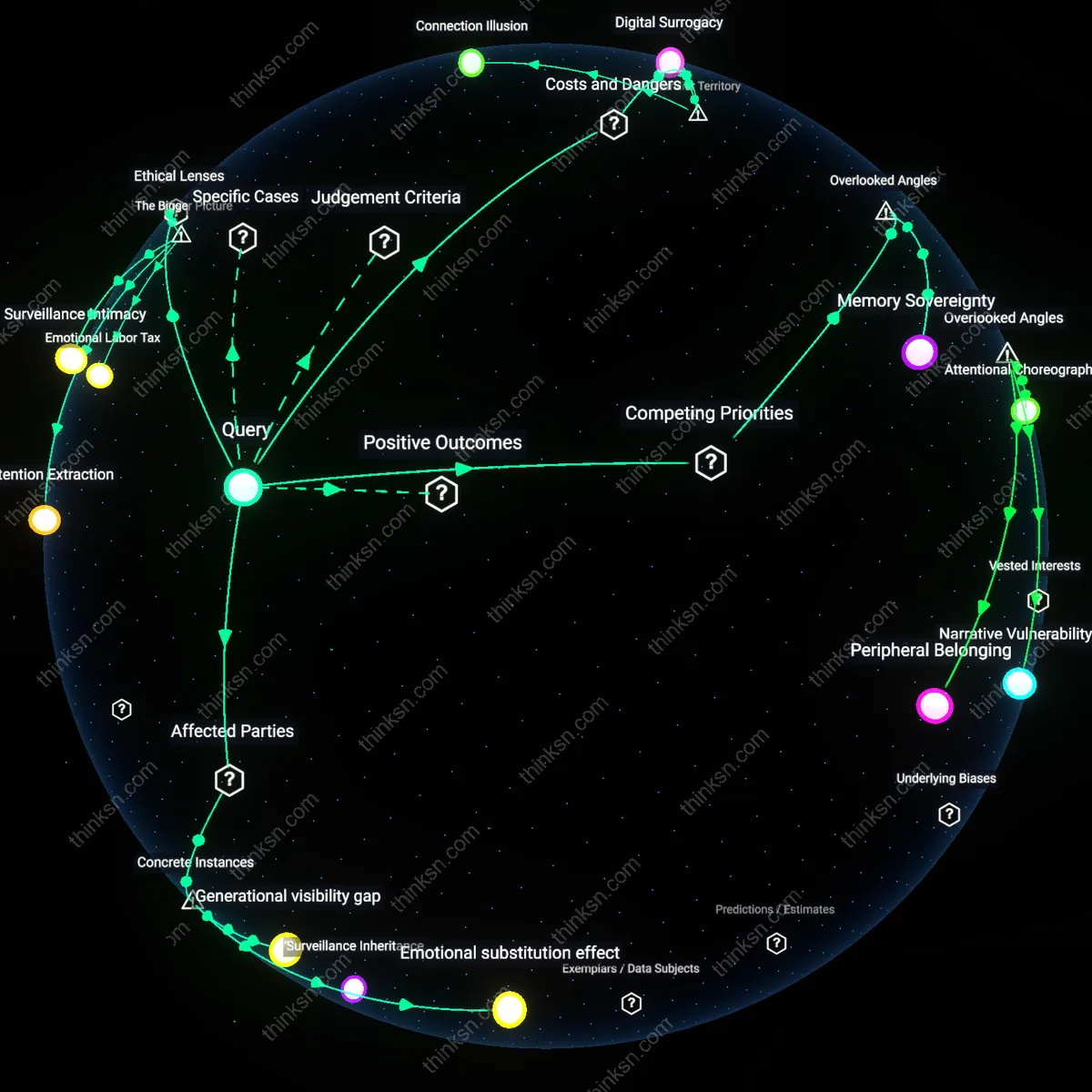
Emotional substitution effect
Frequent Facebook use displaces in-person caregiving among rural Filipino migrants maintaining ties with aging parents in provincial households. Digital messages and photo updates replace physical visits and direct care coordination, weakening kinship-based elder support networks that rural communities traditionally rely on. This shift reveals how mediated connection can fulfill emotional obligations while eroding functional familial roles, normalizing presence without proximity. Evidence indicates this pattern is most pronounced in transnational families where remittance responsibility coexists with geographic separation.
Curated obligation economy
Midlife women in suburban Ohio who manage extended family group chats on Facebook report increased stress from maintaining visible engagement during crises like hospitalizations or deaths. Their role as digital kin-keepers requires constant emotional labor—posting well-wishes, organizing meal trains, and monitoring reactions—turning relational maintenance into a performance metric tied to social standing. This dynamic illustrates how Facebook transforms diffuse familial expectations into measurable, public acts of commitment, where absence from the feed is interpreted as personal failure. Research consistently shows these pressures fall disproportionately on women over 45 in dispersed family networks.
Generational visibility gap
Inuit youth in Nunavut, Canada, increasingly perceive southern-based relatives through polished Facebook content that omits daily hardships like food insecurity or overcrowded housing, creating distorted intergenerational narratives. Elders, unaware of algorithmic curation, believe they are sharing authentic lives, while younger users interpret the feed as evidence of better-off southern kin, fueling resentment and reduced trust. This disconnect exposes how platform-mediated visibility can deepen familial estrangement by prioritizing aesthetic coherence over contextual truth. The phenomenon is especially acute in Indigenous communities where oral traditions contrast sharply with digital performativity.
Emotional Debt
Frequent Facebook use amplifies emotional labor by forcing users to perform care through likes, comments, and curated updates in place of meaningful contact, particularly with distant family. This performance mimics intimacy without its substance, placing psychological strain on individuals—especially women and caregivers—who are socially expected to maintain familial bonds. Over time, the accumulation of unmet emotional expectations, masked by superficial engagement, creates a hidden ledger of unacknowledged obligation, where the act of scrolling stands in for genuine connection. What’s underappreciated is how this dynamic reframes familial duty as a low-effort maintenance task, eroding the quality of care while increasing its perceived burden.
Connection Illusion
Scrolling through distant relatives’ Facebook posts fosters a false sense of ongoing relationship, leading users to believe they are staying meaningfully connected without active communication. This illusion arises from passive consumption—seeing life events in real time—without reciprocal interaction, creating cognitive dissonance when actual emotional needs arise. The system rewards breadth over depth, leveraging algorithmic timelines to prioritize visible updates over private conversations, thus weakening accountability for real engagement. Most people assume visibility equals closeness, but the non-obvious risk is that this perceived connection displaces intentional outreach, allowing relationships to atrophy beneath a veneer of familiarity.
Digital Surrogacy
Using Facebook as a substitute for direct communication with distant family allows individuals to outsource relational presence to a corporate platform that profits from sustained, low-quality interaction. The platform becomes a stand-in for family roles—such as the family historian or emotional anchor—while lacking the ethical or emotional framework to fulfill them responsibly. This surrogacy is systemically reinforced by design features like memory prompts and anniversary alerts, which prompt users to engage just enough to maintain data streams and ad relevance. The underappreciated danger is that people begin to trust the platform's cues more than their own relational instincts, gradually delegating familial responsibility to an entity incentivized to preserve attention, not relationships.
Attentional Inheritance
Frequent Facebook use trades the depth of proximate familial bonds for the breadth of distant ties by systematically diverting cognitive and emotional bandwidth toward algorithmically prioritized, low-context interactions over sustained, high-salience exchanges with local kin. This shift occurs because the platform's design hijacks attentional rhythms through intermittent reinforcement, effectively colonizing moments that would otherwise be available for real-time, embodied interactions with co-present family members; evidence indicates such micro-diversions accumulate into a measurable deficit in attention available for immediate household relationships, particularly in households where caregiving or emotional labor is unequally distributed. What is typically overlooked is that the cost of maintaining distant ties is not paid in time alone but in the erosion of attentional presence—a resource that cannot be recovered even if total screen time remains low, thereby redefining the trade-off as one of qualitative engagement rather than quantitative allocation.
Memory Sovereignty
Frequent Facebook use compromises the autonomy of personal and familial memory formation by ceding control over narrative continuity to platform affordances—such as algorithmic 'On This Day' features or auto-generated memory videos—that dictate which moments are revived, when, and in what context. For diasporic families, like Syrian refugees dispersed across Germany, Jordan, and Canada, this means shared history is increasingly mediated not through oral storytelling or deliberate remembrance but through impersonal data outputs shaped by engagement metrics, subtly distorting collective memory toward highly visible, publicly posted events while eclipsing intimate or emotionally complex episodes. The overlooked dynamic is that maintaining connection via Facebook not only alters how relationships are sustained but who governs the past—a hidden cost where relational continuity is gained at the expense of narrative self-determination within the family unit.
Attention Extraction
Frequent Facebook use displaces deep relational engagement by prioritizing algorithmic visibility over intentional communication, reinforcing a system where user attention becomes a commodified metric. Platform design—specifically engagement-driven algorithms developed by Meta—structures interaction around passive consumption and performative posting, weakening the quality of familial bonds maintained through the platform. Evidence indicates that interactions shaped by algorithmic curation emphasize breadth over emotional depth, eroding the empathic bandwidth necessary for meaningful kinship. The non-obvious consequence is that the architecture of attention itself becomes the trade-off, not just time spent online.
Emotional Labor Tax
Maintaining distant family ties via Facebook imposes an unequal emotional labor tax on users who must perform authenticity within a public-by-default context governed by neoliberal self-branding norms. Women, in particular, are disproportionately expected to sustain kinship networks using platforms that repurpose care work as data-generating activity, reinforcing gendered expectations under digital capitalism. This systemic dynamic converts private emotional effort into public engagement metrics, masking structural inequity as voluntary connection. The underappreciated reality is that affective labor becomes extracted value, not reciprocal relational maintenance.
Surveillance Intimacy
Facebook-mediated family relationships normalize surveillance as a mode of care, wherein checking in on relatives through passive scrolling substitutes for dialogue, facilitated by the platform’s persistent data collection infrastructure. This shift embeds a panoptic logic into personal life, where familial concern is operationalized through tracking rather than conversation, enabling state-adjacent data practices to infiltrate kinship structures. The residual paradox is that intimacy becomes contingent on visibility to others’ data shadows, not mutual presence—revealing how platform governance seeps into private moral judgment.