TikTok and Sleep: Why Research Fails to Rest Easy?
Analysis reveals 8 key thematic connections.
Key Findings
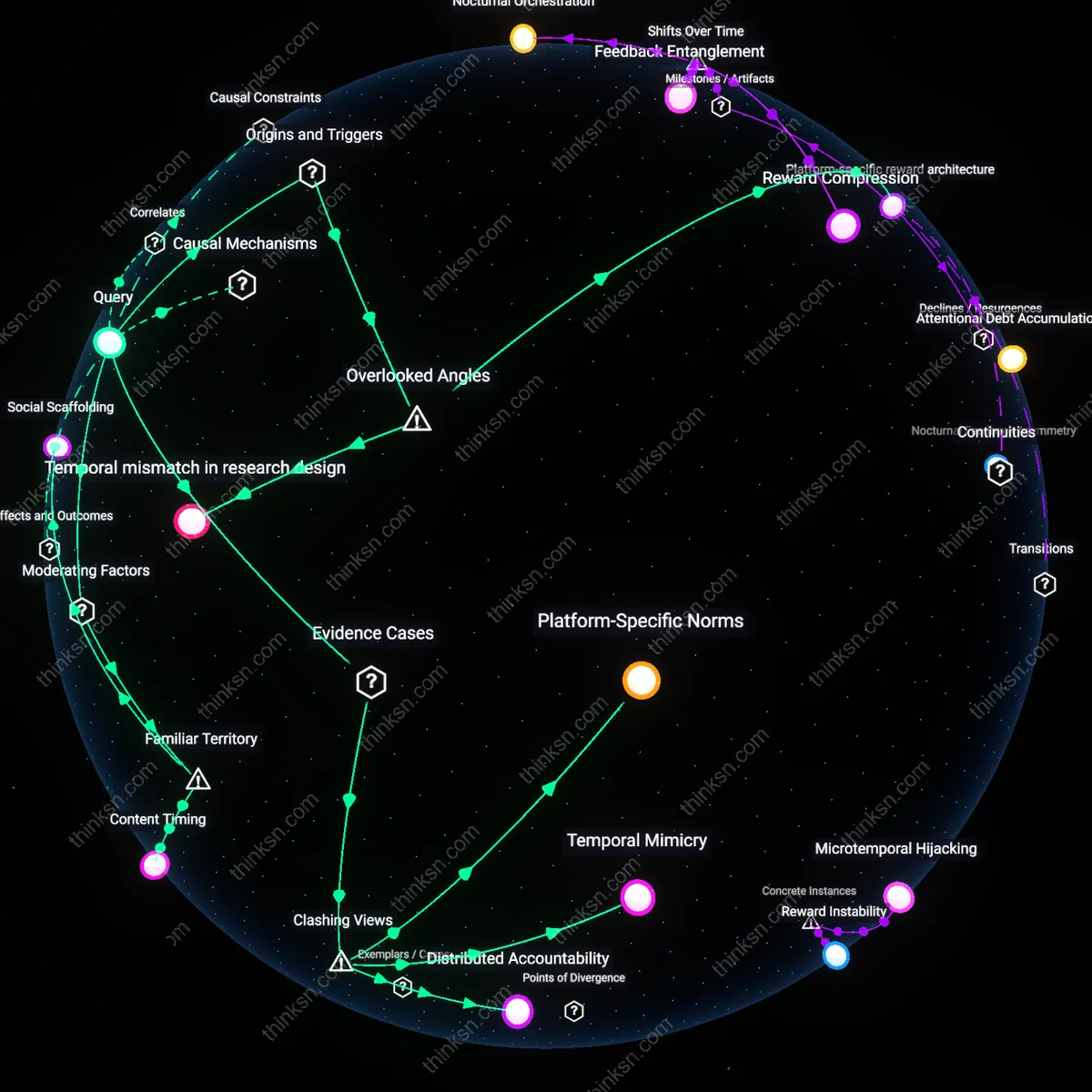
Platform-specific reward architecture
TikTok’s unique algorithmic feedback loops—delivering unpredictable, high-intensity rewards in microbursts—override circadian regulation more effectively than other social media. Unlike passive scrolling on legacy platforms, TikTok’s design couples rapid content turnover with neural reinforcement mechanisms that exploit the brain’s dopaminergic timing sensitivity, making disengagement physiologically harder. This distinction is masked in studies that treat all screen time as equivalent, overlooking how the platform’s micro-reward scheduling—not its content or duration—disrupts sleep onset. The non-obvious factor is that the temporal rhythm of user interaction, not psychological engagement or blue light, constitutes the primary sleep-inhibiting mechanism.
Temporal mismatch in research design
Longitudinal sleep studies rely on nightly consistency to detect effects, but TikTok usage spikes during irregular social transitions—like weekend sleepovers, exam breaks, or holiday gatherings—when both sleep schedules and platform engagement are destabilized. Because research typically treats these bursts as noise rather than signal, the causal link appears inconsistent when it is actually contingent on socially synchronized disruption windows. This temporal misalignment between measurement protocols and real-world usage contexts leads to false negatives in meta-analyses that average across stable and volatile periods. The underappreciated factor is that TikTok’s sleep impact is episodic and socially embedded, not cumulative or individual.
Content Timing
The time of day when teens access TikTok determines whether it disrupts sleep, because nighttime use—especially in the hour before bed—amplifies exposure to stimulating content and delays melatonin onset, whereas daytime scrolling has negligible impact on circadian rhythms. This timing mechanism operates through the interplay between blue light exposure and algorithmic content pacing, which together intensify arousal just when sleep pressure should be rising. Although parents commonly associate screen time with sleep problems, the less obvious truth is that *when* the screen time occurs—shaped by household routines and parental monitoring—matters more than total duration, turning bedtime enforcement into a critical moderating variable.
Feedback Loops
TikTok’s recommendation engine sustains usage by adapting to teen neurobehavioral cues, creating personalized feedback loops that override natural stopping points and fragment sleep onset, making some users more vulnerable than others. The system leverages rapid reward signaling—likes, new videos, sonic cues—tightly coupled with user engagement patterns, effectively conditioning late-night use in emotionally labile or impulsive adolescents. While most parents think of TikTok as just another app competing for attention, the underappreciated reality is that its algorithmic responsiveness mimics intermittent reinforcement schedules typically found in gambling, turning individual psychological traits into pivot points that can intensify or mitigate sleep disruption.
Social Scaffolding
Whether TikTok erodes or integrates into healthy sleep depends on whether family norms scaffold usage with shared expectations, because teens regulate their behavior more by social cues than by rules. In households where parents co-view, discuss trends, or engage around content, the platform becomes embedded in relational routines rather than a solitary escape, reducing late-night use driven by emotional compensation. Despite common fears about isolation, the non-obvious insight is that parental presence—even indirect or symbolic—transforms TikTok from a sleep thief into a socially bounded activity, implicating the quality of family interaction as the hidden moderator of circadian risk.
Platform-Specific Norms
The inconsistency in TikTok’s sleep impact stems not from usage duration but from the algorithmically shaped norms of engagement that differ drastically across user cohorts, where teenage dance-challenge creators in Manila sleep significantly later than ASMR-focused retirees in Hamburg despite similar screen time. This divergence reveals that TikTok’s effect on sleep is mediated less by the app itself and more by subcultural performance expectations embedded in its content clusters—challenging the dominant assumption that platform-wide metrics like daily use predict sleep disruption, exposing a non-obvious layer of behavioral modulation through peer-defined content rituals.
Temporal Mimicry
TikTok does not uniformly disrupt sleep because its most sleep-resistant users are neurodivergent teens in online autism support communities who use the app’s repetitive audiovisual rhythms as a self-regulated sleep onset tool, actively synchronizing scrolling patterns with circadian transitions. This flips the intuitive narrative of passive algorithmic entrapment, revealing instead a counterintuitive agentive mimicry of platform mechanics for biological regulation—complicating the view that algorithmic engagement is inherently erosive of sleep by showing how its temporal structures can be inverted into therapeutic scaffolds.
Distributed Accountability
Parents misattribute sleep loss to TikTok because school administrators in affluent U.S. districts publicly blame the platform to deflect from their own policies requiring evening-heavy project work and early start times, creating a moral panic that positions digital use as the lone culprit. This absolves institutional actors of circadian responsibility and demonstrates how blame becomes a distributed system across households, tech firms, and schools—revealing that inconsistent evidence on TikTok’s impact reflects not scientific confusion but strategic fragmentation of causality among powerful entities avoiding reform.