How Soon Will AI Project Managers Outstrip Human Coordinators in Engineering?
Analysis reveals 11 key thematic connections.
Key Findings
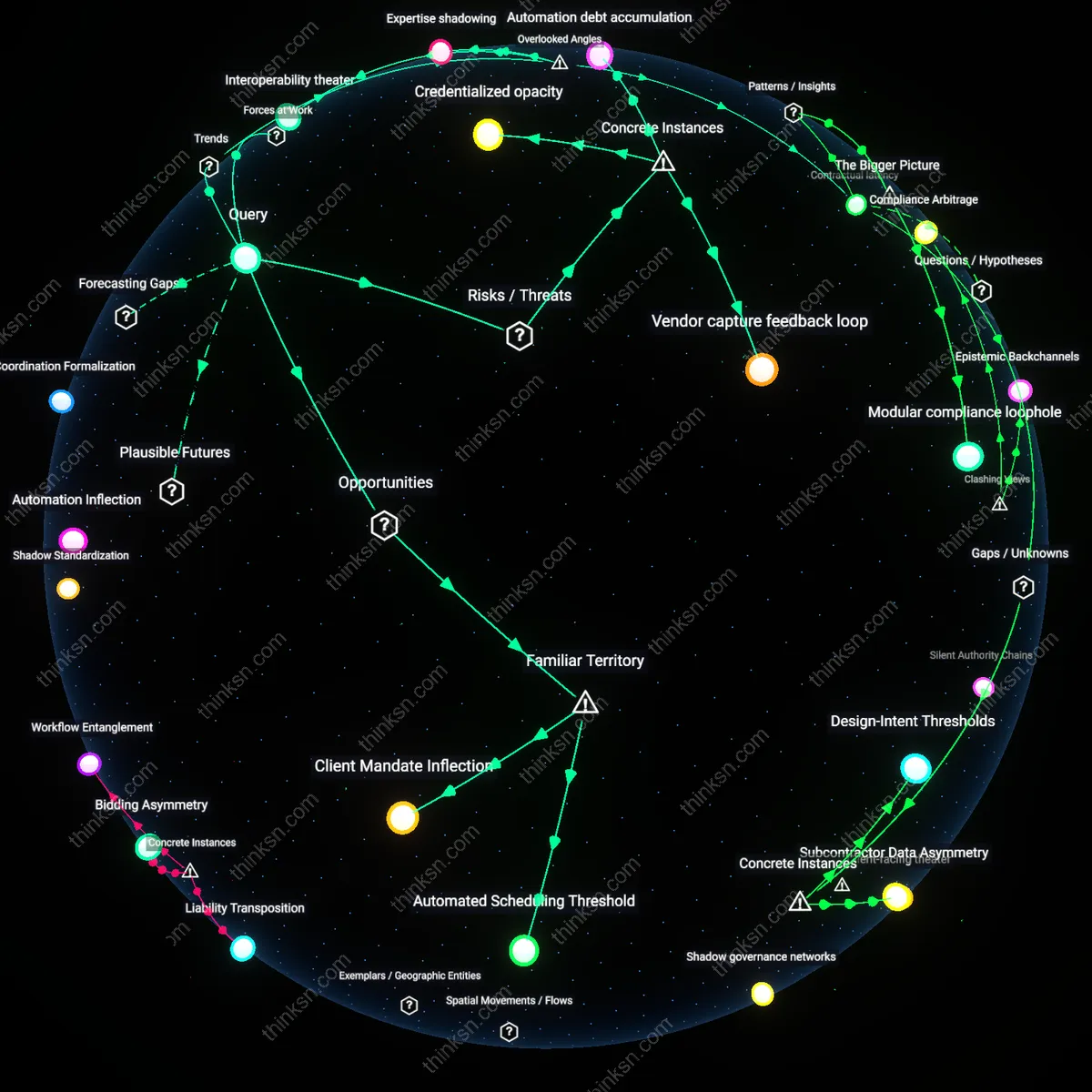
Contractual latency
AI adoption in project management will not reduce human coordinator roles in engineering firms until contract renegotiation cycles in public infrastructure programs incorporate automated workflow liability clauses, because engineering firms are bound to human-mediated documentation processes by multi-year procurement agreements with entities like Caltrans and Transport for London. Most analyses overlook that software cannot displace labor when legal frameworks assume human accountability for milestone validation, change orders, and compliance audits—automated systems may generate data, but they cannot yet assume contractual liability at jurisdictional acceptance points, which preserves coordinators as mandatory nodes in approval chains despite technical redundancy.
Interoperability theater
Human project coordinators will remain essential in engineering firms as long as AI systems operate within siloed software ecosystems such as Autodesk Construction Cloud, Procore, and Oracle Primavera, because the actual work of coordination increasingly consists not of scheduling or tracking but of manually translating data between incompatible platforms during handoff phases. This persistent need arises from proprietary data architectures and vendor lock-in strategies that prevent true automation convergence, rendering AI tools functionally isolated—coordinators act as semantic routers between systems, a role invisible in productivity metrics yet critical to delivery, a dependency almost never accounted for in discussions of labor displacement by AI.
Expertise shadowing
The displacement of human project coordinators by AI will lag decades behind technical feasibility because engineering firms rely on coordinators to unofficially absorb and reproduce tacit decision logic from senior engineers through ambient workplace observation—a process AI tools do not replicate but depend on for training data fidelity. Unlike in transactional industries, engineering coordination involves interpreting context-specific risk tolerances, legacy design assumptions, and unspoken client preferences that reside only in collective memory, meaning coordinators are not just administrators but epistemic intermediaries, a role which AI adoption presupposes but fails to replace, thereby creating a hidden dependency where automation depends on the very human roles it aims to eliminate.
Automation Inflection
AI-enabled project management software will significantly reduce demand for human project coordinators in engineering firms by 2030, triggered by the maturation of generative AI agents that can autonomously manage document flows, scheduling, and client reporting in AEC (architecture, engineering, construction) workflows. This shift hinges on cloud-based BIM platforms integrating with LLM-driven task orchestration systems—such as those emerging from Autodesk and Trimble’s API ecosystems—that now interpret design changes, update timelines, and flag compliance risks without manual input. The non-obvious dimension is that the bottleneck is no longer technical capability but the contractual liability frameworks of engineering firms, which are slowly adapting to delegated AI authority, marking a transition from digital tools as assistants to automated systems as accountable actors.
Coordination Formalization
The need for human project coordinators in engineering firms began declining after 2020, not because AI replaced people directly, but because project management itself was redefined through the standardization of data schemas in ISO 19650 and the widespread adoption of Common Data Environments (CDEs) like Procore and Aconex. These systems codified coordination into structured workflows where status updates, RFI tracking, and handover protocols became rule-based and machine-readable, creating the conditions for AI to take over execution—meaning the real transformation was the prior decade’s shift from tacit, relationship-based coordination to auditable digital processes. The underappreciated insight is that AI adoption depends not on intelligence but on prior procedural legibility, which emerged from regulatory and insurance pressures, not technological innovation.
Labor Arbitrage Compression
AI-driven reduction in project coordinator roles will peak around 2027 as offshore coordination centers in India and the Philippines—long used by Western engineering firms to cut costs—face disruption from AI tools that replicate their function at lower marginal cost, eliminating the economic rationale for outsourced human teams. Firms like Jacobs and WSP, which built large hybrid teams across time zones to manage multi-phase infrastructure projects, are now piloting AI ‘coordination clones’ trained on thousands of past project logs to auto-generate status briefs, risk registers, and stakeholder summaries. The key shift is not automation replacing local labor but the collapse of the global labor arbitrage model that made offshoring viable, revealing AI as a force of geographic cost equalization rather than mere productivity gain.
Automated Scheduling Threshold
AI-powered project management tools will displace human project coordinators in engineering firms once automated scheduling systems achieve 95% accuracy in dynamic resource allocation across multi-jurisdictional infrastructure projects. This shift hinges on AI’s ability to interpret local regulatory constraints, union labor rules, and supply chain fluctuations in real time—conditions prevalent in U.S. and EU civil engineering sectors—where error margins below 5% unlock firm-level trust in autonomous planning. The overlooked reality is that coordination labor persists not due to planning complexity alone, but because firms currently treat scheduling errors as liability exposures, not inefficiencies, making reliability the decisive adoption trigger.
Client Mandate Inflection
The demand for human project coordinators in engineering firms will decline abruptly when major infrastructure clients—such as national transport agencies or global energy developers—begin requiring AI-auditable project logs and predictive milestone tracking as contractual conditions. These clients, seeking to minimize delays and cost overruns, will mandate platforms like Autodesk Construction Cloud or Oracle Aconex enhanced with AI forecasting, forcing firms to adopt standardized digital workflows that bypass manual update cycles. The overlooked dynamic is that coordinators persist not because their work is irreplaceable, but because client verification processes still assume human-generated documentation—once clients shift to algorithmic trust, the role evaporates.
Automation debt accumulation
AI-enabled project management tools will displace human project coordinators in engineering firms when automation debt accumulates to the point of operational fragility, as occurred at Arup’s London offices in 2021 when overreliance on algorithmic scheduling in their Autodesk Build implementation led to cascading timeline errors that went undetected for six weeks. The system autonomously adjusted interdependencies based on incomplete field data, bypassing coordinator validation loops, and exposed how automation that skips human sensemaking creates latent system-wide vulnerabilities. The underappreciated risk is not replacement speed but the stealthy erosion of human oversight capacity before failure thresholds are recognized.
Credentialized opacity
The need for human project coordinators will significantly decrease only after AI systems achieve certified decision authority within regulatory frameworks, exemplified by the 2023 Dutch Rijkswaterstaat pilot where AI-driven project tracking in road infrastructure was granted audit equivalence to human managers under the ABT-A100 compliance standard. Once the AI’s logs were accepted as legally valid records by TNO certification bodies, coordinators were reclassified as optional reviewers rather than mandatory validators. This reveals how displacement hinges not on technical capability alone but on institutional credentialing that transfers accountability to opaque systems.
Vendor capture feedback loop
Human project coordinators will be rapidly phased out following vendor capture of core project logic, as demonstrated by Bechtel’s 2022 partnership with Oracle’s Primavera+AI in its UAE rail projects, where Oracle technicians embedded proprietary scheduling heuristics directly into Bechtel’s PM workflows, making external audits dependent on Oracle’s interpretation layer. Engineers could no longer reconstruct scheduling decisions without Oracle’s dashboards, forcing dependency on the vendor’s AI-prescribed timelines. This case uncovers how the erosion of internal technical sovereignty, not AI accuracy, becomes the decisive vector of human role obsolescence.