Audit Trail Infrastructure
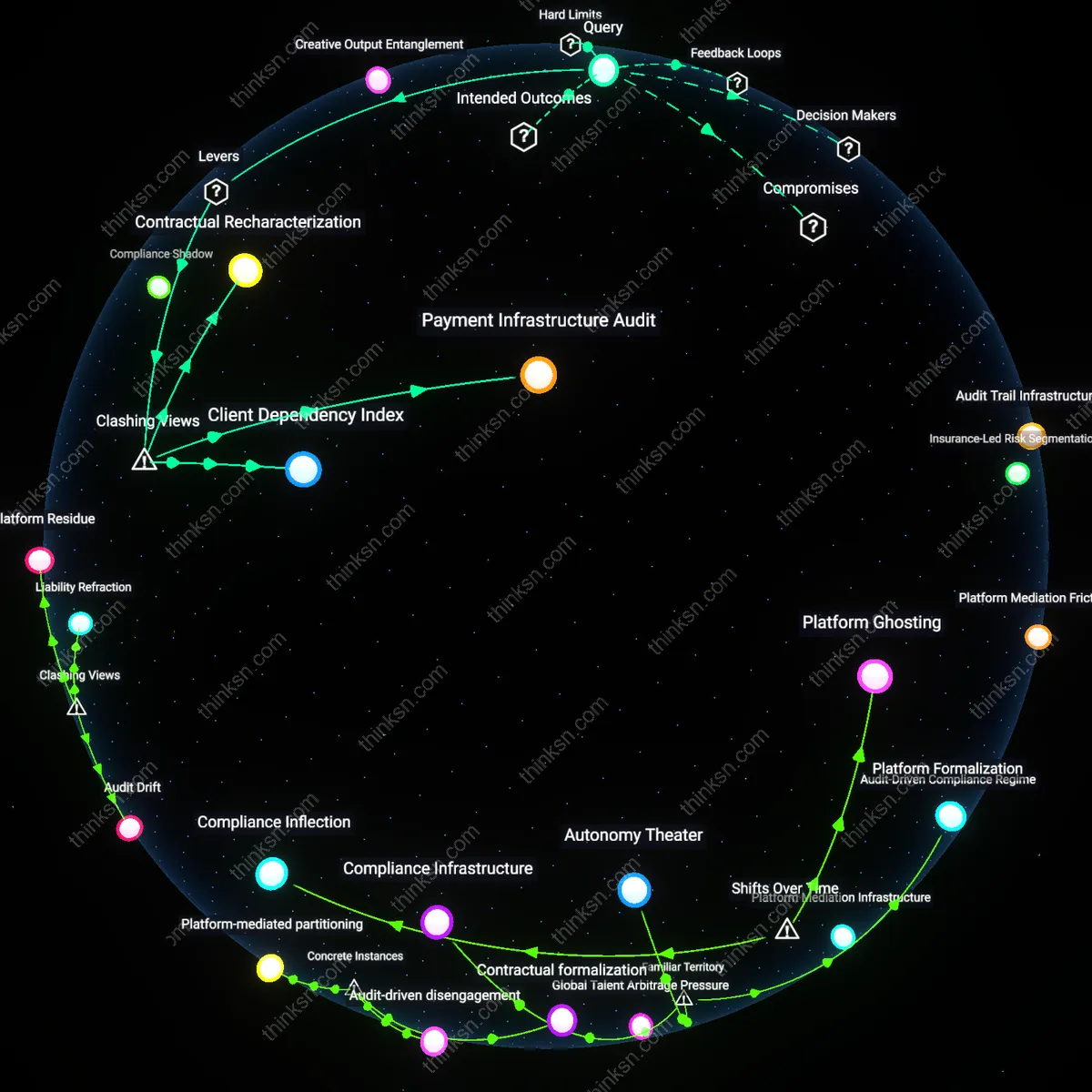
Tax compliance enforcement by national revenue authorities, particularly in the UK and EU after 2016, directly compelled agencies to document freelancer separations through the mechanization of IR35-style employment classification rules, which required verifiable records of contractual boundaries, project-based engagements, and service delivery timelines. This shift was not driven by HR policy or labor ethics but by the technical need to produce machine-readable evidence for automated audits, where the absence of timestamped, structured separation data triggered financial penalties. Most accounts overlook how fiscal surveillance systems—specifically digital tax platforms like HMRC’s SDS—coerced agencies into treating freelancer status as a data object rather than a relational arrangement, making administrative documentation a precondition of legal operation.
Insurance-Led Risk Segmentation
Professional indemnity and cyber liability insurers began, around 2014–2017, to require agencies to certify the employment status of all contributors involved in client projects, especially in creative and tech contracting, because freelance misclassification posed unforeseen exposure in third-party liability claims. Unlike labor law responses, this pressure originated in underwriting models that treated undocumented separations as uncontrolled risk nodes—akin to unpatched software—thereby forcing agencies to implement standardized offboarding protocols to maintain coverage. The overlooked mechanism here is that insurance adjusters, not regulators or courts, became the first to demand granular proof of labor boundary integrity, reframing workforce flexibility as a technical vulnerability in risk architecture.
Platform Mediation Friction
The integration of third-party workforce platforms like Upwork Enterprise and Catalant into agency operations after 2018 introduced automated separation workflows that required explicit termination logs, skill deprovisioning, and data access revocation, not for legal compliance but to maintain interoperability with client procurement systems that treated all contributors as transient nodes in a supply chain. The overlooked dependency is that platform data models—designed for algorithmic matching and reputation scoring—could not recognize 'loose' disengagements, rendering informal freelancer departures as system errors, which pressured agencies to adopt rigid separation documentation to sustain platform functionality. This technical incompatibility, not cultural or legal evolution, normalized systematic documentation as a prerequisite for digital labor brokerage.
Audit-Driven Compliance Regime
Regulatory scrutiny following labor misclassification lawsuits in the mid-2010s compelled agencies to adopt formal documentation practices that explicitly delineated freelancer status to insulate firms from liability. Tax authorities and labor boards, particularly in California and the EU, began enforcing distinctions between employees and independent contractors through strict documentation requirements, making omission a financial and legal risk. This shifted agency behavior from informal coordination to systematic recordkeeping as a defensive administrative practice, revealing how legal risk—not operational need—drove bureaucratic formalization.
Platform Mediation Infrastructure
The rise of digital talent platforms after 2015 embedded documentation directly into workflow architecture, automatically generating separation records through contract logging, payment routing, and feedback systems that required classification at point of engagement. Unlike earlier freelance arrangements managed via email or verbal agreement, platforms like Upwork or Fiverr institutionalized boundary maintenance through algorithmic governance, where classification dictated access to features, taxation workflows, and dispute resolution. This infrastructural encoding made separation not a retrospective legal safeguard but a precondition of participation, exposing how technical design became a regulatory force.
Global Talent Arbitrage Pressure
As agencies increasingly sourced freelancers from lower-wage economies post-2012, client firms demanded documented separation to justify cost differentials and bypass local labor protections under the guise of 'international contracting.' Multinational corporations, seeking flexible staffing without payroll obligations, pressured intermediaries to produce verifiable proof of non-employment status, turning documentation into a tool of labor segmentation. This reflects how global labor hierarchies reshaped administrative practices not merely to comply with law but to sustain economic arbitrage through bureaucratic differentiation.
Compliance Infrastructure
Agencies began mandating contractual audits and digital paper trails to pre-empt labor classification lawsuits. This shift was driven by legal pressures following high-profile misclassification cases like those against Uber, which made documentation a defensive necessity rather than an administrative afterthought. The non-obvious truth, despite widespread belief that gig economy growth simply increased freelancer numbers, is that documentation ramped up not from growth but from liability containment—transforming paperwork from a back-office function into a central, legally fortified system.
Autonomy Theater
Agencies reframed minimal oversight as proof of independent contractor status to satisfy tax and labor regulations. By emphasizing documented non-interference—such as freelancers setting their own hours or declining assignments—firms could publicly demonstrate separation while still shaping behavior through algorithmic incentives and rating systems. The underappreciated reality is that the records of disengagement became performance artifacts, designed less for internal management and more for external scrutiny, turning invisibility into evidence.
Platform Formalization
Digital platforms replaced handshake agreements with standardized onboarding workflows that required freelancers to actively opt into contractor status through digital consent. Systems like Upwork or Toptal introduced profile disclosures, tax-status affirmations, and service agreements that made separation an explicit, timestamped event within software architecture. While commonly seen as mere scaling tools, these digital rituals institutionalized the boundary, embedding legal distinctions into user experience patterns that feel routine but are juridically choreographed.
Contractual formalization
The shift from informal freelance coordination to systematic documentation of separation at the BBC in the UK exemplifies how public broadcasting agencies formalized contractual boundaries after 2010 to mitigate employment tribunal risks. Faced with high-profile cases like that of freelance journalist Paul Lewis, whose long-term editorial integration blurred employment lines, the BBC implemented standardized termination clauses and written scope delineations across all freelance engagements. This created a formalized exit architecture that distanced agencies from claims of de facto employment, preserving institutional autonomy while enabling continued contingent labor use—revealing that legal defensibility, not managerial preference, drove documentation intensification.
Audit-driven disengagement
In the U.S. Government Accountability Office's 2018 review of contractor classification in federal agencies, it was revealed that IRS divisions had systematically increased documentation of freelancer disengagement following audits that exposed misclassification of 'independent contractors' performing core tax processing tasks. The IRS response—codified in Directive 10.8.1—mandated timestamped deliverables, explicit non-supervision clauses, and third-party validation of work product to prove separation of control. This audit-triggered documentation regime reflects how external oversight mechanisms transformed agency-freelancer boundaries into auditable sequences, where disengagement is not assumed but must be proven through administrative trace.
Platform-mediated partitioning
The adoption of Upwork’s enterprise platform by UNICEF’s Innovation Fund after 2015 restructured how technical freelancers were onboarded and later disconnected from project workflows, replacing ad hoc email agreements with version-locked task records, algorithmic performance scoring, and auto-generated completion certificates. Unlike prior informal dissolutions, freelancer 'exit' now occurs through platform-driven notification chains and data purging schedules that enforce artificial temporal boundaries—demonstrating that digital labor platforms function not only as matching tools but as partitioning systems, where separation is algorithmically scripted rather than negotiated.
Compliance Inflection
Agencies began formalizing freelancer separations after 2018 IRS audits targeted misclassification in media and tech contracting, triggering a shift from informal collaboration to preemptive documentation. Firms like those in the Association of Independent Creative Professionals adapted by adopting standardized exit workflows previously seen only in regulated sectors, embedding legal risk assessment into routine project closure. This mechanism made visible an underappreciated threshold where creative autonomy became administratively inseparable from liability containment, marking a break from the post-2008 gig economy’s hands-off ethos.
Platform Ghosting
The decline of long-term retainers in digital marketing agencies after 2015 coincided with the rise of platform-mediated project bidding, where freelancer turnover became so routine that separation ceased to be acknowledged except through algorithmic status updates. As agencies migrated to hybrid models using Upwork and Fiverr Enterprise, the act of documenting departure shifted from human resource rituals to automated workflow tags, revealing a latent normalization of ephemeral engagement. This transition disguised systemic disengagement as technical efficiency, erasing the social contract once implied by even temporary affiliation.
Audit Drift
Agencies shifted by embedding compliance templates into freelance onboarding packets, replacing ad hoc email chains with standardized IRS Form 1099-NEC checklists that required digital sign-offs. This procedural shift—pioneered by firms like Omnicom in 2016 with internal Vendor Management Systems—was not driven by labor regulation but by tax accounting cycles, turning contractor status into a re-certified annual event rather than a one-time classification. The non-obvious mechanism here is that documentation became a retroactive audit shield, not a tool for clarity, privileging paper trail integrity over operational reality—an inversion of intended function long unnoticed by labor advocates focused on worker rights rather than back-office risk deferral.
Liability Refraction
The pivot to active documentation emerged not from HR reform but from litigation risk reallocation following the 2018 Dynamex decision in California, which triggered mass reclassification threats in gig-adjacent creative sectors. Agencies like Wieden+Kennedy began filing freelance agreements not to clarify roles but as court-admissible exhibits, treating contracts as narrative props for future depositions rather than operational guides. This reframed independence as a performative legal script, not a factual condition—revealing that documentation evolved not to reduce ambiguity but to stage ideological distance from employment ties under judicial scrutiny, making legibility a defense strategy rather than a management function.
Platform Residue
The shift stemmed from agencies adopting third-party talent platforms like Catalant and Malt, whose API-integrated workflows auto-generated time-stamped disengagement records as default outputs, not negotiated deliverables. These platforms, originally marketed for matching efficiency, embedded forensic documentation as a technical byproduct—session logs, access revocations, milestone confirmations—making separation visible not through intent but through data exhaust. The underappreciated truth is that agencies didn't 'decide' to document more; they offloaded coordination to systems that, by design, treated disconnection as a data event, redefining administrative attention as a side effect of software logic rather than policy choice.