Is Remote Work Dooming Your Promotional Prospects?
Analysis reveals 10 key thematic connections.
Key Findings
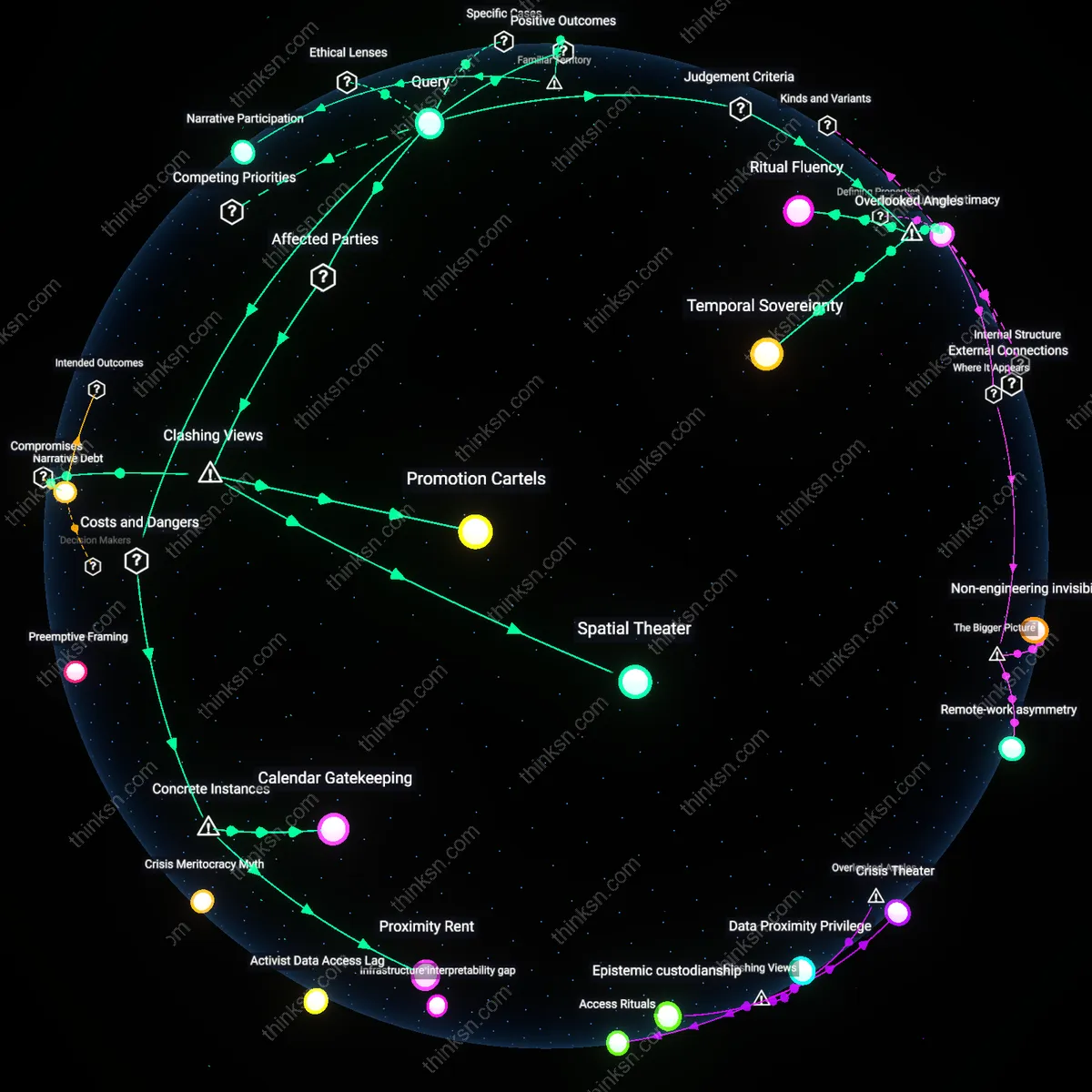
Promotion Cartels
A knowledge worker should evaluate their risk of exclusion by identifying informal coalitions of middle managers and senior mentors who preemptively allocate promotions through back-channel agreements, because these groups control access to high-visibility projects and sponsorships that precede formal review cycles. These cartels operate through routine off-site meetings and social dinners not logged in official calendars, making exclusion invisible in performance metrics, and their influence is greatest in flat organizations where role ambiguity allows gatekeeping to masquerade as meritocratic discernment. This reveals that promotion risk is less tied to individual performance than to absence from tacitly sanctioned alliances that simulate consensus before decisions are announced.
Spatial Theater
A knowledge worker can assess exclusion risk by mapping how physical office spaces are used to stage impromptu decision-making moments—such as whiteboard brainstorming sessions or executive drop-ins at certain desks—that are designed to appear spontaneous but are predictably dominated by a recurring cast of visible performers. These events produce the illusion of organic inclusion while systematically bypassing remote or less presenteeism-compliant workers, and their outcomes are later ratified in official meetings, rendering the initial exclusion undebatable. The non-obvious mechanism here is not discrimination per se, but the theatrical reenactment of influence as a substitute for actual deliberation, privileging those who perform availability over those who deliver output.
Narrative Debt
A knowledge worker should gauge exclusion by auditing whose contributions are consistently narrated by others in leadership updates—even when absent—because individuals who accumulate narrative debt are being symbolically integrated into the leadership’s storyline, while those who must speak for themselves remain transactional. This dynamic is maintained by executive assistants, chief of staff roles, and peer advocates who serve as narrative conduits, and it becomes decisive when promotion panels rely on synthesized impressions rather than raw deliverables. The overlooked truth is that influence is not about being heard but about being represented in the absence of presence, turning storytelling into a covert inclusion mechanism.
Temporal Sovereignty
A knowledge worker can assess their risk of exclusion by measuring their access to unmediated control over shared team calendars and meeting scheduling authority, particularly for ad hoc or last-minute events. Most high-impact networking occurs in fluid, unscheduled time blocks—such as post-meeting debriefs or impromptu lunches—that are coordinated through informal scheduling dominance held by in-group members; those without calendar privileges or visibility are systematically time-excluded. This mechanism operates through administrative gatekeeping, where assistants or coordinators aligned with dominant factions filter access, rendering exclusion invisible and deniable. The non-obvious insight is that time allocation infrastructure, not social skill or proximity, becomes the decisive filter for influence.
Infrastructure Intimacy
A knowledge worker should evaluate their degree of access to the 'shadow IT' tools their team habitually uses for informal coordination—such as private Slack channels, shared Google Docs with real-time editing, or internal dashboards updated before official release. These platforms function as hidden information markets where promotion-relevant narratives are shaped before formal record, and exclusion from them means operating on delayed, sanitized data. The dynamic hinges on who is granted early-edit or backstage-view permissions, often informally assigned based on perceived loyalty rather than role. The overlooked factor is that digital infrastructure permissions, not physical presence, constitute the true boundary of professional inclusion.
Ritual Fluency
A knowledge worker can gauge exclusion risk by mapping their ability to correctly interpret and reproduce subtle ritual acts—such as the specific way senior leaders toast at events, the humor style used in private meetings, or the unspoken rules for interrupting a discussion—that signal cultural kinship among the dominant coalition. These micro-behaviors function as social passwords; even physically present outsiders who misstep are cognitively marked as 'not one of us' despite formal qualifications. The mechanism operates through pattern-matching biases in judgment, where perceived fluency in ritual substitutes for competence in promotion deliberations. The underappreciated insight is that cultural choreography, not networking volume, determines influence access.
Proximity Visibility
A knowledge worker can assess their risk of exclusion by tracking physical presence in shared office spaces where informal leadership interactions occur. Managers and senior teams habitually meet near common areas like kitchens or entry lobbies during peak hours, creating a visibility gradient tied to bodily proximity; this system rewards those already embedded in spatial routines that align with decision-makers’ movements. The non-obvious insight is that access to influence is not just social but geospatial—bypassing remote or satellite workstations reduces chances of being included in spontaneous meetings that shape advancement, even when formal performance metrics are strong.
Narrative Participation
A worker can evaluate exclusion risk by measuring how frequently their contributions are cited in internal storytelling—such as project retrospectives, all-hands shoutouts, or leadership anecdotes. Senior leaders draw on these narratives to justify promotions, privileging individuals who appear as central characters in the organization’s success mythology. The underappreciated reality is that influence is not only earned through output but through repeated symbolic representation; invisibility in storytelling often precedes formal exclusion, even when technical competence is acknowledged.
Proximity Rent
Working from home during the pandemic at Google removed software engineers in Mountain View from spontaneous design reviews in Building 43, where informal access to senior directors determined project visibility; remote workers were systematically excluded from hallway whiteboard sessions that shaped Q3 roadmaps, revealing that physical adjacency functioned as an invisible promotion gate despite official policy supporting remote equity. This mechanism privileged those already positioned near executive pathways, not through formal criteria but through the unacknowledged currency of bodily presence—demonstrating that influence is often extracted not from output, but from proximity.
Calendar Gatekeeping
During Microsoft’s 2016 reorganization under Satya Nadella, access to OneNote meeting notes and Teams invites was restricted to attendees of Redmond campus ‘vision syncs,’ where promotion slates were informally ratified; remote knowledge workers, even when their presence was technically permitted, were denied calendar invites by executive assistants acting as cultural gatekeepers, not through explicit policy but through habitual distribution patterns favoring local teams. This reveals that control over scheduling infrastructure—not managerial intent—became the decisive filter, weaponizing administrative routine to sustain spatial bias under the guise of logistical efficiency.