Does Twitters Public Nature Undermine Professional Privacy?
Analysis reveals 4 key thematic connections.
Key Findings
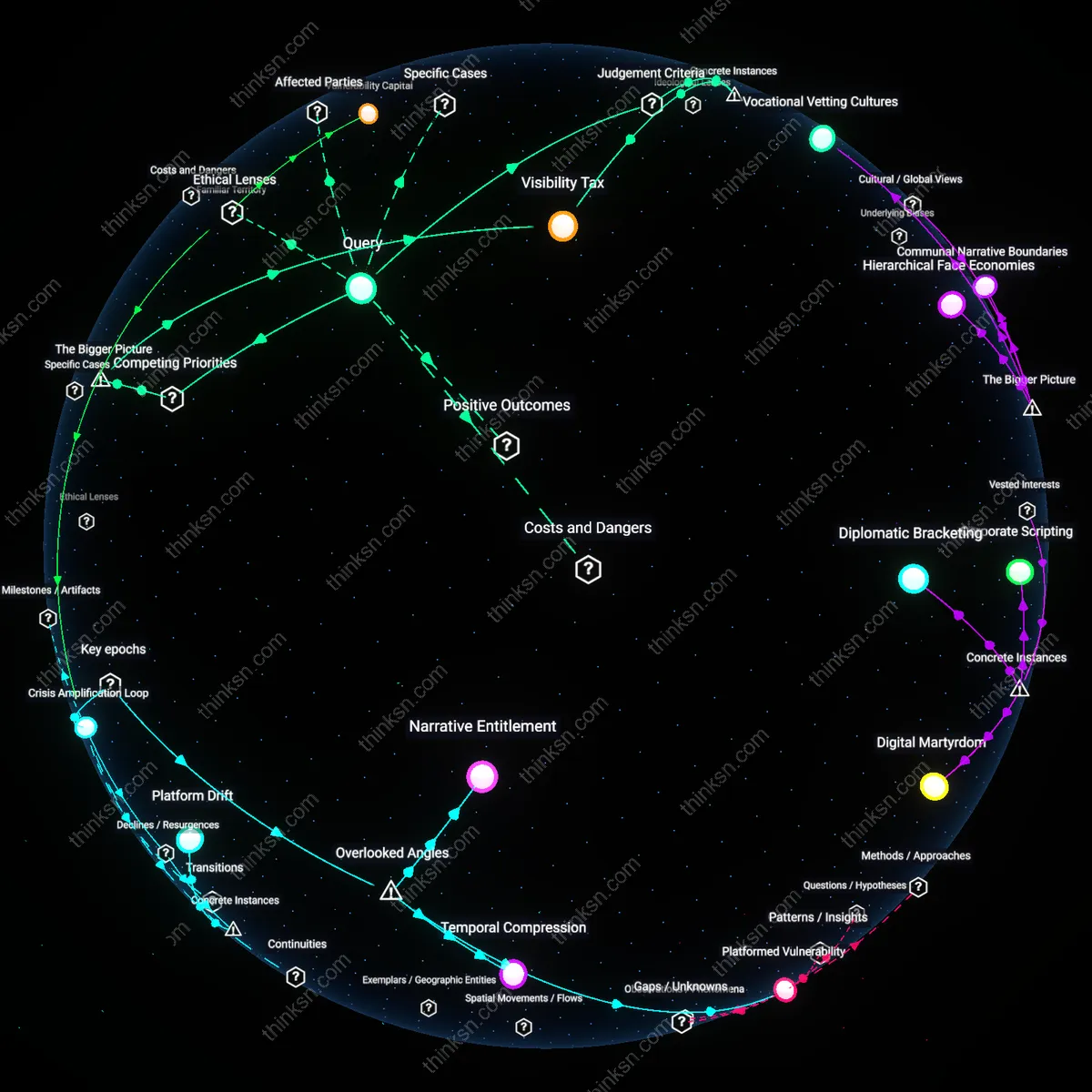
Visibility Tax
Public visibility on Twitter forces professionals to forfeit personal privacy as a fixed cost for career networking, disadvantaging those whose identities or views are socially contested. When U.S. immigration lawyer and immigration reform advocate César Cuauhtémoc García Hernández shared critiques of ICE policies on Twitter, his professionally necessary visibility amplified targeted harassment and surveillance by federal agencies, revealing that marginalized professionals pay a disproportionate 'visibility tax'—where authentic professional engagement risks personal safety and autonomy. This exposes an asymmetric burden where the platform’s open architecture converts privacy erosion into a systemic career prerequisite, particularly penalizing those already subject to institutional distrust.
Reputation Arbitrage
The public nature of Twitter enables strategic reputation arbitrage, where professionals selectively disclose personal information to gain credibility and career advancement despite privacy loss. During the 2020 #AcademicTwitter surge, Dr. Sarah Wan, a climate scientist at the University of Washington, leveraged autobiographical threads about her journey as a disabled researcher to build public trust and secure media collaborations, demonstrating that visibility functions not as a privacy liability but as a calculated exchange. Her case reveals a mechanism where professionals transmute privacy into symbolic capital, exploiting platform transparency to bypass traditional gatekeepers—thus turning privacy compromise into a career-accelerating tool under conditions of narrative control.
Context Collapse Penalty
Twitter’s public interface collapses multiple social contexts into a single performative arena, leading to professional penalties when private identities breach expected norms. When Dr. David Moran, a NASA astrophysicist, faced internal scrutiny in 2021 over his satirical alt-history threads—intended for niche literary circles—his informal expressions were decontextualized by colleagues and leadership, triggering an informal freeze on high-profile project assignments. This illustrates how the platform’s inability to segment audiences results in a 'context collapse penalty,' whereby professional advancement stalls not due to misconduct but due to the irreversible blending of personal and professional personae in a public feed.
Attention Obligation
Career advancement on Twitter generates an attention obligation, wherein professionals must continuously produce content to remain visible, inadvertently surrendering privacy through cumulative digital footprints. This dynamic is sustained by competitive peer networks and institutional HR analytics that favor demonstrated online engagement as a proxy for thought leadership, pressuring individuals to prioritize visibility over discretion. What remains hidden in plain sight is that organizational promotion criteria have quietly incorporated social media persistence as an informal ranking mechanism, making retreat from public discourse a de facto career penalty—even when the cost is psychological depletion or identity erosion.
Deeper Analysis
How did the way professionals share personal stories on Twitter change after moments like the 2020 #AcademicTwitter surge?
Crisis Amplification Loop
Professionals began sharing personal stories on Twitter more frequently after the 2020 #AcademicTwitter surge because the platform became an accessible emergency conduit during global lockdowns, when institutional communication channels failed to address widespread job insecurity and mental health distress among researchers. Early-career academics, particularly in the U.S. and U.K., used viral threads to expose exploitative labor conditions under the guise of storytelling, which gained traction because Twitter’s real-time visibility rewarded emotional authenticity with disciplinary solidarity. This shift normalized confessional narratives as a legitimate form of professional resistance, transforming what had been private struggles into public data points—making visible a feedback loop where trauma disclosure amplified systemic critique precisely because institutions lacked corresponding response mechanisms.
Vulnerability Capital
The increase in personal storytelling on Twitter post-2020 was driven by professionals converting emotional exposure into reputational credit, particularly within knowledge sectors like academia and journalism where authority is tied to moral credibility. As tenure-track positions declined and digital visibility became a proxy for impact, scholars deployed autobiographical tweets about burnout or identity to signal integrity to peers and publics, exploiting Twitter’s algorithmic bias toward relatability. The non-obvious consequence was the emergence of vulnerability as a calculated performance rather than spontaneous revelation—where the most retweeted voices were not necessarily the most harmed, but those who could narrate harm most strategically in service of career advancement.
Public Accountability Veil
After the 2020 #AcadermicTwitter surge, professionals adopted personal storytelling on Twitter to shift accountability from individual failure to structural mechanisms, using autobiographical detail as forensic evidence in arguments about systemic bias. Faculty from marginalized backgrounds, for example, framed experiences with racism or disability not as personal complaints but as documented patterns requiring institutional remedy, leveraging the platform’s permanence and citation features to create an ad hoc audit trail. The underappreciated dynamic was that these narratives functioned less as catharsis and more as procedural interventions—where the appearance of casual confession masked a deliberate strategy to force transparency in opaque hierarchies by making private suffering citable, timestamped, and thus legally or ethically actionable.
Institutional Venting
Professionals began using personal storytelling on Twitter not to build public identity but as a covert channel for airing grievances previously managed through closed institutional networks. This shift, amplified by the 2020 #AcademicTwitter surge, repurposed a platform marketed for self-promotion into a surrogate grievance infrastructure, where trauma narratives and burnout confessions functioned as coded appeals for systemic recognition—despite Twitter's publicness, these stories operated like internal memos in institutions too dysfunctional to receive them. The non-obvious outcome is that vulnerability became a form of labor discipline evasion, slipping past formal channels that had systematically dismissed such claims.
Affective Gatekeeping
The surge in personal storytelling restructured professional credibility not by democratizing voice but by elevating emotional disclosure as a new currency of authenticity, which ironically tightened elite control over who counts as a legitimate witness. After 2020, those already embedded in academic networks leveraged their tales of mental health struggles or marginalization to assert moral authority, reifying hierarchies under the guise of vulnerability—this mechanism privileged those with institutional protection to risk confession, while exposing contingent workers to greater professional risk for similar disclosures. The dissonance lies in how openness, framed as liberation, became a refined tool of exclusion masked as intimacy.
Narrative Arbitrage
Professionals began treating personal stories as speculative assets, timing their emotional disclosures to coincide with moments of collective attention like #AcademicTwitter surges to extract professional gains such as followers, invitations, or job offers. This transformation turned storytelling into a calculated performance economy, where authenticity was less about truth-telling and more about strategic resonance within attention cycles—stories of tenure struggles or discrimination were not shared because conditions worsened, but because the expected return on such disclosures spiked. The underappreciated reality is that vulnerability became a volatility play, not a cry for solidarity.
Explore further:
How do people in different professions decide what parts of their lives to keep off Twitter when they’re worried about being misunderstood by colleagues or bosses?
Hierarchical Face Economies
People in Confucian-influenced East Asian professions like Japanese corporate law or South Korean academia avoid sharing personal political or emotional content on Twitter because public self-expression that disrupts group harmony risks damaging organizational face, a mechanism enforced through vertically structured workplace hierarchies where junior members are expected to suppress individuality to maintain senior legitimacy and social cohesion; this restraint is not primarily fear of misunderstanding but of violating unspoken relational duties that preserve institutional stability, revealing how digital self-censorship functions as a ritual of deference rather than personal risk management.
Vocational Vetting Cultures
Western tech and media professionals, particularly in U.S.-based startups or Silicon Valley–aligned firms, curate Twitter identities by omitting religious convictions or politically polarizing lifestyle choices because their career advancement depends on signaling alignment with meritocratic, secular-liberal epistemic communities that equate ideological neutrality with professional reliability, a system sustained by venture capital networks and HR-driven cultural fit assessments that treat social media as a proxy for institutional trustworthiness, exposing how digital identity management serves as an invisible credentialing mechanism within innovation-driven labor markets.
Communal Narrative Boundaries
Muslim scholars and religious educators in Indonesia and Malaysia restrict sharing personal doubts or philosophical experimentation on Twitter because deviating from locally accepted interpretations of Islamic orthodoxy risks triggering communal censure through religious councils (MUI) or digital counter-movements that enforce doctrinal boundaries, a dynamic amplified by state-recognized fatwa systems and community-based surveillance norms that treat public speech as collective property, illustrating how online self-limitation emerges not from individual fear but from embeddedness in sociotheological ecosystems where discourse is accountable to communal moral custodians.
Corporate Scripting
Executives at ExxonMobil avoid discussing climate policy on Twitter to maintain alignment with corporate messaging, relying on internal compliance protocols that standardize public communication through pre-approved channels. This controlled narrative prevents individual deviations from disrupting the company’s legal and lobbying positions, particularly during regulatory hearings such as those before the U.S. Senate Committee on Energy in 2019. The non-obvious mechanism here is not censorship but institutional scripting—where career preservation depends on adherence to a coordinated linguistic performance, revealing how corporate actors outsource authenticity to institutional identity.
Digital Martyrdom
In 2020, Black Lives Matter organizers in Minneapolis restricted personal Twitter use during protests to prevent doxxing and discreditation by law enforcement, who had previously weaponized social media content to justify surveillance. By carefully partitioning their digital lives, activists preserved operational security while amplifying tactical narratives through collective accounts, demonstrating that silence on personal platforms can be a disciplined strategy rather than self-censorship. This reveals how marginalized movements treat personal exposure not as a risk but as a calculable vulnerability to be managed through distributed identity practices.
Diplomatic Bracketing
During the 2018 U.S.-North Korea summit, State Department officials refrained from posting about internal debates on Twitter, even satirically, to preserve backchannel negotiation coherence and avoid undermining public diplomatic postures. This selective muting of opinion operated through a protocol known as 'channel discipline,' where messaging is confined to designated platforms and personnel, insulating sensitive processes from performative social media expectations. The underappreciated insight is that in high-stakes diplomacy, offstage silence functions as a technical safeguard, not just prudence, making social media omission a formal component of statecraft.
How did the shift from private struggles to public storytelling on Twitter change the way early-career academics push back against working conditions over time?
Narrative Entitlement
The shift to public storytelling on Twitter granted early-career academics a previously inaccessible sense of narrative entitlement—the right to position their personal experiences as valid contributions to institutional critique, which reconfigured power in knowledge production by bypassing traditional gatekeepers in academic publishing and tenure committees. This mechanism operated through the platform’s flattening of epistemic authority, where a graduate student’s thread on exploitative mentoring could circulate with the same visibility as a senior scholar’s research, disrupting the unspoken norm that only established figures could define structural problems. The non-obvious dimension here is that resistance became possible not through argument or evidence alone, but through the symbolic act of claiming the right to speak at all—an affective precondition for collective action that most analyses overlook when focusing on policy outcomes or network size.
Temporal Compression
Public storytelling on Twitter compressed the timeline of academic resistance, making it possible for grievances to escalate from private venting to institutional crisis within hours rather than semesters, thereby altering the strategic calculations of both junior scholars and administrators. This dynamic emerged from the platform’s algorithmic amplification of emotionally resonant content, which transformed individual accounts of overwork or harassment into immediate reputational threats to departments and funders, forcing reactive responses before formal channels could mobilize. What is typically overlooked is that this speed eroded the latency once used by institutions to defuse dissent—time for committees to form, statements to be drafted, or grievances to fade—shifting leverage toward those who could narrate first and fastest, regardless of positional power.
Platformed Vulnerability
Early-career academics strategically deployed platformed vulnerability—performing personal risk in public tweets—not as mere emotional release but as a tactical currency that generated solidarity and shielded them from retaliation through the visibility of their exposure. This worked because the public documentation of precariousness (e.g., admitting to depression due to advisor abuse) created a reputational cost for institutions if the individual were later punished, effectively using the audience-as-witness as a weak form of protection. The overlooked dynamic is that vulnerability became a disciplined, calculated practice rather than an uncontrolled leak of sentiment, inverting the traditional association of weakness with powerlessness and revealing how affective disclosure can function as infrastructural resistance in the absence of formal labor protections.
Platform Drift
When the 2018 UC strike organizers shifted from Twitter to Slack and Signal after university IT departments began archiving public tweets for disciplinary review, their storytelling transformed from broadcast rhetoric to encrypted coordination, exposing how platform governance forces tactical obsolescence. The mechanism—algorithmic surveillance converting public dissent into liability—compelled a retreat from open platforms to closed networks, receding the visibility that once enabled mass alignment. The underappreciated dynamic is that publicness, once a weapon, became a vulnerability, reshaping resistance into ephemeral, privatized channels that resist archival but limit resonance.
Narrative Reseeding
After the 2020 sidelining of #AcademicTwitter during pandemic grading crises, former participants repurposed failed Twitter mobilizations into Substack newsletters like 'The Adjunct Project,' repackaging serialized personal accounts as investigative reporting on tuition revenue allocation at Arizona State University. This revival operates through narrative recommodification—where previously dismissed stories gain traction when reformatted as data-driven exposés for donor audiences—revealing that decline on one platform enables resurgence elsewhere only when framed as remediation. The non-obvious point is that resurrection depends not on persistence but on aesthetic retranslation across media economies.
Who gets heard when professionals share personal struggles online, and who ends up paying a higher price for that honesty?
Credentialized vulnerability
Professionals with elite affiliations gain legitimacy when sharing personal struggles online because post-2008 neoliberal discourse redefined emotional disclosure as a mark of resilience and leadership, transforming pain into a polished narrative compatible with productivity—thus amplifying voices already trusted by institutions while marginalizing those whose suffering disrupts efficiency. This mechanism operates through platforms like LinkedIn and TED, where the confessional mode is filtered by editorial norms that privilege upwardly mobile redemption arcs, making visible how the professionalization of trauma since the early 2010s has turned honesty into a differentiated status performance rather than an egalitarian act.
Affective redlining
Since the mid-2010s, professionals from historically excluded groups face disproportionate reputational penalties when disclosing mental health or socioeconomic struggles online because dominant conservative and colorblind liberal frameworks interpret such revelations not as structural critique but as personal deficiency, especially when shared outside sanctioned forums like HR channels. This selective toleration—where white, male, or upper-class professionals are seen as courageous while others are deemed unstable or unprofessional—reveals how digital discourse enforces old hierarchies under the guise of openness, exposing a shift from workplace silence to conditional speech regimes policed by implicit cultural capital.
Emotional proletariat
Under the post-Fordist turn in labor relations since the 1990s, the expectation that professionals perform emotional authenticity online has created a class of knowledge workers whose uncompensated psychological labor—sharing personal hardship to build 'relatable' brands—fuels engagement economies dominated by corporate influencers and tech platforms. Unlike earlier eras when workplace solidarity was collective and union-mediated, today’s individualized disclosures since the rise of Web 2.0 have privatized emotional risk, leaving mid-tier and contingent professionals to bear the psychic cost of visibility while shareholders and algorithms extract relational value.
Reputation Laundering
Corporate-led mental wellness initiatives selectively amplify employee vulnerability narratives to deflect structural critique and position psychological harm as an individual concern rather than an outcome of exploitative work design. Multinational tech firms, for example, promote senior engineers’ public disclosures about burnout while suppressing internal data on forced overwork, thereby transforming systemic failures into testimonial content that enhances employer branding. This mechanism operates through public-private health partnerships that financially reward personal storytelling, making authenticity a compliance tool. The non-obvious consequence is that visibility becomes a metric of organizational virtue, even as the conditions producing distress remain unaltered—thereby laundering institutional responsibility through individual candor.
Vulnerability Tax
Marginalized professionals who share mental health struggles online face disproportionate career penalties because identity-based stigma converges with professional norms to interpret disclosure as instability, particularly in hierarchical sectors like law or finance. Black female physicians, for instance, are more likely to be scrutinized or excluded from high-profile assignments after discussing anxiety online, whereas their white male peers receive accolades for the same gesture, revealing a pattern where the cost of authenticity is modulated by preexisting inequities. This operates through institutional risk assessment logics that privilege emotional neutrality as competence, pathologizing affective expression when it emanates from already-defeated groups. The underappreciated dynamic is that systemic inclusion is often framed as tolerance for diversity while simultaneously punishing the behavioral markers associated with surviving marginalization, thus taxing those who cannot strategically perform invulnerability.
Crisis Capitalization
Venture-backed mental health startups leverage authentic first-person narratives collected via digital platforms to refine therapeutic algorithms and validate their market solutions, thereby converting user disclosures into proprietary training data under the guise of empathetic innovation. Companies like Talkspace or BetterHelp institutionalize stories of professional burnout to simulate clinician empathy in AI-driven chatbots, which are then marketed back to the same stressed industries—management consulting, tech startups—that produced the distress. This cycle functions through data colonialism, where emotional labor from vulnerable professionals is extracted without consent to build scalable products that redefine care as a subscription. The non-obvious insight is that personal honesty becomes raw material for new profit models, not a pathway to structural reform, positioning emotional authenticity as a renewable resource for late-stage mental health capitalism.