Is an AI-Focused MBA Riskier for Mid-Level Managers?
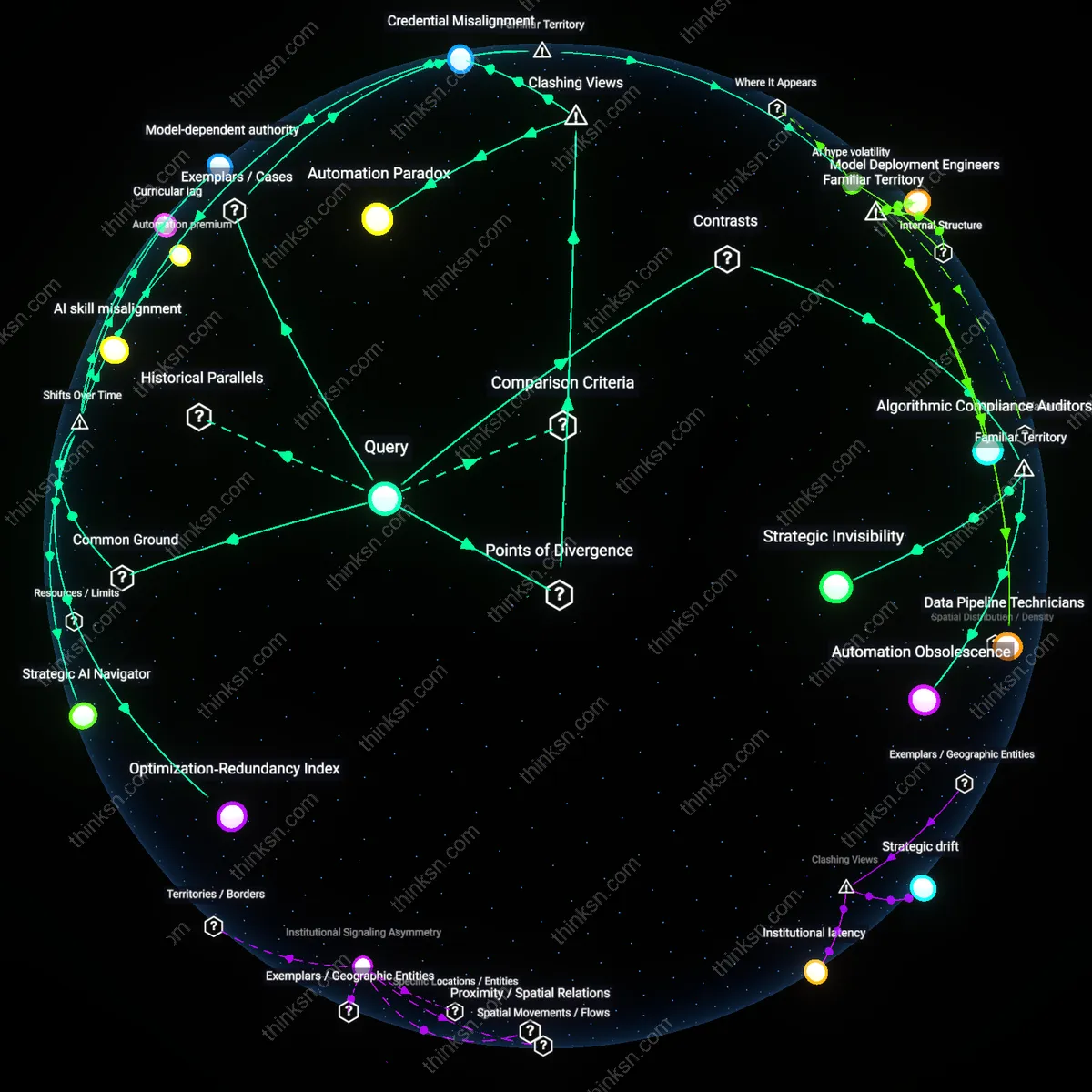
Analysis reveals 13 key thematic connections.
Key Findings
Automation Obsolescence
An AI-focused MBA risks accelerating the mid-level manager’s displacement by aligning their expertise with systems designed to replace human oversight in routine decision-making. Managers in automated industries often gain promotion by demonstrating efficiency, but AI-MBAs train them in deploying tools that erode the very roles they occupy—intelligent process automation in supply chains or HR platforms in services eliminate middle layers by design. The mechanism isn't just technological substitution but institutional reskilling that redefines competence around algorithmic management, making traditional oversight redundant. What’s underappreciated is that the degree itself becomes a vector of obsolescence, not a shield against it.
Strategic Invisibility
A traditional management degree maintains a mid-level manager’s relevance by embedding them in longstanding organizational rituals that value narrative control, budget ownership, and hierarchical navigation over technical specificity. In industries undergoing automation, these degrees reinforce credibility in legacy governance systems—like capital allocation committees or regulatory compliance units—where decisions are justified through precedent and political alignment rather than data modeling. The underappreciated reality is that visibility in such structures often depends on symbolic fluency with outdated forms, and the traditional MBA sustains that illusion of control even as technical work is outsourced to AI teams.
Credibility Arbitrage
Pursuing an AI-focused MBA allows a mid-level manager to reposition themselves as a rare hybrid capable of translating between technical teams and C-suite executives, exploiting a scarcity premium in organizations reluctant to promote engineers into strategic roles. This works through the persistent gap between data scientists, who lack business rhetoric, and executives, who lack technical discernment—managers with AI-MBAs insert themselves as interpreters in boardroom discussions about model deployment or automation ROI. The non-obvious insight is that the real value isn't in deeper technical mastery but in being perceived as technically literate while retaining managerial plausibility, creating leverage not through skill but through asymmetric understanding.
Gap‑Based Career Pivot
In the early 2000s, as manufacturing plants began shifting from mechanical to cognitive automation, mid‑level managers who opted for AI‑focused MBAs reduced the risk of skill obsolescence while modestly increasing career mobility compared to peers who remained entrenched in traditional curricula. Their new AI expertise opened doors to analytics‑centric roles within fast‑automating companies such as GE and Siemens while the conventional degrees lagged behind. Because AI began to make routine managerial decisions, those who held only conventional credentials faced an underappreciated risk of being replaced by algorithmic oversight. This transition highlighted the common grounding that both degrees still needed leadership skills but diverged in the critical additional production‑augmenting toolset.
Optimization‑Redundancy Index
Between 2015 and 2020, the proliferation of AI‑driven decision engines in supply chains flattened the reward curve of AI‑focused MBAs relative to traditional degrees, granting mid‑level managers equal operational sway but elevating the risk they specialize too narrowly. Companies like Walmart and Amazon integrated machine‑learning forecasting so human strategic input diminished, yet AI‑trained managers could accelerate deployment of those tools, creating a fragile reward that hinged on continuous learning. The overlapping structure is that both paths still required negotiation and coordination, but the mechanism shifted from human analysis to algorithmic optimization. At this juncture, the common ground of leadership became a platform to steer AI, yet the intangible cost of over‑specialization became a novel risk that previous managers had not confronted.
Strategic AI Navigator
By 2030, as AI evolves into an indispensable decision‑support system rather than a replacement, mid‑level managers who pursue AI‑focused MBAs stand to reap greater rewards from strategic foresight while the danger of obsolescence declines; the risk–reward landscape has flipped to favor those who can translate algorithmic output into organizational strategy. The 2025‑2030 interval saw firms like Google and IBM formalize roles titled 'AI Strategist', providing an institutional dependence on human interpretation that safeguards such professionals, whereas traditional MBA graduates lacking AI literacy find these positions out of reach. The shared structures include analytical rigor and leadership, but the shift reveals the unique requirement of bridging cognitive gaps—a nuance underappreciated when AI was first introduced. Consequently, the tradeoff now manifests as a higher upside for AI‑savvy managers and reduced downside because AI is a tool, not a replacement.
Automation premium
An AI-focused MBA now yields higher risk-adjusted returns than a traditional management degree because it equips mid-level managers with specialized fluency in deploying machine learning systems within legacy industrial workflows, a skill gap that emerged sharply after 2018 when automation shifted from peripheral efficiency tools to core decision infrastructure in manufacturing and logistics. This return advantage operates through real-time operational control—where managers must interpret model outputs, reconcile data drift, and allocate hybrid human-machine labor—making the premium not just technological but managerial. What is underappreciated is that automation no longer supplements management; it redistributes authority, exposing traditional degree holders to obsolescence not through job loss but through erosion of decision sovereignty.
Curricular lag
Traditional management degrees still assume stable supervisory hierarchies, but since the 2008 financial crisis, especially post-2015, corporate promotion pathways have increasingly favored data-literate operators over generalist administrators, shifting the career trajectory for mid-level managers. This structural shift reveals that the traditional MBA’s value—rooted in standardized processes and financial abstraction—now matures too slowly to keep pace with quarterly automation cycles, creating a time-value mismatch. The underappreciated consequence is not that traditional MBAs are obsolete, but that their delayed payoff period increases exposure to mid-career disruption when algorithmic systems renegotiate accountability structures.
Model-dependent authority
Mid-level managers with AI-focused MBAs now inherit legitimate decision-making power not from organizational rank alone, but from their ability to interpret, tune, and justify algorithmic recommendations—an authority structure that crystallized between 2020 and 2023 as automated scheduling, predictive maintenance, and workforce analytics became auditable performance metrics. This shift replaces the traditional manager’s role as a relational broker with that of a model steward, embedding managerial legitimacy in technical fluency. What has become visible is not simply new skills, but a reconstituted chain of administrative legitimacy, where influence flows from proximity to model infrastructures, not managerial seniority.
Automation Paradox
An AI-focused MBA increases career risk for mid-level managers in automating industries because it signals over-specialization in a domain dominated by technical teams who distrust management-led AI strategy, causing such managers to be excluded from both operational AI implementation and traditional leadership succession. This dynamic intensifies in manufacturing and logistics firms where data scientists report directly to C-suite technologists, bypassing mid-tier managers with hybrid credentials; the resulting career limbo reveals that perceived adaptability can deepen structural irrelevance when new expertise disrupts established promotion pipelines.
Credential Misalignment
Traditional management degrees still command higher reward in rapidly automating industries because their vague, generalized curricula allow mid-level managers to perform organizational ‘translation work’—reframing automated workflows into legacy reporting structures—preserving their role as bureaucratic intermediaries. In regulated sectors like healthcare and insurance, where compliance demands persist despite automation, the ability to delay or interpret technological change becomes more valuable than accelerating it, exposing how inertia, not innovation, sustains managerial power in transition periods.
AI skill misalignment
Mid‑level managers who pursue an AI‑focused MBA at programs such as MIT Sloan’s AI‑focused track and then move into AI‑heavy roles at automobile manufacturers like Tesla earn a higher immediate salary and faster promotion, but the same credential can leave them skill‑misaligned in departments that still rely on manual inspection, increasing the risk of underutilization. The mechanism is that Tesla’s Fremont factory now deploys AI for predictive maintenance and quality inspection, rewarding data‑science skills with a 15% salary bump and promotion to product line lead. Conversely, the plant’s legacy quality control team continues to use legacy PLC software, where the AI training provides little added value, creating an opportunity cost. This dynamic shows that while the prestige of an AI MBA promises reward, the real‑world risk is skill misalignment that people often overlook when they assume AI is ubiquitous across all manufacturing.
AI hype volatility
Choosing an AI‑focused MBA for a mid‑level manager in a fast‑automating industry provides the upside of positioning the individual for emerging AI strategy roles but carries the risk that the industry's AI initiatives may lag, leaving the new skill set underused. For example, a mid‑level manager at Hyundai’s auto plant who enrolls in a leading university’s AI‑focused MBA expects to lead AI‑enabled forecasting for supply chain; however, Hyundai’s current roadmap focuses on electric‑vehicle production without AI analytics, postponing the role. The mechanism is the mismatch between the plant's adoption pace and the AI curriculum’s emphasis on predictive modeling, creating a vacancy that the manager may remain in limbo. The subtlety lies in the assumption that automation equates to AI; in reality, many fast‑automating plants still rely on robotic assembly without data‑science integration, so the AI training can become an overhyped asset.