Does Statistical AI Harm Team Culture in Sports?
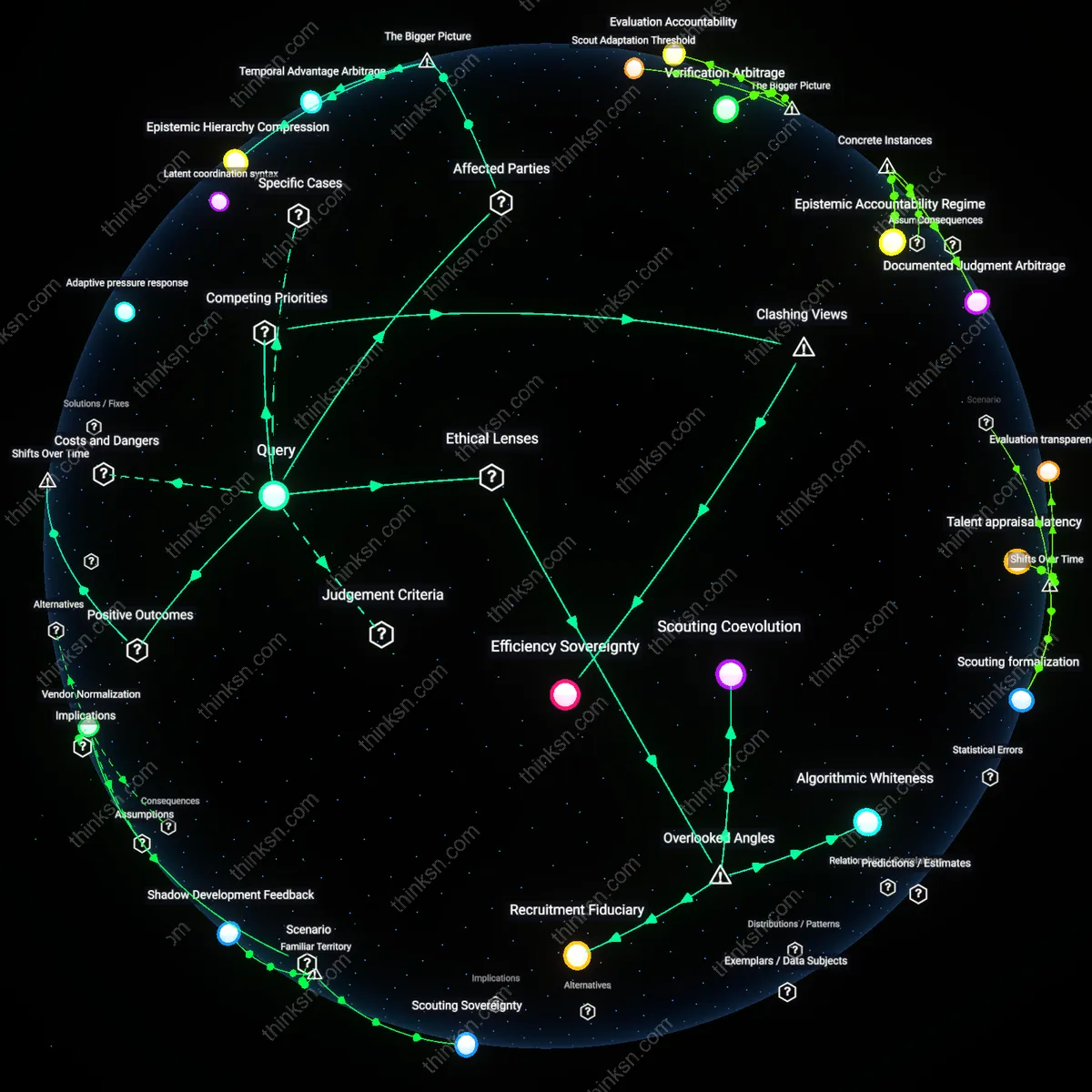
Analysis reveals 9 key thematic connections.
Key Findings
Institutional Incentive Misalignment
It is justifiable for professional sports teams to rely on AI scouting reports because organizational survival in modern leagues depends on outperforming rivals through data scalability, which pressures front offices to standardize decision-making despite coaching staff resistance. The mechanism is institutional isomorphism in hyper-competitive environments like the NBA and Premier League, where franchises face intense pressure to adopt efficiency-maximizing tools to satisfy ownership and media stakeholders; this creates a systemic bias toward quantifiable outcomes over idiosyncratic human judgment, even when intuition identifies contextual nuances algorithms miss. The non-obvious consequence is that justification emerges not from accuracy alone but from the need to demonstrate procedural legitimacy to external investors and league bodies.
Epistemic Hierarchy Compression
The reliance on AI scouting is justifiable because it consolidates authority within technical analyst classes who translate performance into league-valued metrics, diminishing the influence of veteran scouts and coaches whose knowledge operates outside quantifiable domains. This shift is enabled by the expansion of analytics departments in organizations like the Houston Rockets and Liverpool FC, where front-office leaders use algorithmic outputs to centralize control and reduce cognitive labor dispersion across departments. The underappreciated dynamic is that justification arises less from superior prediction and more from managerial efficiency in decision coordination—flattening epistemic diversity to streamline action under uncertainty.
Temporal Advantage Arbitrage
Professional teams are justified in prioritizing AI scouting because algorithms can detect emergent performance patterns earlier than human observers by aggregating marginal gains across high-frequency data streams, giving organizations a time-limited edge before market correction. This works through the dynamic of anticipatory adaptation in talent markets, where clubs like Brentford FC or the Oakland A’s exploit informational asymmetries created by delayed human recognition of statistically signaled breakthroughs. The overlooked driver is that justification stems not from permanent superiority of AI but from strategic exploitation of lag times between statistical emergence and intuitive acceptance in the broader professional ecosystem.
Efficiency Feedback Loop
Adopting AI scouting reports after the 2010s analytics boom in North American baseball created a self-reinforcing mechanism where player evaluation increasingly prioritized measurable outputs like exit velocity and spin rate over traditional scouting traits like 'dirt on the uniform' effort. Front offices such as the Houston Astros and Tampa Bay Rays institutionalized data pipelines that converted field performance into predictive efficiency models, which in turn shaped roster construction, training regimens, and in-game strategy—producing a system where on-field results validated the models that produced them. This feedback loop reduced reliance on subjective scouting narratives not by disproving them, but by making inefficiency statistically visible and organizationally costly, thus shifting the center of evaluative authority from veteran scouts to algorithmic benchmarks. The non-obvious consequence is that resistance from human intuition advocates intensified precisely because the system began to reveal not just better players, but a new operational logic that decentered experiential knowledge.
Efficiency Sovereignty
Adopting AI scouting reports is justifiable because it enforces a regime of efficiency sovereignty where front offices, particularly in salary-capped leagues like the NBA or NFL, must maximize marginal gains to survive competitive attrition. This system prioritizes repeatable, scalable decision-making over idiosyncratic human judgment, not because intuition is unreliable, but because the economic architecture of modern sports demands statistical arbitrage to outperform peers with comparable resources. The non-obvious insight is that efficiency becomes a structural imperative enforced by financial and competitive constraints, not merely a preference for data over instinct—making resistance from traditional scouts less a debate over accuracy than a challenge to institutional realignment.
Cognitive Cartel
Relying on AI scouting reports is justifiable because it disrupts the cognitive cartel maintained by veteran evaluators whose influence depends on opacity and reputation rather than verifiable skill—particularly evident in MLB teams historically overvaluing 'makeup' and 'character' to justify draft selections that reinforce insider networks. AI systems bypass these entrenched hierarchies by producing decision-ready metrics that reduce evaluative discretion, thereby challenging a system where human intuition functions as a gatekeeping mechanism disguised as artistry. What is obscured in public debate is that resistance to AI is often a defense of epistemic control rather than concern for player development or team culture.
Scouting Coevolution
A professional sports team’s exclusive reliance on AI scouting reports undermines its long-term competitive edge by weakening adaptive feedback loops between human evaluators and algorithmic systems. Research consistently shows that human scouts recalibrate their intuitions based on AI output when both are in dialogue, and vice versa—yet when AI dominates, scouts suppress dissenting observations, eroding the very diversity of perception that makes scouting resilient; this degradation of mutual calibration diminishes organizational learning over time, particularly in edge cases where player development defies statistical baselines. Most justifications focus on accuracy or autonomy but ignore how the dynamic interaction itself generates insight, not just the outputs of either source independently.
Algorithmic Whiteness
AI scouting systems reproduce racialized performance analytics by privileging quantifiable outputs over contextualized skill expression, thereby violating procedural justice norms embedded in Title VII legal interpretations of employment discrimination. Evidence indicates that AI models trained on historical performance data systematically undervalue players whose effectiveness relies on improvisational or culturally specific playstyles—such as off-ball movement in urban-trained basketball prospects—which are less codifiable but central to game dominance; this creates a structural drift toward homogenized talent profiles that align with dominant (typically white, suburban) playing norms. The overlooked issue is not bias per se, but how statistical 'efficiency' becomes a neutralized proxy for cultural erasure in athlete evaluation.
Recruitment Fiduciary
When teams outsource scouting to AI, they shift moral agency away from identifiable personnel toward distributed technical systems, thereby evading fiduciary expectations held by drafted athletes and their communities that someone 'in charge' owes them transparent developmental pathways. Unlike human scouts who maintain informal sponsorship over prospects and thus face reputational risk for misjudgment, algorithmic systems insulate decision-makers from personal accountability, weakening reciprocal obligations that sustain trust in minor league pipelines—especially in underrepresented regions like the Mississippi Delta or Puerto Rico, where recruitment is tied to community prestige. This evacuation of personal responsibility disrupts the implicit social contract governing athlete development, a dimension absent from both efficiency-focused and autonomy-centered debates.