Is Heart Rate Data Worth the Risk to Health Insurance?
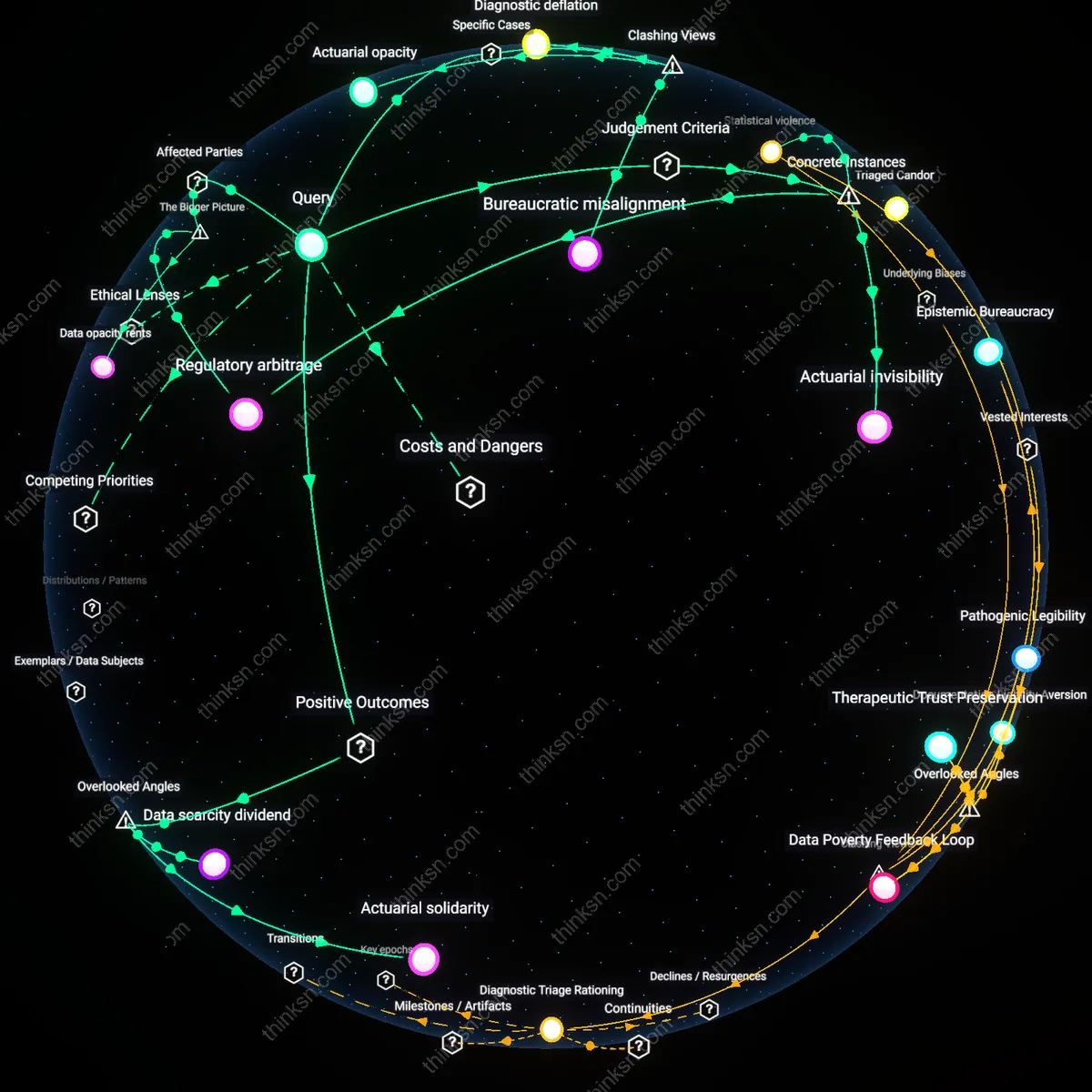
Analysis reveals 6 key thematic connections.
Key Findings
Actuarial Coercion
In Oregon's 2018 pilot program with Vitality, state employees who declined to share continuous heart-rate data via wearable devices faced a $600 annual premium surcharge, establishing a precedent where actuarial fairness is enforced through financial compulsion rather than voluntary participation. The mechanism reframes personal health data sharing as a cost-saving duty, leveraging public-sector employer authority to redefine risk pooling as risk individualization; what is underappreciated is how this normalizes economic pressure to surrender privacy, not through overt denial of service but through structurally coerced consent within a supposedly voluntary system.
Biometric Arbitrage
When UnitedHealthcare partnered with Fitbit in 2016 to offer subsidized devices in exchange for real-time physiological data, it created a feedback loop where insurers could price incentives based on continuous monitoring, privileging data-rich enrollees while disadvantaging those without access or digital literacy. This system institutionalizes differential risk assessment not from health status per se, but from data-generating capacity, revealing how the integration of consumer wearables into insurance models enables arbitrage between biological reality and data abundance—where it becomes more profitable to insure the quantified than the unmonitored.
Preemption Paradox
In 2020, the Florida Blue health plan introduced a diabetes management program that offered lower premiums to members who allowed real-time heart-rate and activity tracking, but those who accepted were later found to be disproportionately excluded from experimental treatments due to 'stable compliance' in monitored data. The paradox lies in how surveillance is used not only to reward behavior but to deprioritize clinical intervention for compliant users, exposing how data-driven incentives can silently deactivate rights to care under the guise of responsibility—a dynamic where adherence becomes a reason to withhold advancement.
Actuarial normalization
The integration of continuous heart-rate data into premium-setting was materially legitimized by the 2016 partnership between Vitality and Aetna, where biometric monitoring was rebranded as a wellness incentive within employer-sponsored plans. This marked a shift from reactive claims-based underwriting to proactive risk-shaping, where actuarial models began treating anticipated behavior—derived from real-time data—as a valid proxy for risk, thus normalizing continuous surveillance as an actuarial standard. The non-obvious consequence of this historical pivot was the quiet erosion of medical underwriting as a discrete event, replacing it with an ongoing, data-driven process that masked power asymmetries under wellness rhetoric.
Asymmetric compliance
After the introduction of wearables-linked insurance discounts in Japan by Sony Life and Omron in 2018, low-income policyholders increasingly enrolled in data-sharing programs not for health benefits but to maintain premium affordability, revealing a coercive shift in compliance driven by economic precarity. This marked a transition from voluntary health monitoring to survival-driven data submission, where the structural imbalance of choice became a permanent feature of risk-based pricing models. The underappreciated dynamic is that compliance is no longer measured by engagement but by desperation, making data access a mechanism of stratified inclusion rather than shared benefit.
Temporal plunder
The 2020 expansion of UnitedHealth’s Optum wearable programs into Medicaid-adjacent populations reframed longitudinal heart-rate data as a proxy for 'behavioral responsibility,' transforming historical patterns into future liabilities through predictive modeling. This signaled a shift from assessing present health to penalizing probable futures—where past biological responses become evidence of non-compliance with actuarial timelines. The non-obvious effect is that time itself becomes a contested asset, extracted from vulnerable bodies to project risk, producing a regime where biological history is looted for actuarial gain.