Do Expert Panels Hide Corporate Agendas on News Streams?
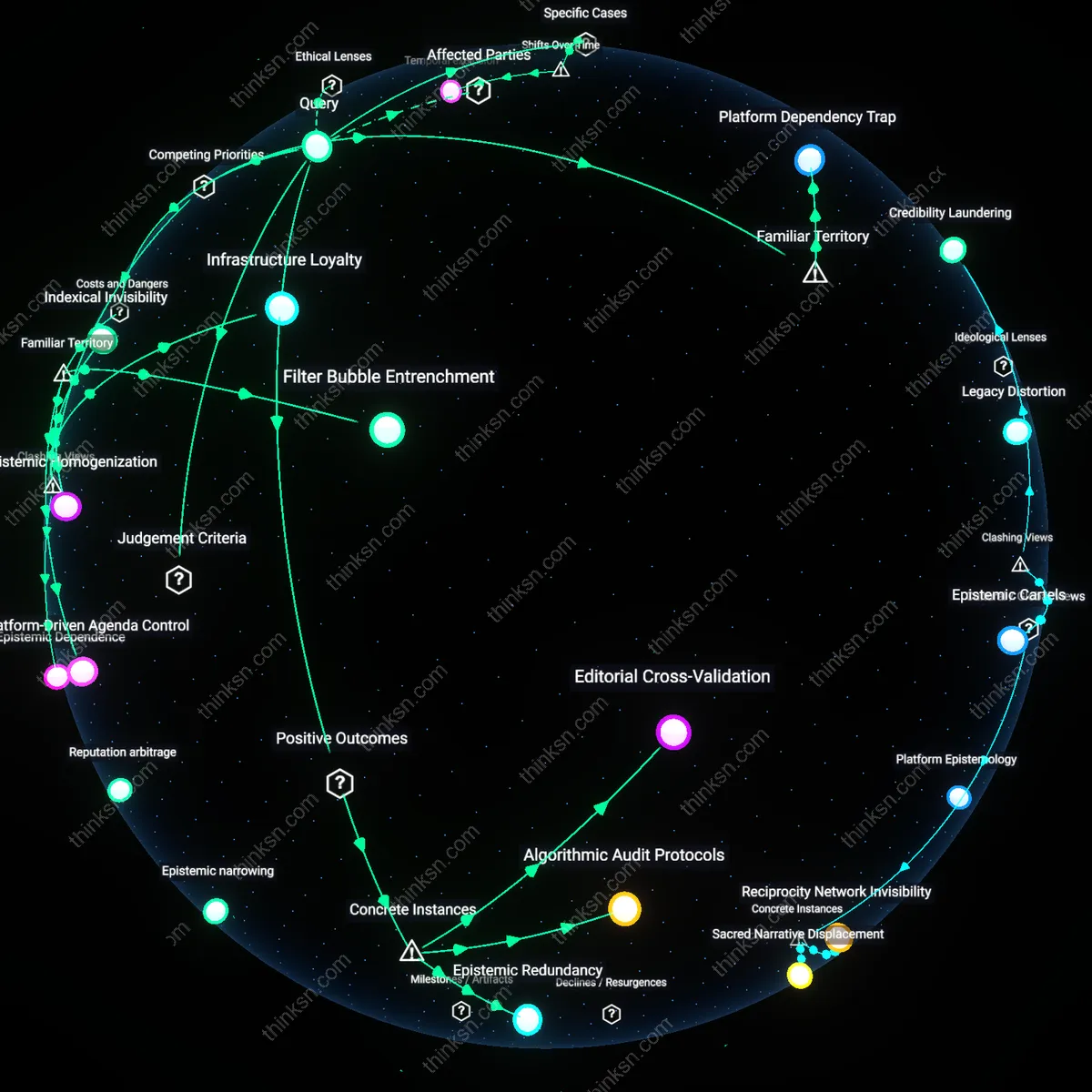
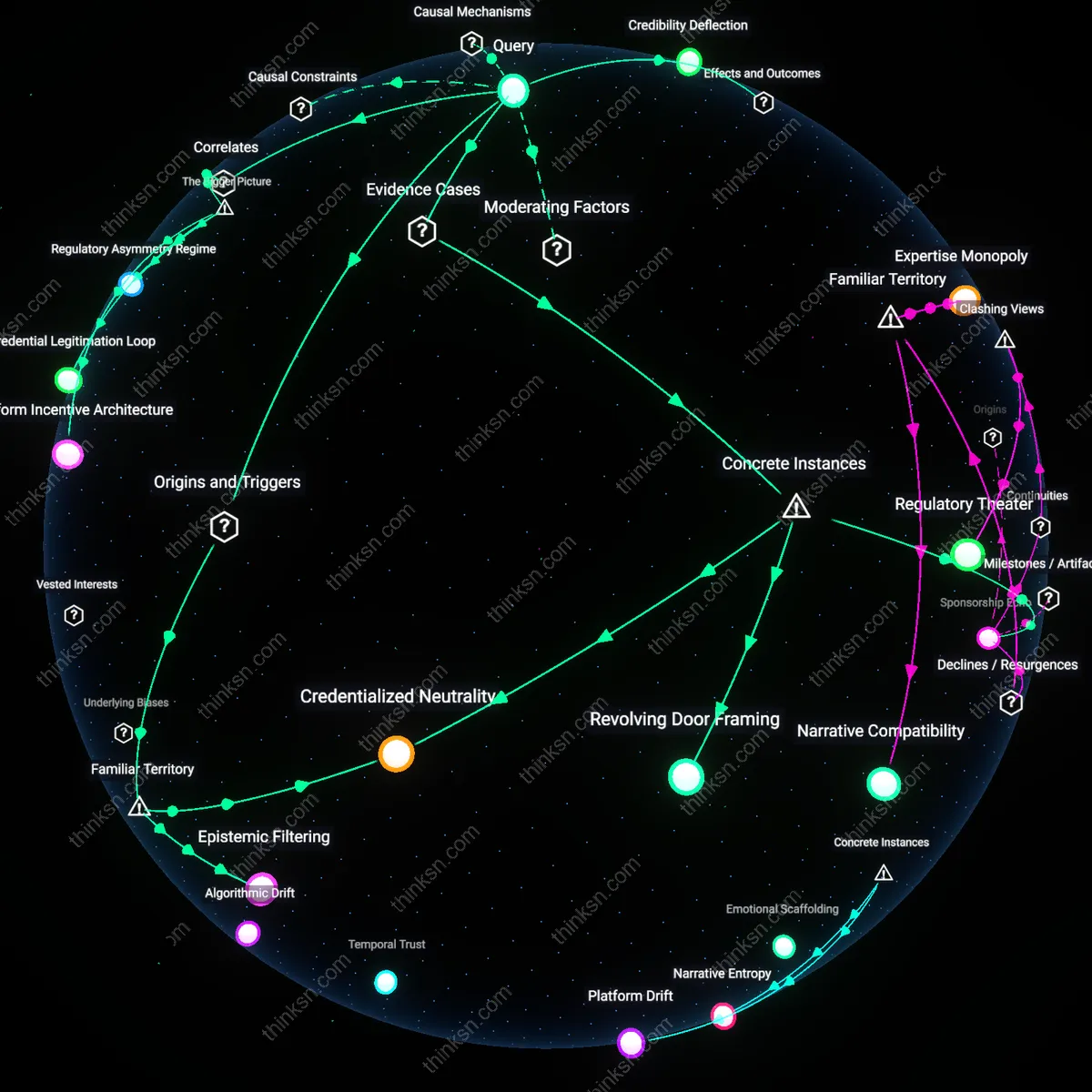
Analysis reveals 11 key thematic connections.
Key Findings
Credentialized Neutrality
Expert panels on streaming news services mask corporate influence by selectively recruiting credentialed professionals whose academic or institutional affiliations signal objectivity, thereby framing editorial content as impartial despite alignment with corporate interests. Networks like MSNBC or Fox Business prioritize economists from top-tier universities or former government officials whose presence legitimizes commentary that subtly reinforces owner-driven narratives, such as deregulation or market expansion. The mechanism relies on the public’s trust in institutional validation—such as Ivy League degrees or prior federal appointments—to obscure how these panelists are filtered through ideological and institutional gatekeeping that favors pro-corporate assumptions. What’s underappreciated is that the very markers of expertise that audiences associate with reliability are the same filters that preselect for compatibility with corporate editorial guardrails.
Infotainment Convergence
Streaming news platforms mask corporate influence by structuring expert panels as performative spectacles where credentials serve as props in an entertainment-driven format that prioritizes conflict over critique. On services like CNN+, panelists with elite resumes are placed in timed, emotionally charged debates that reward strong opinions over structural analysis, effectively depoliticizing corporate power by subsuming it into the rhythm of televised drama. This format exploits the audience’s familiarity with talk-show dynamics, where expertise is equated with visibility and vocal dominance rather than depth or dissent. The non-obvious insight is that the entertainment logic doesn’t just dilute corporate scrutiny—it repurposes credentials to aestheticize debate, making the absence of systemic challenge feel like engagement.
Epistemic Filtering
Corporate influence is masked through editorial pipelines that pre-curate which expert voices appear on streaming news panels, ensuring only those whose worldview aligns with dominant economic paradigms are featured, regardless of their individual credentials. Platforms such as Bloomberg Live or Yahoo Finance draw from a narrow epistemic network—often economists, former central bankers, or corporate strategists—whose analytical frameworks assume market efficiency and shareholder primacy, thereby excluding heterodox or institutionally critical perspectives. This filtering operates not through overt censorship but through sourcing norms that equate professionalism with adherence to mainstream economic orthodoxy. The underappreciated reality is that audiences perceive diversity in titles and institutional affiliations while missing the overwhelming homogeneity in underlying ideology, mistaking representational variation for intellectual independence.
Credibility Deflection
Expert panels on streaming news services mask corporate influence by redirecting audience attention from editorial ownership to panelist prestige, a mechanism that intensified after the 2010s shift from network-affiliated journalism to platform-dependent digital outlets where reputation capital substitutes for institutional accountability. As legacy media brands fragmented and tech platforms became dominant distribution channels, hiring tenured academics or former government officials allowed corporate-backed streamers like MSNBC or Fox Nation to anchor legitimacy in individual biographies rather than transparent editorial processes, making scrutiny of corporate agendas appear personally offensive rather than structurally warranted. This deflection exploits the historical transition from institutional to personalized credibility, obscuring how platform economics shape issue framing under the guise of expert neutrality.
Agenda Temporalization
Corporate editorial influence is masked on streaming news panels by compressing policy discussion into reactive, event-driven formats that emerged prominently after the 2016 election cycle, replacing long-form investigative programming with real-time commentary cycles dependent on immediate viewer engagement. As streaming services prioritized algorithmic retention metrics over archival depth, expert panelists were incentivized to respond to breaking developments rather than trace systemic causalities, fragmenting narrative continuity and displacing questions about institutional responsibility—such as ownership stakes or sponsorship ties—into irrelevant 'past' frames. This temporal shift from cumulative analysis to episodic reaction conceals corporate alignment by anchoring discourse in perpetual presentism, where structural influences are effaced by the urgency of the moment.
Neutrality Theater
Streaming news services simulate ideological balance through expert panel composition—a practice institutionalized after the mid-2000s rise of 'both sides' reporting—where the appearance of debate between credentialed figures from nominally opposing camps legitimizes programming regardless of underlying corporate constraints on permissible discourse boundaries. Unlike public broadcasters with mandated impartiality standards, commercial streaming platforms exploit the legacy of fairness doctrine aesthetics without regulatory oversight, allowing parent companies like Disney or Comcast to host adversarial-seeming exchanges that exclude critiques of their own economic interests or media consolidation practices. This ritualized performance of dissent, amplified during the 24-hour news expansion into on-demand streaming, transforms editorial limitation into theatrical pluralism, normalizing the exclusion of systemic critique as a condition of participation.
Platform Incentive Architecture
Streaming news platforms prioritize user engagement metrics over editorial independence, leading expert panel formats to align with content strategies that maximize watch time and algorithmic visibility. Platform designers, data analysts, and advertising teams shape the structural conditions under which expert panels operate, favoring emotionally resonant or conflict-driven commentary—regardless of panelists’ academic or professional credentials. This creates a systemic bias where corporate influence is reproduced not through direct editorial commands but through engineered audience feedback loops. The underappreciated force here is not overt censorship but the way incentive structures embedded in digital distribution quietly reshape expert discourse into engagement-optimized performance.
Credential Legitimation Loop
Highly credentialed panelists inadvertently authenticate corporate editorial agendas by lending their reputations to formats they perceive as neutral forums. Their presence signals intellectual rigor and independence, masking how scheduling patterns, topic selection, and segment durations are calibrated to fit pre-existing programming grids shaped by advertising cycles and affiliate content partnerships. The key mechanism is the conflation of individual credibility with institutional neutrality—a statistical co-occurrence where expertise correlates with perceived objectivity even when systemic constraints limit actual autonomy. The non-obvious insight is that legitimacy accumulates not from oversight but from the residual authority panelists carry into compromised settings.
Regulatory Asymmetry Regime
Unlike broadcast media, streaming news services operate without mandatory public interest obligations such as balanced coverage or transparency in sourcing, enabling corporate owners to integrate editorial strategies with broader business interests under minimal scrutiny. This absence of enforceable structural safeguards allows platforms like News Corp-affiliated services or tech-owned streams to embed influence through ownership-aligned executive producers and opaque funding arrangements that dictate panel composition behind the scenes. The enabling condition is a fragmented regulatory environment where digital platforms exploit jurisdictional gray zones to avoid the accountability norms imposed on traditional media—making corporate influence systemic rather than anomalous.
Sponsorship Echo
CNBC’s ‘Squawk Box’ panel discussions frequently emphasize growth metrics and investor sentiment in ways that mirror the interests of major financial institutions such as Goldman Sachs and BlackRock, even without direct sponsorship. The panels operate within a production ecosystem where guests are often current or former executives from these firms, normalizing a market-centric worldview as neutral commentary. This illustrates how structural access—rather than overt payment—creates alignment between editorial framing and corporate priorities, an effect often mistaken for expertise when it is actually institutional osmosis.
Revolving Door Framing
MSNBC panels on healthcare policy regularly include figures like Ezekiel Emanuel, who transitioned from corporate health consulting roles to prominent media commentary, embedding commercial health system assumptions into discussions of public reform. His presence, while credible due to academic and policy experience, consistently emphasizes incremental change and market-integrated solutions, marginalizing single-payer or decentralized models. This case exposes how the mobility of individuals between corporate-funded institutions and media platforms embeds commercial logics into editorial discourse without requiring explicit corporate direction.