Is Corporate Funding Biased When News and Science Collide?
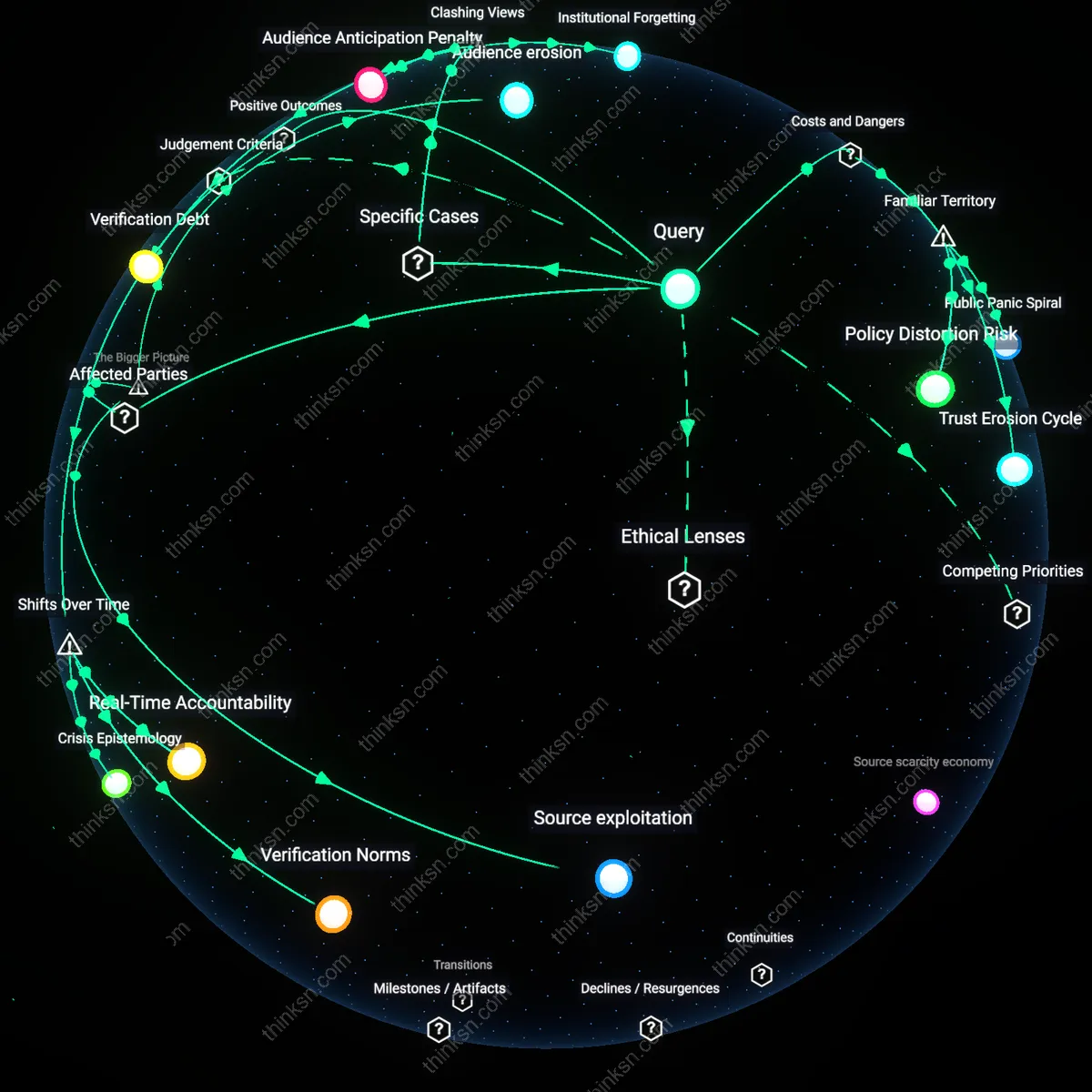
Analysis reveals 12 key thematic connections.
Key Findings
Epistemic opacity
Citizens can counter corporate-influenced scientific narratives by mapping the shared data infrastructure between funded research institutions and allied media outlets, revealing how proprietary datasets are selectively released to shape public interpretation. This technical bottleneck—where access to raw or unprocessed data is restricted by contracts between the corporation, its research partners, and affiliated newsrooms—creates an invisible filtration system that standard peer review cannot audit, meaning scrutiny must shift from publishing venues to data provenance chains. The non-obvious insight is that bias here is less about spin or funding source and more about controlled access to the empirical foundations themselves, altering the locus of media literacy from critical reading to infrastructural transparency.
Temporal anchoring
Citizens can detect bias by analyzing the timing discrepancies between the release of internal corporate regulatory filings and the public rollout of corresponding scientific studies in owned media, exposing how pre-registered safety claims in FDA or SEC documents diverge from later journalistic framings. Because legal disclosure timelines are institutionally rigid while news narratives are fluid, comparing versions of risk assessment across these domains reveals strategic slippage in how uncertainties are minimized or amplified. This overlooked rhythm—where corporate science exploits the lag between legal obligation and public consumption to refine messaging—shifts detection from content analysis to forensic timestamping, making time itself a diagnostic tool rather than a background condition.
Institutional mimicry
Citizens can identify bias by tracking how corporate-funded studies adopt the stylistic and procedural markers of independent science—such as multi-institutional author lists or open-access publication—while embedding decision influence within collaborative governance structures like joint steering committees that include media division liaisons. The mimicry fools conventional credibility heuristics because the study appears structurally legitimate, yet informal feedback loops between scientific teams and editorial boards distort prioritization and framing long before publication. This hidden coordination—where legitimacy is manufactured through borrowed academic architecture rather than forged results—means that authenticity checks must target governance design, not just conflict-of-interest statements, revealing mimicry as a covert integration mechanism.
Epistemic ownership
Citizens can detect bias by mapping the institutional overlap between corporate funders of science and media outlets reporting on it, because concentrated ownership structures enable strategic control over knowledge production and dissemination. When a single corporation finances both scientific research and the news coverage that interprets it, it gains epistemic authority—not through scientific consensus but through structural dominance—allowing it to shape what counts as credible evidence. This mechanism operates through vertically integrated information systems, where the same entity controls data generation and public narrative formation, making bias difficult to detect without institutional transparency. The non-obvious insight is that the distortion arises not from overt falsification but from the systemic alignment of epistemic roles within a profit-driven hierarchy.
Ideological buffering
Citizens can counteract bias by recognizing how their ideological affiliations predispose them to either accept or reject corporate-sponsored science, since belief systems like liberalism, conservatism, and Marxism filter credibility through distinct epistemic priorities. For instance, conservatives may distrust state-linked scientific institutions but accept market-funded studies as neutral, while Marxists may see all corporate science as inherently compromised, regardless of methodology. This dynamic functions through ideological buffering, where preexisting worldviews insulate individuals from structural critique by redirecting skepticism toward ideologically convenient targets. The underappreciated consequence is that ideological lenses often obscure the material convergence of media and scientific power by reframing bias as a battle of values rather than a structural conflict of interest.
Regulatory forbearance
Citizens can expose bias by tracing how weakened antitrust enforcement enables corporations to simultaneously dominate research funding and news dissemination, because decades of regulatory forbearance have allowed cross-sector consolidation that blurs boundaries between science, media, and capital. In the U.S., the erosion of policies like the Fairness Doctrine and lax scrutiny of mergers—such as those involving telecom and pharmaceutical firms—have created conglomerates with both the motive and means to shape public understanding of science in service of profit. This condition persists through a feedback loop where concentrated firms lobby against oversight while presenting themselves as neutral information providers, normalizing the fusion of research sponsorship and media control. The overlooked reality is that bias is less a product of individual study integrity than of a permissive legal architecture that treats information-as-commodity rather than public good.
Epistemic Dualism
Citizens can resist corporate-influenced science reporting by relying on religiously embedded knowledge systems that predate secular media monopolies, as seen in Indigenous Māori communities in Aotearoa (New Zealand) who consult ancestral knowledge (mātauranga Māori) to counter industry-funded environmental studies reported by corporate-aligned outlets. This mechanism operates through institutionalized co-governance of science communication, where state recognition of non-Western epistemologies since the 1990s Treaty of Waitangi settlements created a dual legitimacy structure—one that does not dismiss corporate science outright but situates it alongside collectively held truths. The non-obvious insight is that decolonization policies from the late 20th century, not general media literacy, enabled a structural buffer against epistemic capture by market actors.
Media Conglomerate Disenchantment
Citizens in post-dictatorship South Korea developed grassroots scientific watchdog networks in the 2010s to scrutinize food safety studies funded by chaebols like CJ Group, whose subsidiaries also dominate TV and print news. This shift emerged after the 2008 U.S. beef import protests, when scientific claims about mad cow disease were simultaneously published by university researchers and broadcast uncritically by major networks under the same corporate umbrella, triggering a crisis of scientific trust. The historically distinct development was the rise of independent digital platforms like OhmyNews and citizen-participatory science forums, which institutionalized skepticism toward vertically integrated knowledge chains—a reaction not to bias per se, but to the collapse of the post-1987 democratic illusion of press independence.
Confessional Objectivity
In contemporary Scandinavia, citizens increasingly demand that scientific journals and news outlets adopt mandatory disclosure regimes identifying not only direct funders but also media ownership structures, a practice that evolved from Lutheran-influenced public service traditions where institutional transparency became a moral duty rather than a legal formality after the 1970s media democratization reforms. This works through publicly funded broadcasters like Sweden’s SVT, which now annotate health and environmental reports with flowcharts showing corporate interlocks between research sponsors and media groups, transforming ownership data into a ritual of public accountability. The underappreciated shift is that Northern European objectivity is no longer defined by neutrality, but by the public performance of moral confession—the institutional admission of structural influence, a transformation rooted in state-church norms of penitential honesty.
Media-financial entanglement
Citizens can detect bias by investigating shared ownership between research funders and news platforms, as seen when Comcast funded studies on broadband performance while NBC News, its subsidiary, reported those findings as neutral consumer insights. This corporate integration allows favorable science to be laundered through editorial arms that maintain a façade of independence, masking how financial alignment shapes both knowledge production and its public narration. The non-obvious insight is that the bias does not reside solely in the study design but in the structural convergence of data generation and dissemination under one capital structure.
Credibility shielding
Citizens can uncover bias by tracking how corporate-funded science is amplified through affiliated news outlets using third-party validators, such as when Monsanto sponsored cancer risk studies on glyphosate, and The Weather Channel—partially owned by Monsanto’s parent company at the time—featured oncologists citing those studies without disclosing funding ties. This system leverages the prestige of independent-seeming experts to absorb reputational risk, allowing the science to gain public trust even when embedded in a conflict-of-interest ecosystem. The underappreciated mechanism is not direct propaganda but the delegation of credibility to intermediaries who insulate the sponsor from scrutiny.
Narrative preemption
Citizens can identify bias by observing how corporate-owned media frame scientific debates before independent evaluation, as occurred when Aetna-funded studies on healthcare cost-efficiency were previewed in Fortune magazine—owned by Aetna’s strategic partner Time Inc.—which labeled critics as 'anti-reform ideologues' prior to peer review. This preemptive storytelling installs a preferred interpretation in the public mind, rendering subsequent contradictory evidence dismissible as outlier noise. What remains hidden is not manipulation of data but the temporal capture of narrative authority, where the sponsor’s media access allows it to define the terms of debate in advance.