Losing Your Expert Label in Transition to Entrepreneurship?
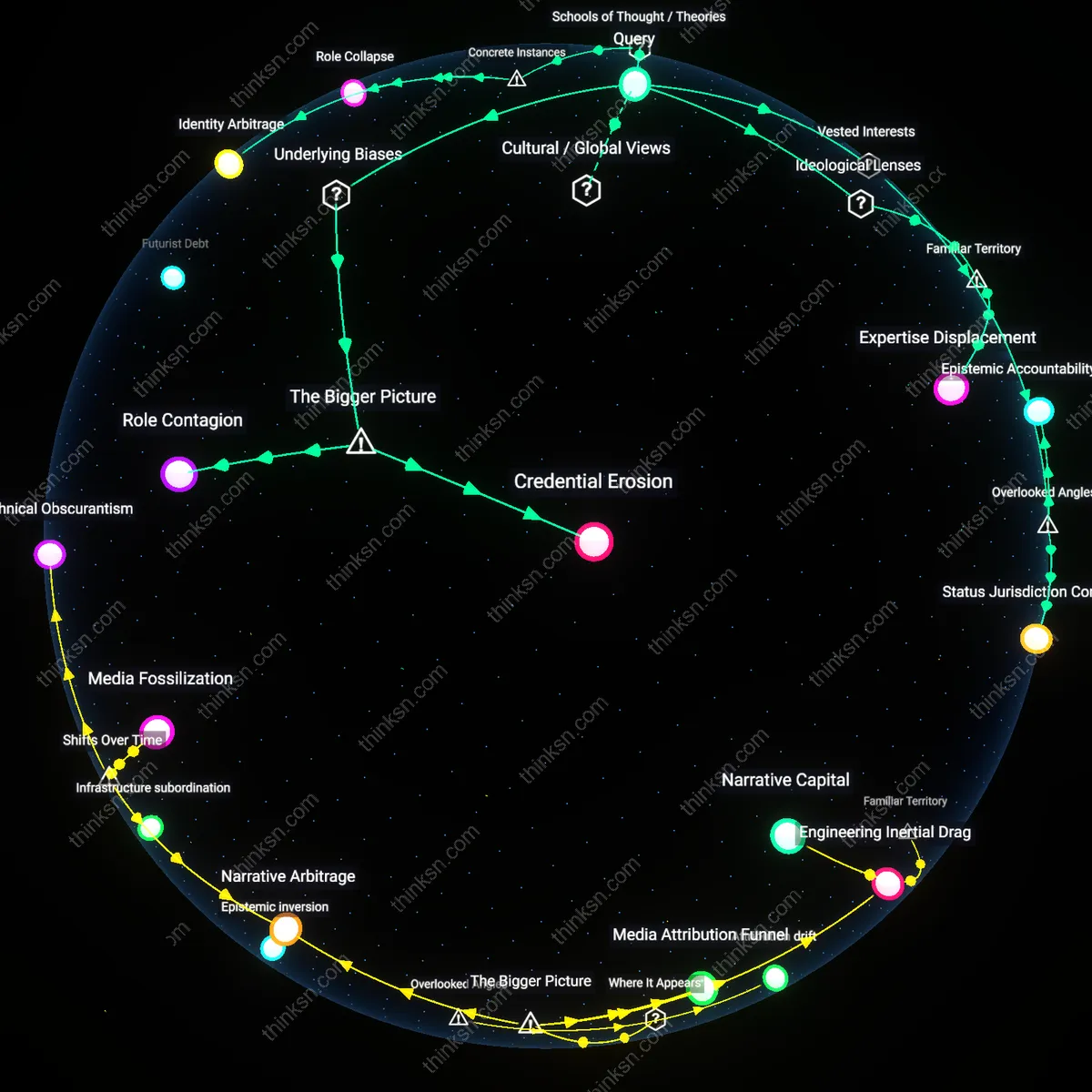
Analysis reveals 8 key thematic connections.
Key Findings
Expertise Anchoring
Shifting from a technical specialist to an entrepreneurial founder destabilizes professional identity because the founder’s legitimacy, once rooted in demonstrable mastery of a codified domain, must now be performed through speculative vision—exemplified by Elon Musk’s transition from physicist-engineer at NASA-affiliated projects to CEO of SpaceX, where his authority shifted from peer-validated credentials to risk-laden narrative construction around Mars colonization, revealing that technical credibility can become a liability when organizational survival depends on unverifiable future claims rather than past competence.
Identity Arbitrage
The move from technical specialization to entrepreneurial founding enables identity arbitrage, as seen in the case of Arlan Hamilton of Backstage Capital, who leveraged her marginalized position as a Black, female, formerly homeless individual with no prior venture experience to reframe lack of traditional expertise as an epistemic advantage in identifying undervalued founders, thereby transforming perceived deficits in technical legitimacy into a market niche through narrative inversion—where her outsider status became the core of her entrepreneurial brand, illustrating that identity itself can be a deployable asset when expertise is decentered.
Role Collapse
In the early days of GitHub, co-founder Tom Preston-Werner transitioned from a recognized maintainer of open-source developer tools to a CEO navigating investor demands and team scaling, only to be removed after cultural missteps—demonstrating that founding often induces role collapse, where the behavioral norms validating technical excellence (e.g., blunt code critique, autonomy) directly conflict with those required for organizational leadership (e.g., consensus, emotional intelligence), and in this case revealing that the very traits that confer authority in technical communities can destabilize governance structures when identity fails to adapt beyond competence.
Expertise Displacement
Shifting from technical specialist to entrepreneurial founder displaces expertise as identity because capitalist market logic supersedes epistemic authority. In liberal innovation economies like Silicon Valley, founders must convert specialized knowledge into scalable value propositions, subordinating technical mastery to investor expectations, user growth metrics, and product-market fit. This transition reframes competence not as command over a domain but as alignment with market incentives, rendering the specialist’s identity contingent on adaptation rather than depth—an underappreciated erosion that feels like professional invisibility despite external success.
Credential Erosion
Shifting from a technical specialist to an entrepreneurial founder diminishes the professional’s reliance on formally recognized expertise, weakening their access to credential-based authority networks. Technical specialists derive status and gatekept opportunities from verifiable competencies certified by institutions or peer communities, but founders operate in evaluative environments—such as venture capital markets—where success is measured by traction, narrative coherence, and investor confidence rather than technical mastery. This shift undermines the salience of prior expertise not because it is irrelevant, but because the entrepreneurial ecosystem redistributes legitimacy through financial and social capital flows centered on scalable growth rather than rigorous domain knowledge. The non-obvious consequence is that technical credibility becomes performative rather than probative, serving as backdrop for storytelling rather than a decision-making anchor.
Role Contagion
Adopting the founder role transforms professional identity by overwriting specialized cognitive habits with generalized executive pressures, fundamentally altering how decisions are made and justified. Technical specialists are trained to minimize error within bounded domains, but founders must make high-stakes decisions under uncertainty, privileging speed and adaptability over precision—a cognitive mode propagated by the venture-backed startup environment where survival depends on rapid iteration and investor signaling. This transformation is not a personal evolution but a systemic capture of identity by the logics of startup capitalism, wherein the founder becomes a conduit for external expectations rather than an autonomous practitioner. The underappreciated mechanism is that role-based identity in entrepreneurship is contagious, spreading from funding structures and governance models into the self-conception of individuals regardless of background.
Epistemic Accountability Debt
Shifting from technical specialist to entrepreneurial founder induces epistemic accountability debt, where the founder accumulates unrecognized obligations to justify knowledge claims across domains they no longer master. Unlike technical roles governed by peer-reviewed precision and disciplinary standards, founders face investors, regulators, and media who demand authoritative answers on engineering, finance, and ethics without requiring actual expertise—pressuring them to perform omniscience. This dynamic is rarely acknowledged in identity transition narratives, which emphasize empowerment rather than the concealed strain of maintaining credibility across collapsing knowledge boundaries. The residual concept reveals how institutional audiences collectively erode epistemic integrity not through malice, but through routine questioning rituals that reward confidence over competence.
Status Jurisdiction Conflict
Professional identity fractures during the specialist-to-founder shift not due to loss of skill, but because status jurisdiction conflict emerges when peer communities—such as academic institutions or engineering associations—withdraw legitimacy from those who abandon narrow technical contribution for entrepreneurial breadth. These groups enforce identity boundaries by privileging citation counts, peer validation, and methodological rigor over market traction or scalability, rendering the founder ‘competent but not one of us’—a liminal figure without standing in either world. This conflict is overlooked because most analyses assume identity follows function, when in reality, professional belonging depends on ongoing ritual affirmation from gatekeeping networks that rarely recognize hybrid roles. The loss of defined expertise thus becomes socially enforced, not self-imposed.