Quick Tweets or Fact-Checked News? The Journalists Dilemma
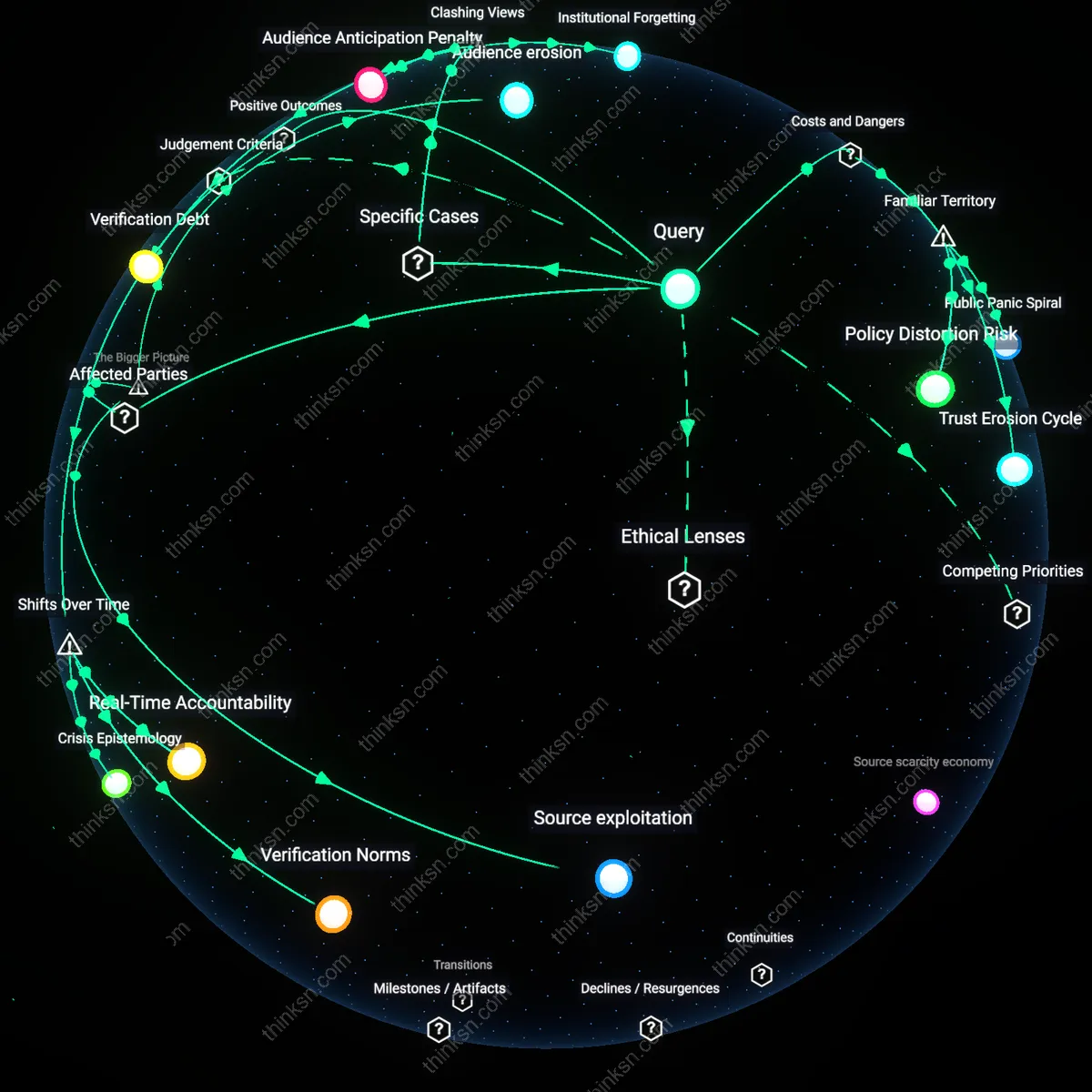
Analysis reveals 12 key thematic connections.
Key Findings
Audience erosion
Rapid dissemination of unverified reports degrades public trust in news institutions, particularly among demographics that rely on digital platforms for real-time updates. As audiences encounter frequent retractions or corrections following rushed coverage, they recalibrate their expectations downward, treating all breaking news as potentially suspect—especially in politically polarized environments like the United States, where media credibility is already contested. This dynamic undermines the institutional legitimacy of journalism as a truth-seeking practice, not because of isolated errors but due to systemic incentives favoring speed over verification in competitive digital news cycles driven by algorithmic visibility and engagement metrics. The erosion is non-obvious because it accumulates incrementally, masking long-term damage behind short-term traffic gains.
Source exploitation
State and non-state actors, including disinformation campaigns originating from entities like Russian troll farms or domestic political operatives, exploit journalistic urgency by seeding plausible but false narratives during chaotic breaking events. These actors understand that the pressure to publish quickly creates a vulnerability in newsrooms—especially during crises such as mass shootings or elections—where reporters may prioritize official-sounding statements or social media content without full authentication. The mechanism operates through the asymmetry between verification time and dissemination speed, allowing bad-faith actors to weaponize journalistic norms against themselves. What’s underappreciated is that the ethical breach isn’t just internal to journalism; it’s externally engineered, turning reporters into unwitting vectors of manipulation.
Editorial deferral
Newsroom decision-making increasingly shifts verification responsibility downstream to individual reporters under deadline pressure, reducing collective editorial oversight in moments when it is most needed. In legacy organizations like regional newspapers adapting to 24/7 digital publishing, this deferral reflects both staffing cuts and a structural reliance on freelancers or junior staff who lack institutional support to challenge sourcing assumptions. The systemic condition enabling this is the economic precarity of modern journalism, where budget constraints hollow out mid-level editorial functions that once served as factual gatekeepers. This dynamic is non-obvious because the ethical failure appears individual—e.g., a reporter citing an unconfirmed tweet—but actually stems from organizational decay masked as operational agility.
Verification Norms
The professionalization of journalism in the early 20th century institutionalized verification as a response to the sensationalism of yellow journalism, embedding fact-checking protocols into newsroom workflows to prioritize credibility over speed. This shift—exemplified by the rise of metropolitan dailies under editors like Adolph Ochs at *The New York Times*—treated accuracy not merely as ethical caution but as a competitive advantage in gaining public trust, thereby creating a durable norm that redefined journalistic authority. The underappreciated insight is that this norm emerged less from abstract ethics than from market differentiation in an era of information chaos, anchoring legitimacy in procedural discipline rather than moral assertion.
Real-Time Accountability
The 24-hour news cycle and digital publishing platforms since the 1990s have transformed the tension between speed and accuracy into a dynamic of continuous correction, where early reports are now expected to evolve transparently through updates, corrections, and crowd-sourced verification. This shift—from treating news as fixed dispatch to iterative refinement—has repurposed speed not as a threat to truth but as a scaffold for public accountability, as seen in live-blogged events like the Boston Marathon bombing coverage, where journalists now operate under constant scrutiny from both audiences and social media. What is underappreciated is that this temporal pressure has not degraded standards but reorganized them around openness and process, fostering a new public ethic of provisional transparency.
Crisis Epistemology
The post-9/11 era recalibrated journalistic responsibility during breaking events by aligning news verification with national security concerns, where erroneous reporting could trigger panic, policy overreach, or military escalation, compelling media to collaborate more closely with official sources and adopt delay-prone verification filters even at the cost of being second to publish. This transition, visible in the cautious tone of network anchors during terrorist attacks or election crises, revealed that ethical tension now functions as a societal risk-management mechanism rather than just a professional guideline. The underappreciated reality is that journalistic restraint in real-time reporting has become a form of epistemic triage—suppressing plausible but unverified information to protect collective stability.
Public Panic Spiral
Racing to break news before factual verification entrenches misinformation in public discourse, particularly during crises like terrorist attacks or pandemics, where initial reports are amplified by social media and cable news networks. This dynamic overwhelms official correction mechanisms, as seen in the 2013 Boston Marathon bombing coverage, when false identification of suspects spread uncontrollably, leading to public harassment and diverted law enforcement resources. The non-obvious cost is not just reputational harm to media outlets, but the structural vulnerability of democratic information ecosystems to self-reinforcing fear cycles triggered by unverified reporting.
Trust Erosion Cycle
Prioritizing speed over accuracy systematically degrades audience trust in journalism as an institution, particularly when corrections are issued quietly compared to the initial sensational headlines, as routinely observed in 24-hour digital news cycles like those of major wire services or broadcast affiliates. This creates a feedback loop where diminished credibility incentivizes outlets to chase even more dramatic scoops to retain attention, further compromising editorial rigor. The underappreciated danger is that this cycle mimics the very disinformation tactics it seeks to expose, hollowing out journalism’s normative role in democratic accountability.
Policy Distortion Risk
When unverified reports from influential outlets inform real-time decision-making by government actors—such as military, public health, or financial regulators—false narratives can trigger irreversible actions, as occurred during early coronavirus reports that inaccurately cited transmission rates and mortality, influencing lockdown timing and economic interventions. These decisions are often made under pressure with incomplete data, making them especially vulnerable to media-driven assumptions presented as facts. The rarely acknowledged systemic cost is that journalism, even unintentionally, becomes a de facto policy actor without oversight, checks, or corrective mechanisms aligned with governance standards.
Verification Debt
Speed in breaking news creates a deferred ethical obligation to correct inaccuracies, exemplified by CNN's 2017 false report linking Trump aides to Russian hackers, which spread widely before retraction; the mechanism lies in competitive newsroom incentives that prioritize attribution and exclusivity over internal skepticism, revealing an underappreciated accounting logic in journalism where factual errors are treated as liabilities amortized over time rather than immediate failures—this challenges the intuitive view that misinformation is a breakdown in ethics by showing it as a systemic byproduct of real-time reporting economies.
Audience Anticipation Penalty
News organizations like The Associated Press face greater reputational damage for delayed verified reports than for rapid errors because social media audiences punish absence more than inaccuracy, as seen during the 2022 Buffalo shooting when independent livestreamers filled the information vacuum with unverified claims; the dynamic operates through algorithmic visibility systems that reward speed regardless of truth, flipping the dominant narrative that journalists fail audiences by spreading lies—the deeper ethical tension is that verification becomes a form of public disengagement, penalizing rigor as if it were negligence.
Institutional Forgetting
Major outlets such as The New York Times rarely revisit or audit their high-speed factual errors in breaking news cycles, as with the initial misidentification of suspects in the Boston Marathon bombing, because corporate memory systems are optimized for new production, not retrospective accountability; this functions through editorial workflows that treat stories as disposable commodities post-publication, challenging the prevailing assumption that journalistic ethics are maintained through individual vigilance—instead, it exposes a structural amnesia where the organization learns nothing from its own mistakes, normalizing recurrence.