When Diverse News Sources Backfire and Breed Bias?
Analysis reveals 11 key thematic connections.
Key Findings
Attention Economy Inflection
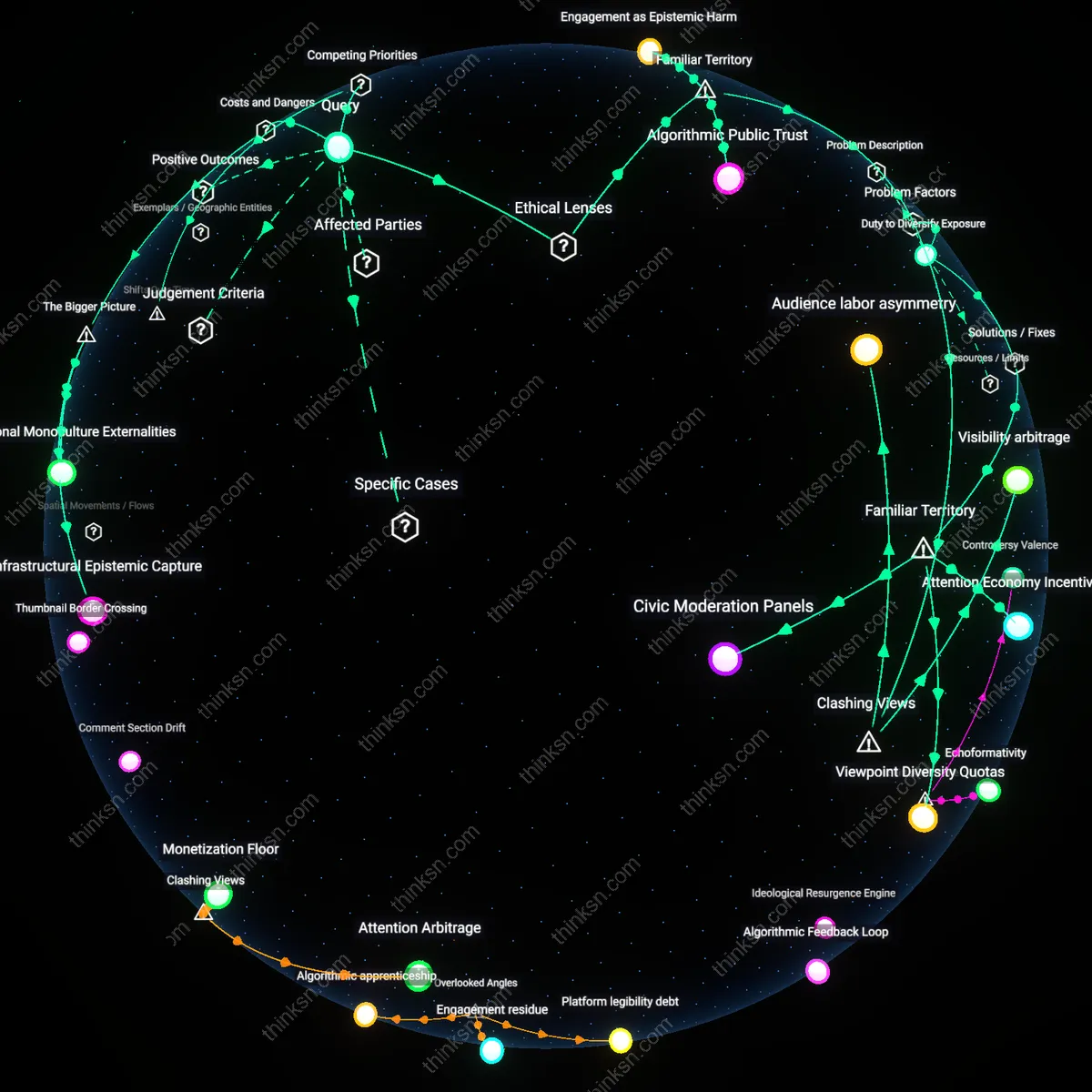
Diversifying news sources begins reinforcing confirmation bias when algorithmic platforms optimize for engagement rather than epistemic diversity, shifting users from active information seeking to passive exposure within ideologically self-reinforcing networks. This occurs not because users deliberately avoid dissenting views, but because recommendation engines on dominant platforms like YouTube and Facebook repurpose plural inputs into behavioral micro-targeting loops that amplify emotionally resonant, identity-aligned content—regardless of source origin. The non-obvious mechanism is that source diversity becomes a feature exploited by engagement systems to increase affective polarization, making ideological segregation more efficient precisely when informational inputs appear most varied.
Institutional Legitimacy Tipping Point
Diversification reinforces confirmation bias when legacy media institutions lose monopolistic control over narrative authority and are displaced by decentralized producers who treat factual claims as negotiable assets in political contestation. This transformation, accelerated by events like the 2016 U.S. election and Brexit, does not originate in public ignorance but in the strategic delegitimization of gatekeeping functions by partisan actors who reframe consensus journalism as elite collusion. The dissonant finding is that increased source variety improves belief accuracy only when audiences trust a central interpretive community; once that trust fractures, diversification enables belief shopping, where exposure to more outlets licenses cherry-picking under the guise of critical inquiry.
Attentional Triage Regime
Diversifying news sources began reinforcing confirmation bias when algorithmic personalization shifted from indexing user behavior to shaping it during the mid-2010s, as platforms like Facebook and Google News prioritized engagement metrics over source diversity. This mechanism operates through users encountering structurally diverse outlets—left, right, independent—that nonetheless conform to their behavioral profiles, creating the illusion of balance while reinforcing latent preferences. The shift marks a departure from pre-2010 information environments where source diversity directly increased exposure variance; the non-obvious consequence is that more sources now mediate attention through predictive modeling rather than user intent, institutionalizing selective exposure at scale.
Epistemic Debt Accumulation
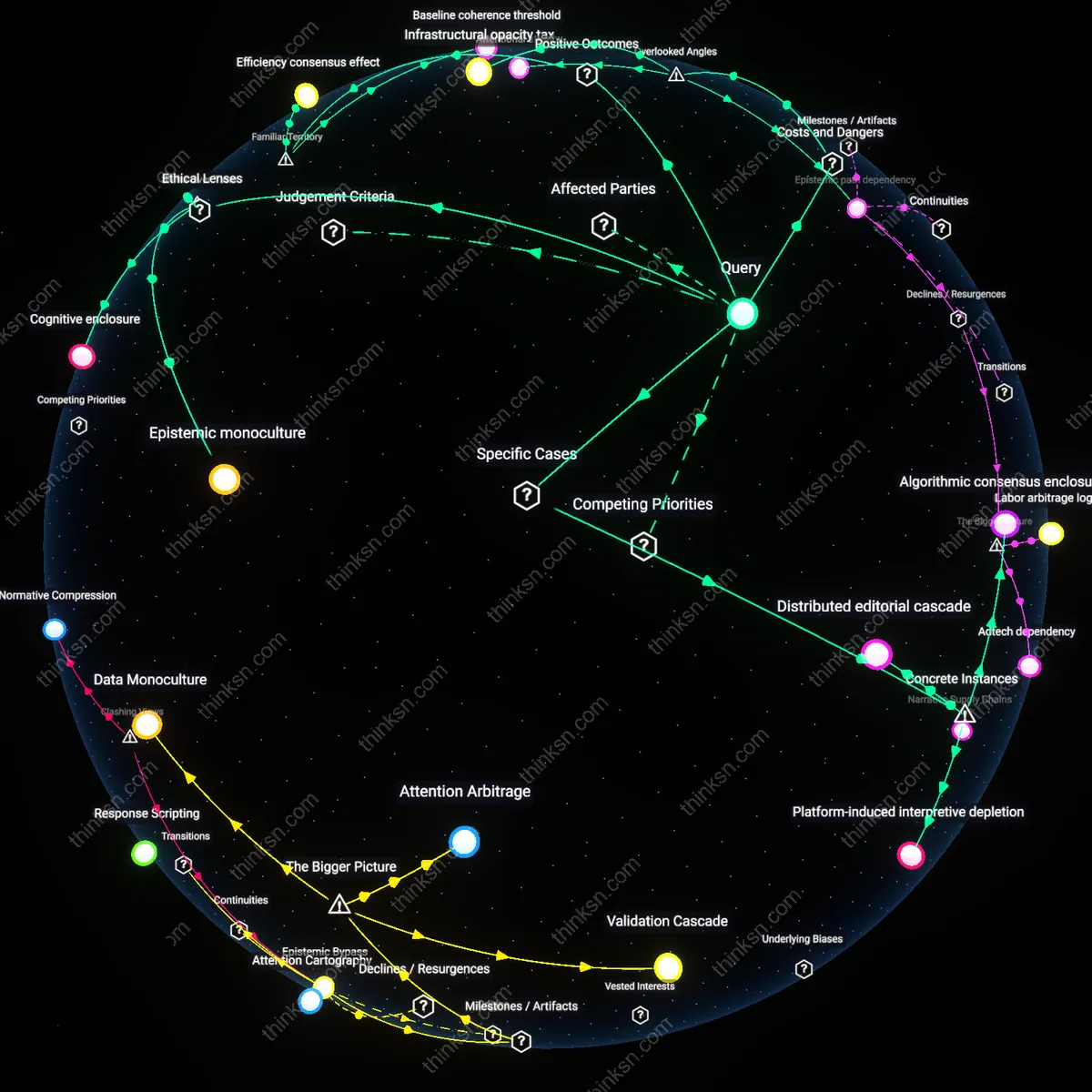
Belief accuracy began declining with source diversification after the post-2008 expansion of partisan think tanks and digital advocacy outlets reconfigured the epistemic infrastructure of U.S. political reporting. In this system, each new 'credible' source adds interpretive frameworks rather than verifiable facts, causing individuals to accumulate unresolved contradictions across otherwise plausible narratives—especially on issues like economic policy or climate change. The shift from scarcity to oversupply of expert-appearing voices meant that diversification ceased to resolve uncertainty and instead required ever-greater cognitive labor to reconcile, resulting in reliance on identity-congruent heuristics; this temporal transition reveals how pluralism in sourcing can erode epistemic coherence when institutional gatekeeping weakens.
Platformized Epistemology
Confirmation bias became entrenched through diversified news consumption when smartphone-native media environments after 2016 decoupled source credibility from content experience, replacing editorial lineage with virality-driven interface design. In this mechanism, users encounter content through algorithmically curated feeds (e.g. Apple News, Twitter/X) where the provenance of an article is secondary to its emotional resonance, causing the cognitive appraisal of truth to depend on real-time reinforcement rather than cross-source verification. The historical pivot from web browsers organizing information by domain to apps organizing by engagement reveals a new epistemology—one where diversification is platform-managed and thus structurally incentivized to maximize belief volatility, not accuracy.
Selective Exposure Threshold
In the 2016 U.S. presidential election, voters who consumed news from both Fox News and Breitbart—ideologically adjacent but formally diverse outlets—showed no improvement in factual accuracy compared to single-source users, because both sources amplified overlapping narratives about Clinton’s corruption; this illustrates that diversification fails when choice is constrained within an epistemic niche that pre-selects for affective alignment, revealing that cognitive diversity depends not on source count but on the ideological variance of the media ecosystem individuals sample from.
Cognitive Load Divergence
During the 2013 Boston Marathon bombing, users on Reddit who cross-referenced local news, official police updates, and social media still misidentified suspects because the volume of conflicting reports triggered pattern-matching heuristics rather than critical synthesis, showing that excessive source diversity under time pressure activates premature closure as a coping mechanism, thereby converting information plurality into confirmation bias under stress-induced processing limits.
Platformized Epistemic Drift
In the Philippines under the Duterte administration, citizens who accessed both traditional newspapers like the Philippine Daily Inquirer and social media influencers supportive of the drug war increasingly justified extrajudicial killings, not due to lack of source variety but because Facebook’s algorithmic architecture framed all content within emotionally charged, moral-purity narratives that recoded factual disagreement as disloyalty, demonstrating that platform-mediated diversification can erode epistemic criteria themselves when affective identity supplants truth judgments.
Echo Chamber Saturation
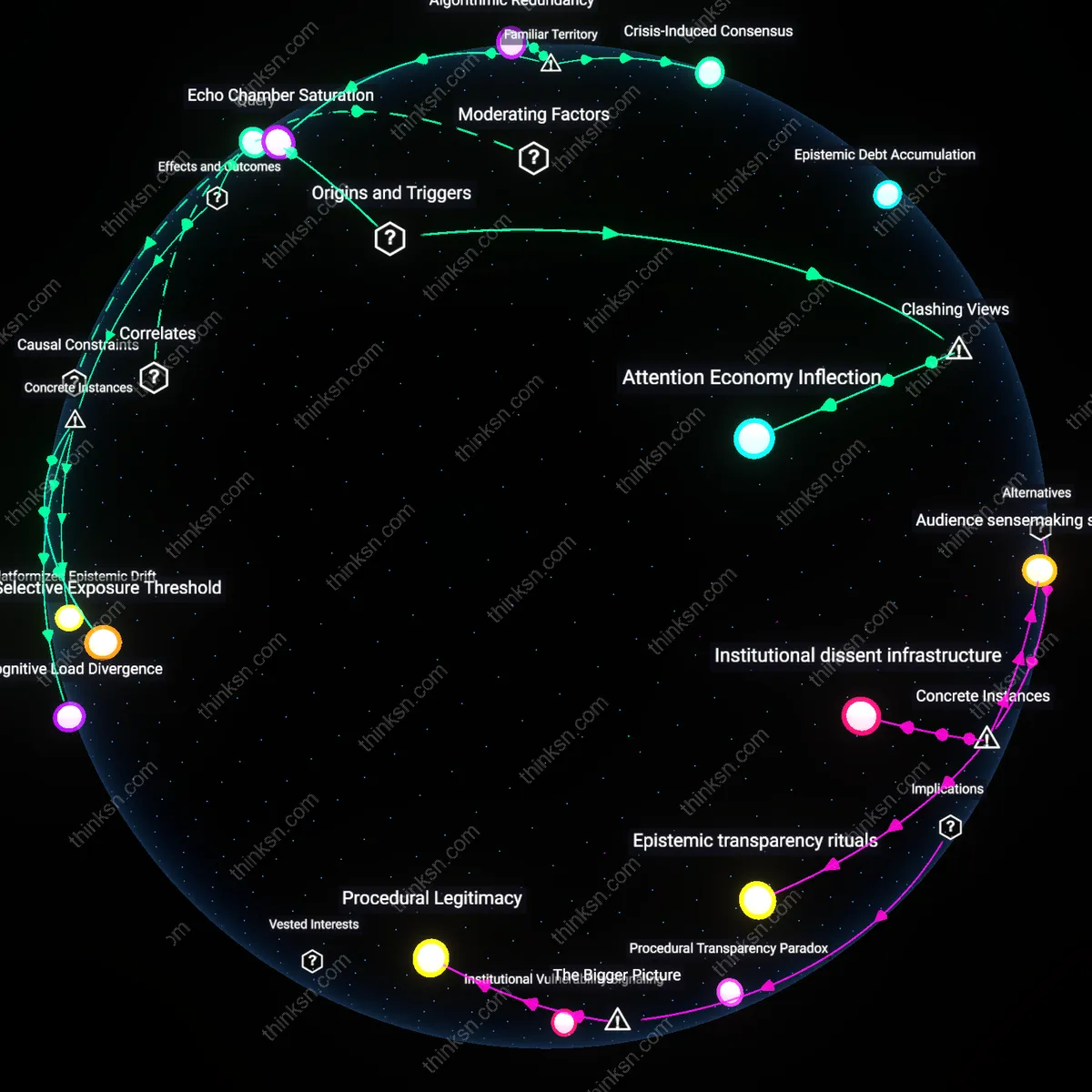
Consuming news from ideologically aligned outlets like Fox News and Breitbart alongside 'centrist' sources such as CNN that still frame stories through a politically reactive lens creates an illusion of balance while maintaining a shared narrative baseline. This dynamic affects politically engaged conservatives who believe they are diversifying by cross-shopping within the right-leaning media ecosystem, not realizing that the boundaries of acceptable discourse have already been constrained by oppositional framing to progressive media. The non-obvious insight is that diversification only improves accuracy when sources challenge core assumptions, not when they simulate objectivity within a congenial worldview.
Algorithmic Redundancy
Social media users on platforms like Facebook experience diminishing returns from source diversity when recommendation algorithms prioritize engagement over epistemic diversity, leading to the same story being repackaged across outlets like The Daily Wire, NBC, and Yahoo News with divergent tones but convergent frames. This affects casual news consumers who encounter multiple headlines on the same event without realizing the underlying consensus is shaped by wire services like AP or algorithmic trending topics. The overlooked mechanism is that structural convergence in sourcing and platform incentives can negate the benefits of surface-level pluralism, making belief refinement impossible regardless of apparent variety.
Crisis-Induced Consensus
During national emergencies like the January 6th Capitol riot, even highly diverse media diets—including sources like MSNBC, Fox News, and The New York Times—reinforce similar narratives about threat and response due to real-time coordination among journalists, official sourcing, and social pressure to conform to civic norms. This affects politically skeptical audiences who consume varied outlets expecting disagreement but instead encounter uniformity that feels like confirmation of systemic bias. The underappreciated point is that belief polarization can increase not from divergence, but from the sudden collapse of media pluralism during high-salience events, where diversification stops at the edge of collective sense-making.