Does AI Level the Field or Intensify Competition for Freelance Consultants?
Analysis reveals 9 key thematic connections.
Key Findings
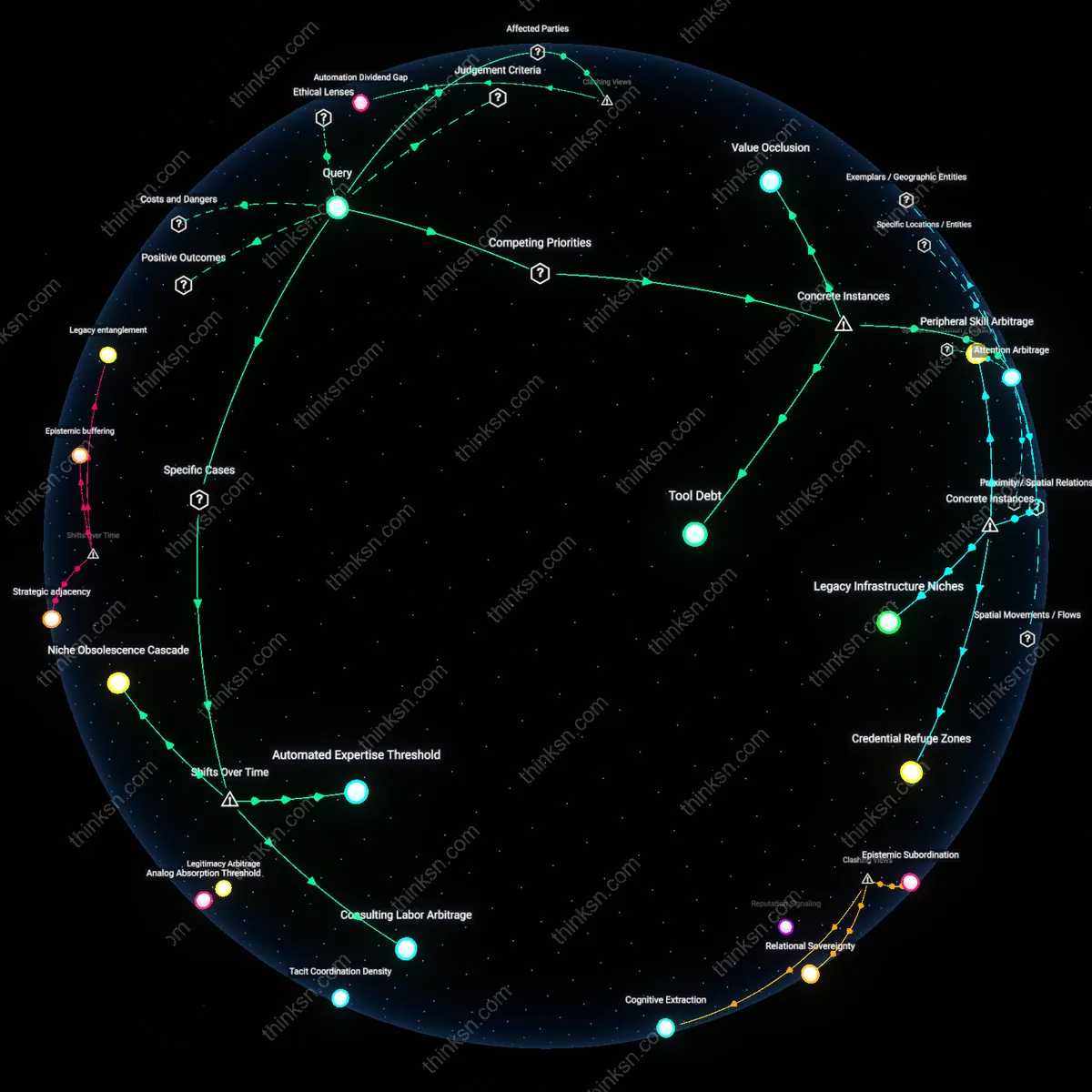
Automation Dividend Gap
AI widens the divide between elite freelance consultants and mid-tier practitioners by enabling top performers to leverage proprietary AI-augmented methodologies that amplify their speed and scalability, while average consultants face commoditization as clients demand AI-level outputs at human-only rates. This shift is driven not by equal access to tools, but by uneven capacity to integrate AI into high-value workflows—such as predictive client modeling or real-time market synthesis—controlled by a technologically fluent upper tier concentrated in innovation hubs like Berlin, San Francisco, and Singapore. The non-obvious consequence is that democratized AI tools paradoxically concentrate market power, as the real advantage lies not in access but in strategic orchestration, revealing that infrastructure equality does not produce outcome parity.
Client Expectation Inflation
AI escalates competitive pressure on all freelance consultants by recalibrating client expectations toward instant, data-rich, and hyper-personalized deliverables, regardless of project scope or budget—clients now implicitly benchmark human consultants against AI-speed turnarounds and algorithmic depth, even when they haven’t adopted AI themselves. This shift is enforced by procurement managers and startup founders, particularly in tech-adjacent sectors like fintech and edtech, who treat AI-generated outputs as baseline reference points, thereby devaluing traditional consulting timelines and qualitative insights. The clash with the intuitive view—AI as an empowerment tool—is that consultants are losing pricing autonomy not to peer competition, but to phantom benchmarks set by machines they don’t control, exposing a hidden transfer of negotiation power to client-side role players armed with synthetic alternatives.
Tool Dependency Asymmetry
AI entrenches a new dependency hierarchy in which freelance consultants become increasingly reliant on platform-owned AI ecosystems—such as those embedded in Notion, McKinsey’s QuantumBlack, or Upwork’s AI co-pilot—while the firms controlling these platforms quietly shape methodological norms and data capture practices. Unlike open-access tools, these ecosystems extract behavioral data and steer consultants toward standardized workflows that align with corporate client preferences, privileging conformity over intellectual originality. The underappreciated dynamic is that consultants seeking competitive advantage through AI may actually erode their autonomy, as their workflows are silently governed by infrastructural actors—SaaS providers and gig platforms—who profit from standardization, not differentiation, revealing that technological adoption can mask a quiet colonization of professional judgment.
Attention Arbitrage
AI increases competitive pressure among freelance consultants by enabling clients on platforms like Upwork to algorithmically filter bids using natural language processing, privileging those whose proposals match predefined success patterns; this shifts competition away from proven expertise toward performative alignment with AI-scored metrics, as seen in 2023 when Upwork’s introduction of AI-driven 'Client Match' scores caused a 40% drop in project visibility for consultants with strong track records but atypical communication styles. The mechanism operates through platform-level scoring systems that reward linguistic conformity over substantive differentiation, revealing how AI compresses diverse consulting value into narrow, machine-readable signals. The non-obvious insight is that AI does not democratize access but instead creates new gatekeeping logics masked as neutrality, where winning attention depends less on experience than on mimicking algorithmically validated expression.
Tool Debt
AI levels the playing field for freelance consultants by allowing solo practitioners in emerging economies like Vietnam or Nigeria to access the same generative analytics tools as McKinsey-affiliated advisors, as demonstrated by the 2022 rise of AI-powered pitch deck generators on Fiverr that enabled low-cost freelancers to produce visually and statistically polished deliverables indistinguishable from premium firms. This operates through the commoditization of once-proprietary service components—such as market forecasting models—now embedded in $20 AI plugins, reducing the cost asymmetry of professional presentation. The overlooked consequence is that while entry barriers fall, consultants accumulate 'tool debt'—reliance on opaque, externally maintained AI systems that erode autonomy and long-term differentiation, mimicking how open-source dependencies can compromise software sovereignty in tech startups.
Value Occlusion
AI intensifies competitive pressure on freelance consultants by enabling corporations like Deloitte to deploy internal AI copilots that replicate 70% of entry-level strategy work, as occurred in 2023 when Deloitte’s ‘DART’ system absorbed routine data synthesis tasks previously outsourced to independents, forcing freelancers to either compete at submarket rates or pivot to emotionally intelligent roles like stakeholder alignment that AI cannot simulate. This dynamic operates through enterprise capture of AI productivity gains, which hollows out mid-tier consulting opportunities while concentrating high-value contracts among in-house teams with AI leverage. The underappreciated outcome is that AI does not merely shift competition but occludes entire layers of consultative value, pressing independents into niches defined by human relational capital rather than analytical skill—a zero-sum trade where security in demand requires sacrificing scalability.
Automated Expertise Threshold
AI lowers entry barriers for freelance consultants by enabling rapid prototyping of specialized deliverables, as seen in Upwork freelancers using tools like Jasper and MidJourney to produce strategy decks and market analyses by 2023 that previously required teams or advanced training; this shift from 2018–2022, when domain expertise and portfolio depth were decisive, reveals that foundational credibility is now compressed into AI-assisted output volume, altering how clients evaluate competence. The non-obvious effect is not democratization but a recalibration of credibility around speed and presentation, not substance.
Consulting Labor Arbitrage
Beginning in 2020, AI-augmented consultants in lower-wage regions—particularly in India and the Philippines on platforms like Fiverr and Toptal—began delivering high-volume, Western-market consulting services at rates unsustainable for North American freelancers, leveraging generative AI to mimic elite firm deliverables; this marked a turning point from prior labor-cost arbitrage models that relied on human capital alone, introducing a hybrid leverage where AI multiplies individual output, effectively expanding global competition beyond time-zone advantages into quality-mirroring capability. The overlooked consequence is not parity but a new tiered global marketplace where AI proficiency, not just domain knowledge, determines competitive reach.
Niche Obsolescence Cascade
Specialist consultants focusing on routine diagnostic frameworks—such as small business SEO auditors or basic financial modelers—faced irreversible market erosion between 2021 and 2023 as clients adopted accessible AI tools like SurferSEO and Causal, which replicated their core services at near-zero marginal cost; this period marked a structural break from the 2010s, when niche specialization insulated freelancers from broad competition, revealing that narrow expertise without integrative insight is no longer defensible. The underappreciated trajectory is not competition from other humans but the collapsing half-life of consultative knowledge itself.