How Much Originality Does AI Cost Freelance Designers?
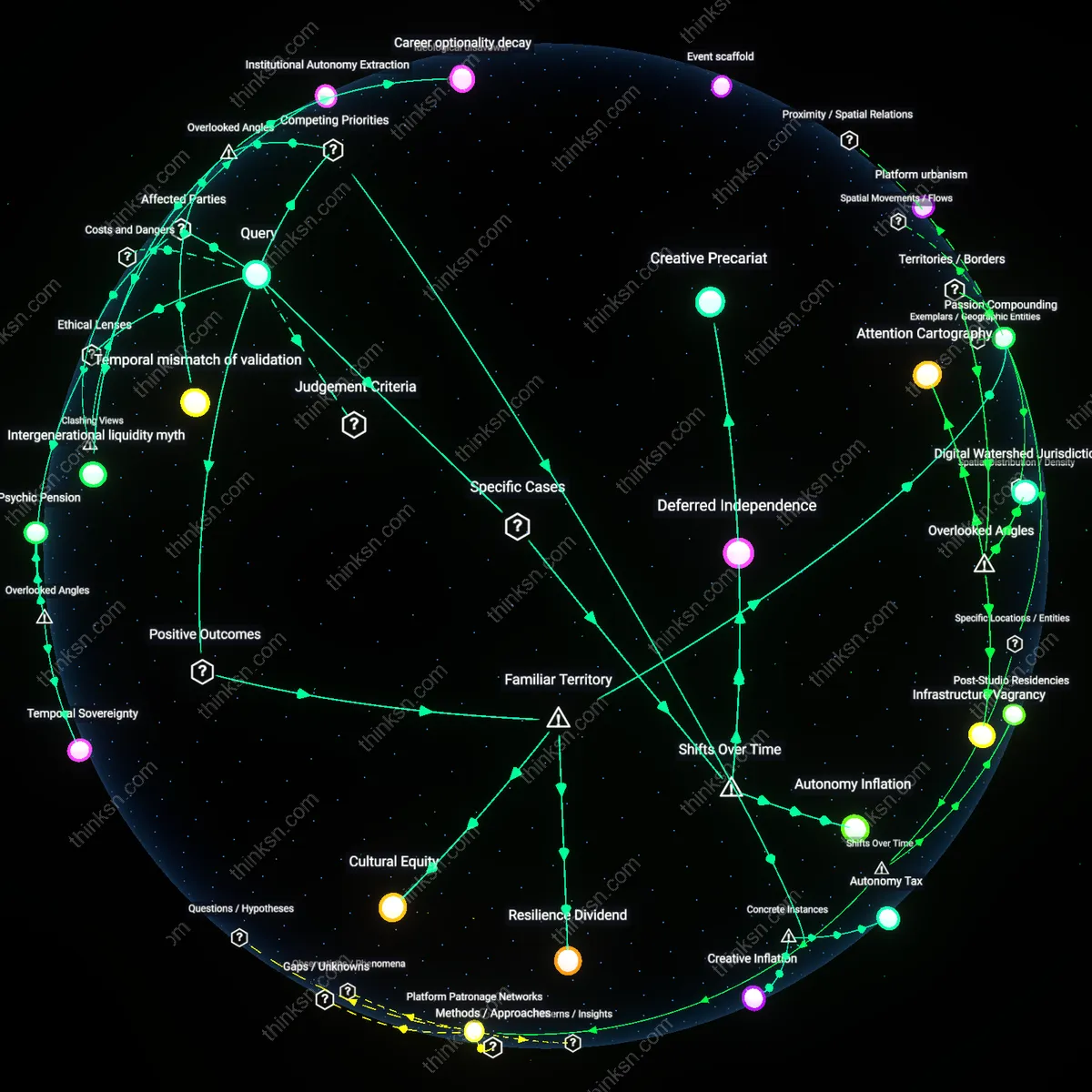
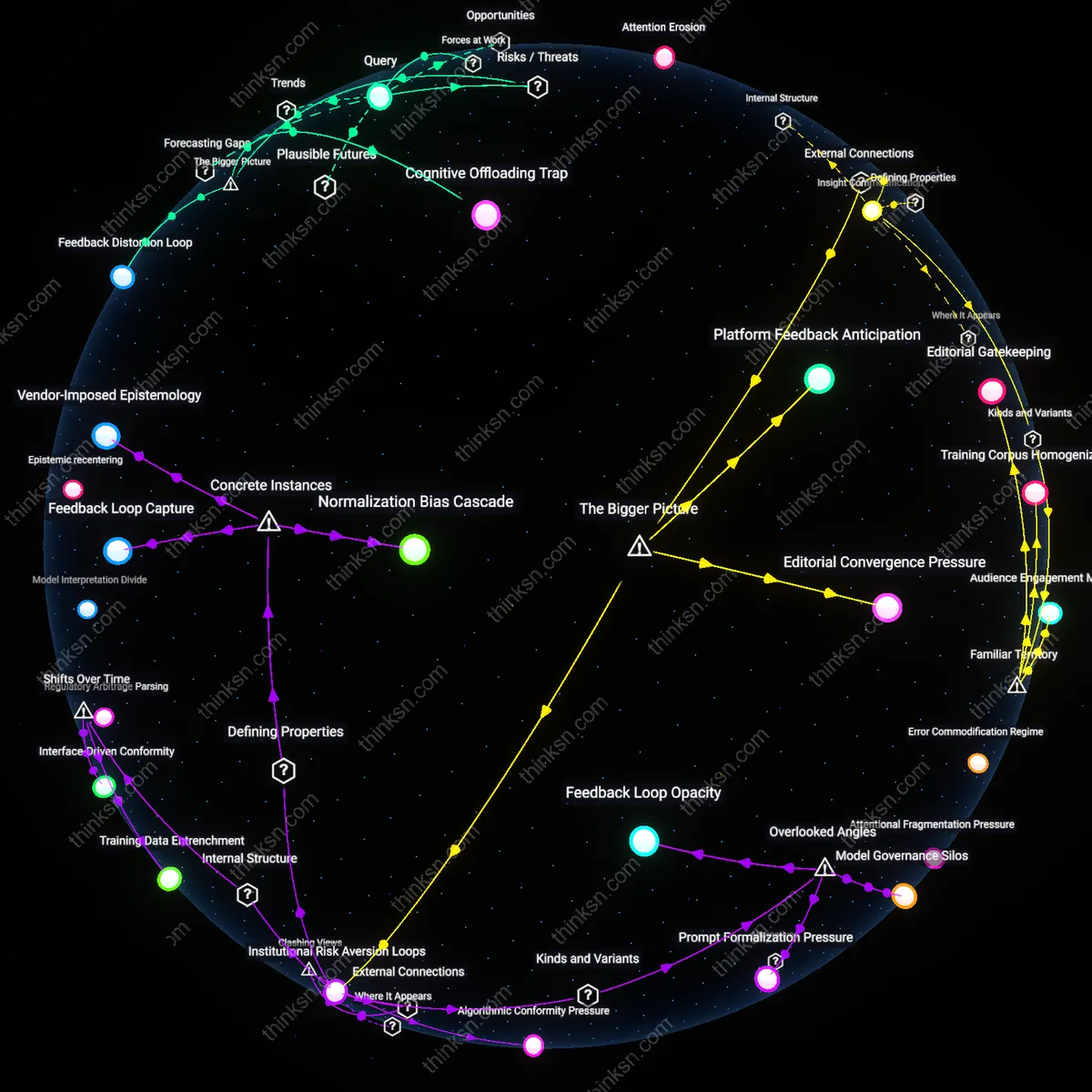
Analysis reveals 10 key thematic connections.
Key Findings
Creative Labor Divestment
Freelance graphic designers increasingly outsource initial ideation to AI, shifting their role from originators to editors, a transition accelerated by gig economy time pressures post-2015 that prioritize speed over authorship. This recalibrates creative responsibility from individual craft to algorithmic suggestion, where platforms like Figma and Canva embed generative tools that normalize pattern replication over invention. What is underappreciated is that this shift does not merely change workflow but erodes the designer’s developmental feedback loop—one that historically relied on iterative struggle to build aesthetic intuition—marking a quiet divestment from creative labor itself.
Pedagogical Displacement
Design education institutions from 2018 onward began emphasizing prompt engineering over foundational composition, responding to employer demands for AI fluency and altering how emerging designers perceive originality. As curricula recenter around manipulating generative systems rather than mastering principles of form, the historical lineage of visual innovation—from Bauhaus exercises to postmodern experimentation—becomes secondary to output optimization. The non-obvious consequence is that the very definition of artistic growth shifts from internal mastery to external system manipulation, producing a generation for whom originality is measured not by departure from canon but by alignment with latent space conventions.
Creative atrophy
Relying on AI-generated design suggestions degrades a freelance graphic designer’s capacity for original ideation by offloading cognitive and aesthetic labor to algorithmic systems optimized for statistical averages rather than artistic risk. Designers, operating under client-driven timelines and platform-based competition, increasingly adopt AI outputs as starting points, which systematically rewards convergence toward dominant visual trends embedded in training data—thus reducing exposure to personal creative friction essential for growth. This erosion is not incidental but structurally incentivized by freelance marketplaces like Fiverr or Upwork, where speed and client approval dominate success metrics, making AI integration a survival tactic rather than a reflective choice. The non-obvious consequence is that originality becomes maladaptive in practice, even when valued in theory, leading to unconscious creative atrophy.
Aesthetic deskilling
Integrating AI design tools into routine workflow undermines the tacit knowledge accumulated through iterative, manual experimentation, effectively deskilling designers in ways analogous to industrial automation eroding craft expertise. As freelance designers substitute exploratory sketching, type-pairing trials, or color experimentation with prompt-refinement and output selection, they bypass the embodied learning that arises from making nuanced, context-sensitive decisions under constraints. This shift is amplified by software ecosystems like Adobe’s Firefly integration, which embed AI directly into creative pipelines, normalizing rapid generation over reflective development. The result is not merely convenience but a systemic rewiring of creative practice, where diminished technical fluency constrains future originality—revealing aesthetic deskilling as a hidden cost of efficiency.
Feedback loop erosion
Outsourcing early-stage creativity to AI disrupts the dialectical feedback loop between effortful ideation and client response, weakening the designer’s ability to evolve a personal aesthetic language over time. When AI generates variants based on shallow prompts rather than the designer’s developing intuition, the designer loses access to the formative tension between intention, execution, and critique—which historically shaped artistic maturation in freelance careers. This erosion is exacerbated by data-rich platforms such as Dribbble and Behance, where AI-flattened portfolios generate engagement through visual familiarity, reinforcing homogenized styles and rewarding designers who prioritize algorithmic visibility over stylistic divergence. The underappreciated systemic consequence is that feedback loop erosion silently hollows out the evolutionary mechanism of artistic identity, substituting adaptation to machine logic for authentic creative growth.
Creative Liability
A freelance graphic designer must reject AI-generated suggestions outright to preserve authorial authenticity, as reliance on algorithmic inputs inherently violates deontological duties to creative integrity under Kantian ethics. The designer, operating within a legal-creative economy that recognizes original authorship through copyright doctrine, risks rendering their work a derivative product not of will but of machine logic, thereby undermining the moral right of the artist as autonomous agent. This refusal is significant not as resistance to efficiency but as an ethical safeguard against the erasure of authorship, revealing that the convenience of AI poses not just an aesthetic compromise but a categorical violation of artistic personhood.
Algorithmic Apprenticeship
Freelance designers should actively integrate AI-generated suggestions as a pedagogical tool, reinterpreting them not as creative substitutes but as dialectical provocations within a Hegelian master-bondsman framework of artistic development. In this dynamic, the designer engages AI not as a subordinate assistant but as an antagonistic counterpart whose limitations force the refinement of human judgment, taste, and innovation through synthetic friction. Far from diluting originality, this adversarial use of AI simulates the historical apprenticeship model—once enforced in guild systems—where growth emerges precisely through overcoming external constraints, exposing the overlooked truth that dependence can be a vector of emancipation.
Labor Fidelity
Designers must evaluate AI use through the lens of labor ethics rooted in syndicalist traditions, where the act of creation is inseparable from the embodied effort of the worker, making the outsourcing of ideation to AI a form of self-alienation equivalent to wage fragmentation under capitalist labor regimes. By accepting AI conveniences, freelancers unconsciously participate in a political economy that devalues creative labor by disaggregating the design process into disposable inputs, thereby weakening collective bargaining power and professional autonomy. This reframing reveals that the core conflict is not between originality and convenience but between sustaining a craft-based labor identity and surrendering to algorithmic deskilling.
Style Arbitrage
Freelancers can strategically deploy AI-generated designs not as creative substitutes but as market-aligned probes, as seen in the case of the Berlin-based studio Content Facility, which uses AI to rapidly simulate regional design tropes for global clients while reserving original composition for brand-critical assets, demonstrating how designers can exploit the gap between localized aesthetic expectations and scalable AI outputs to position themselves as curators rather than producers. The underappreciated insight is that AI’s homogenizing tendency becomes a resource when used to identify, then deliberately deviate from, culturally predictable patterns.
Feedback Distortion
Long-term artistic growth is preserved when designers impose a latency period between AI suggestion intake and client presentation, a practice observed in Singapore’s Substation Collective, where members delay AI-influenced drafts by 72 hours and require peer critique before revision, creating a circuit-breaker that forces reflective comparison between machine output and human intent. The significance lies in the disruption of real-time feedback loops, revealing that the greatest risk to creativity is not AI use itself but the immediate internalization of algorithmic aesthetics as normative.