Is Sacrificing Salary for Autonomy Worth the Retirement Risk?
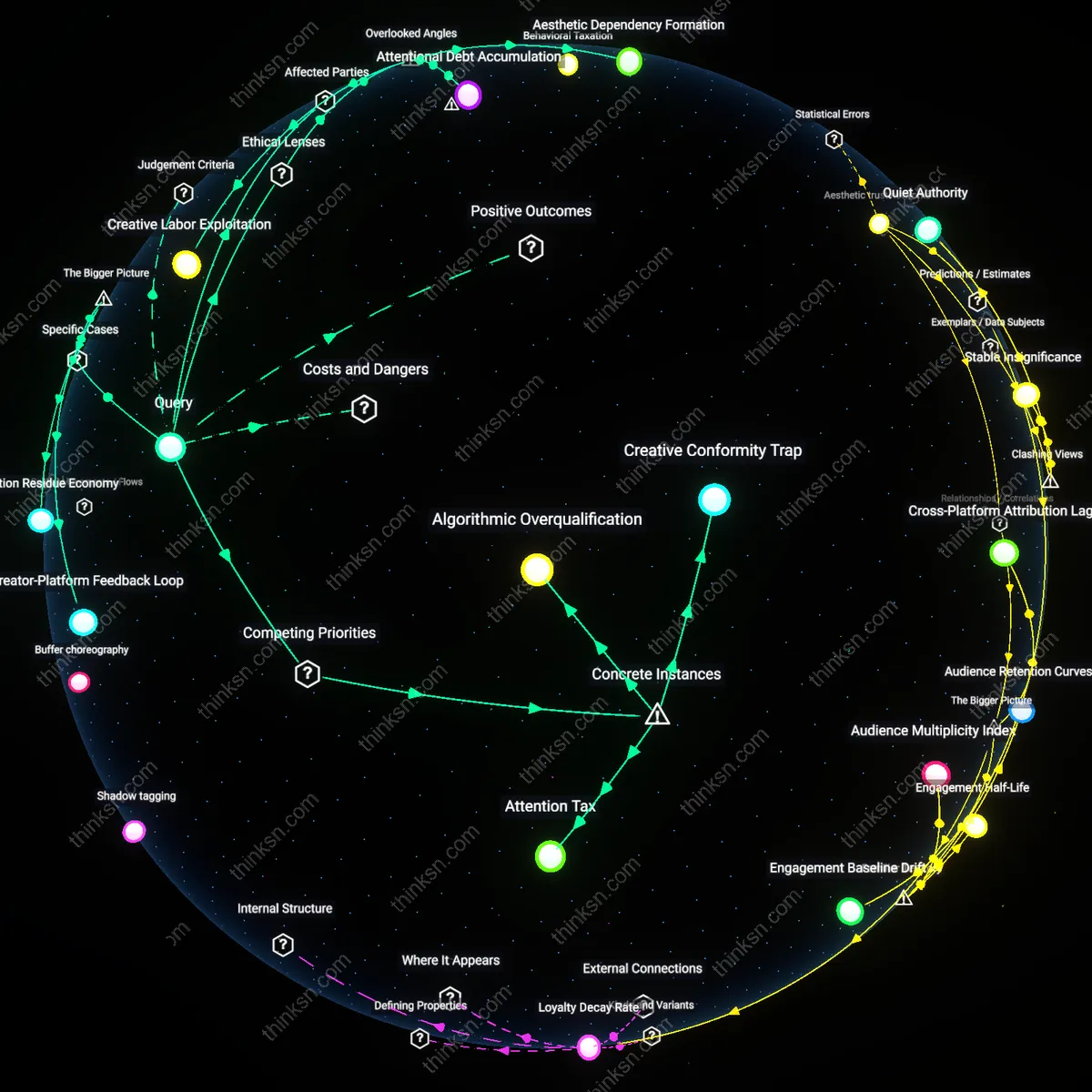
Analysis reveals 16 key thematic connections.
Key Findings
Creative Capital Liquidation
One should reject the premise that creative control has long-term value because platforms like Substack, Patreon, and Shopify commodify autonomy into monetizable personal infrastructure that erodes traditional retirement vehicles. Digital-native freelancers in media and design may earn 30–50% less than corporate peers, but they accumulate audience capital, algorithmic positioning, and direct consumer relationships that function as non-pensionable, high-liquidity assets outside ERISA-protected accounts. This reframes 'creative control' not as a trade-off against retirement but as a parallel wealth track governed by attention economies rather than actuarial logic. The dissonance lies in viewing retirement savings as the sole measure of long-term security when platform-mediated influence can outperform 401(k)s in both growth and access.
Institutional Autonomy Extraction
One should recognize that choosing creative control over salary reinforces extraction by venture-financed firms who reclassify labor costs as optionality, shifting the burden of future security onto individuals while capturing innovation externally. In Silicon Valley and Brooklyn, startups offer equity and open-ended roles to creatives not to empower them but to dissolve boundaries between work and self-investment, transforming retirement risk into a feature of 'passion-driven' employment. These institutions profit from deferring financial obligation under the guise of flexibility, using cultural capital as a wage substitute. The overlooked mechanism is not personal trade-off but systemic absorption of autonomy into scalable, low-liability business models that privatize gains and socialize long-term precarity.
Passion Compounding
Yes, because sustained creative autonomy amplifies intrinsic motivation, which in fields like design, writing, or technology, leads to higher-quality portfolio outputs and audience trust over decades; this compound effect—seen in independent creators on platforms like Substack or Patreon—transforms early income sacrifice into disproportionate long-term influence and monetization opportunities that salaries rarely provide. The underappreciated mechanism isn’t just freedom, but the accumulation of ownership over work products, which can generate passive income streams and legacy value absent in traditional employment, especially as digital distribution lowers barriers to market access.
Resilience Dividend
Yes, because individuals with creative control are more likely to persist through economic disruptions, as seen in freelance artists or indie developers who pivot quickly during industry shifts like streaming booms or AI adoption; their autonomy functions as adaptive capacity, allowing them to repackage skills without employer dependency. The overlooked aspect is that job stability increasingly resides not in corporate tenure but in portable creative authority—those who own their process survive recessions, automation, and obsolescence better than higher-paid but rigidly positioned peers.
Cultural Equity
Yes, because creative autonomy enables contributions to shared cultural narratives—such as indie filmmakers shaping regional identities or open-source programmers setting technical standards—which generate social cohesion and inspire future innovators; these impacts, though not captured in retirement accounts, constitute a form of intangible wealth that benefits communities and industries over generations. The underappreciated truth is that public discourse equates security with financial assets, yet culturally embedded creators often achieve lasting societal influence that translates into late-career opportunities, grants, and recognition that extend economic viability beyond typical retirement timelines.
Artistic Debt
Leaving a tenured professorship in film studies at USC to freelance as an independent documentary filmmaker, Cecilia Rubino traded a $120,000 salary and pension contributions for full editorial control over projects like *The Grab*, a decision materially shaping her retirement precarity through the deferral of institutional income stability; this exposes a dynamic where creative sovereignty accumulates not financial capital but narrative ownership, producing long-term economic risk that is the necessary counterpart to unmediated authorship, a trade rarely acknowledged in creative career advising.
Autonomy Tax
When software engineer Nadia Eghbal documented the economics of open-source maintainers in her 2020 research on GitHub, she revealed that developers who prioritized code autonomy over corporate employment—like those maintaining critical infrastructure such as Babel or Webpack—absorbed invisible labor costs that undermined long-term financial resilience, demonstrating how the absence of structured compensation systems converts technical stewardship into a personally subsidized public good, a burden invisible in standard salary comparisons but definitive in retirement outcomes.
Creative Inflation
In 1970s Detroit, techno-musicians like Juan Atkins rejected stable auto-industry apprenticeships not for immediate gain but to experiment freely with synthesizers in underground spaces like the Music Institute, where the collapse of industrial wages inadvertently subsidized sonic innovation; their lower lifetime earnings were recouped decades later only through cultural valuation, revealing that creative control functions as a deferred economic instrument, appreciating not in personal savings but in field-shaping influence that redefines what counts as valuable long after the financial loss has been incurred.
Career optionality decay
One should trade a lower salary for more autonomy only if the creative work builds transferable decision-making authority that compounds across domains, because sustained creative control in one field gradually erodes the capacity to gain similar control in unrelated future careers, particularly when geographic or network lock-in occurs around a niche identity. This dynamic is invisible in standard tradeoff analyses, which treat career mobility as linear and reversible, but in reality, deep specialization in autonomous creative roles often creates a hidden rigidity—artists, designers, or independent founders who reject corporate salary structures lose access to institutional career ladders that provide late-career re-entry points, thereby reducing long-term optionality. The overlooked mechanism is not the immediate income sacrifice but the decay in strategic flexibility that occurs when creative autonomy becomes a self-reinforcing identity trap.
Temporal mismatch of validation
Trading salary for autonomy is rational only when the individual anticipates that the social or emotional rewards of creative control will offset the psychological toll of deferred financial validation during retirement, because retirement savings are evaluated numerically decades later while creative fulfillment is consumed immediately and individually, creating a temporal mismatch in how these gains are experienced and assessed. Most analyses assume both salary and autonomy pay off on the same timeline, but cognitive science shows that people remember satisfaction in peaks and endings, not accumulation curves—thus, the rich narrative of creative agency may overshadow the quiet erosion of savings in autobiographical memory. This shifts the tradeoff from a fiscal calculation to a phenomenology of retrospective judgment, where the neglected variable is not money but the mismatch between when rewards are felt and when they are measured.
Intergenerational liquidity myth
One should not trade salary for autonomy if the expectation is that creative work will generate non-wage assets convertible to retirement security, because in practice such assets—like intellectual property, portfolios, or audience networks—rarely produce liquid intergenerational wealth and instead become symbolic heirlooms with minimal market conversion, particularly in non-scaled digital creative fields. Standard retirement planning assumes liquidity and transferability of accumulated value, but creative control often produces embedded, context-specific capital that cannot be cashed out or inherited as financial assets, unlike pension accruals or equity in traditional employment. The hidden dependency is on institutional liquidity infrastructures—brokerage systems, trust laws, pension frameworks—that treat financial capital as fungible but ignore the illiquidity of reputation-based or expressive assets, making the long-term sacrifice structurally irreversible.
Temporal Sovereignty
One should accept a lower salary for more creative control because it secures temporal sovereignty—the ability to govern the structure, rhythm, and alignment of one’s working hours with long-term cognitive and emotional sustainability, which retirement savings alone cannot restore. Most economic analyses treat time as a fungible resource to be monetized, but within virtue ethics, particularly Aristotle’s conception of eudaimonia, the quality and agency over one’s time constitute a non-transferable good essential to human flourishing. The overlooked dynamic is that retirement savings compensate for lost time but cannot resurrect the capacity to shape it; choosing autonomy now preserves a dimension of selfhood that deferred financial gains cannot later replicate, altering the standard tradeoff calculus by introducing an inalienable experiential asset.
Psychic Pension
One should accept reduced income for creative autonomy because it cultivates a psychic pension—a reservoir of identity coherence and existential continuity that mitigates the risk of post-retirement anomie, a phenomenon documented in Durkheimian sociology but excluded from financial planning ethics. In Marxist-humanist terms, alienated labor under high-salary regimes erodes the self to the point where accumulated savings fund an empty retirement devoid of purpose; autonomy preserves the worker’s species-being, ensuring that later life is inhabited rather than merely sustained. The overlooked insight is that financial security without existential coherence can exacerbate psychological decline, meaning creative control functions as deferred mental health insurance not captured in balance sheets.
Creative Precariat
Yes, one should trade a lower salary for creative control because the erosion of traditional media patronage models since the mid-2000s has forced artists into self-sustaining portfolio careers, as seen among independent podcast producers who left corporate radio for platforms like Patreon—individuals like Roman Mars of *99% Invisible* who leveraged autonomy to build a loyal audience; the shift from stable, long-term employment to project-based revenue reveals a new class of culturally influential but financially precarious workers who depend on reputation capital rather than retirement accounts, making autonomy a non-negotiable precondition for authenticity in a post-network era.
Deferred Independence
No, one should not trade salary for autonomy because the collapse of defined benefit pensions in the 1980s and their replacement with 401(k) plans redefined individual financial responsibility, exemplified by public school teachers in California who, after Proposition 13 (1978), faced shrinking funding and increasing reliance on personal savings—yet those who stayed in the system accumulated sufficient retirement security to later fund post-career creative work; this delayed model reveals that early-stage financial constraint under institutional frameworks can enable later autonomy, a temporally dislocated form of freedom often overlooked in narratives of immediate self-actualization.
Autonomy Inflation
Yes, one should trade current salary for creative control because the valorization of 'authentic' expression in digital economies since the 2010s has inflated the long-term market value of distinctive personal brands, as demonstrated by independent YouTubers like Marques Brownlee who sacrificed early corporate tech job offers to maintain editorial control, eventually monetizing influence at scale; the shift from linear career ladders to networked visibility loops means that perceived creative authenticity compounds over time, turning early autonomy into disproportionate future leverage that salary compensation alone cannot replicate.