Spousal Privacy vs State Law in Medical Travel Scandals?
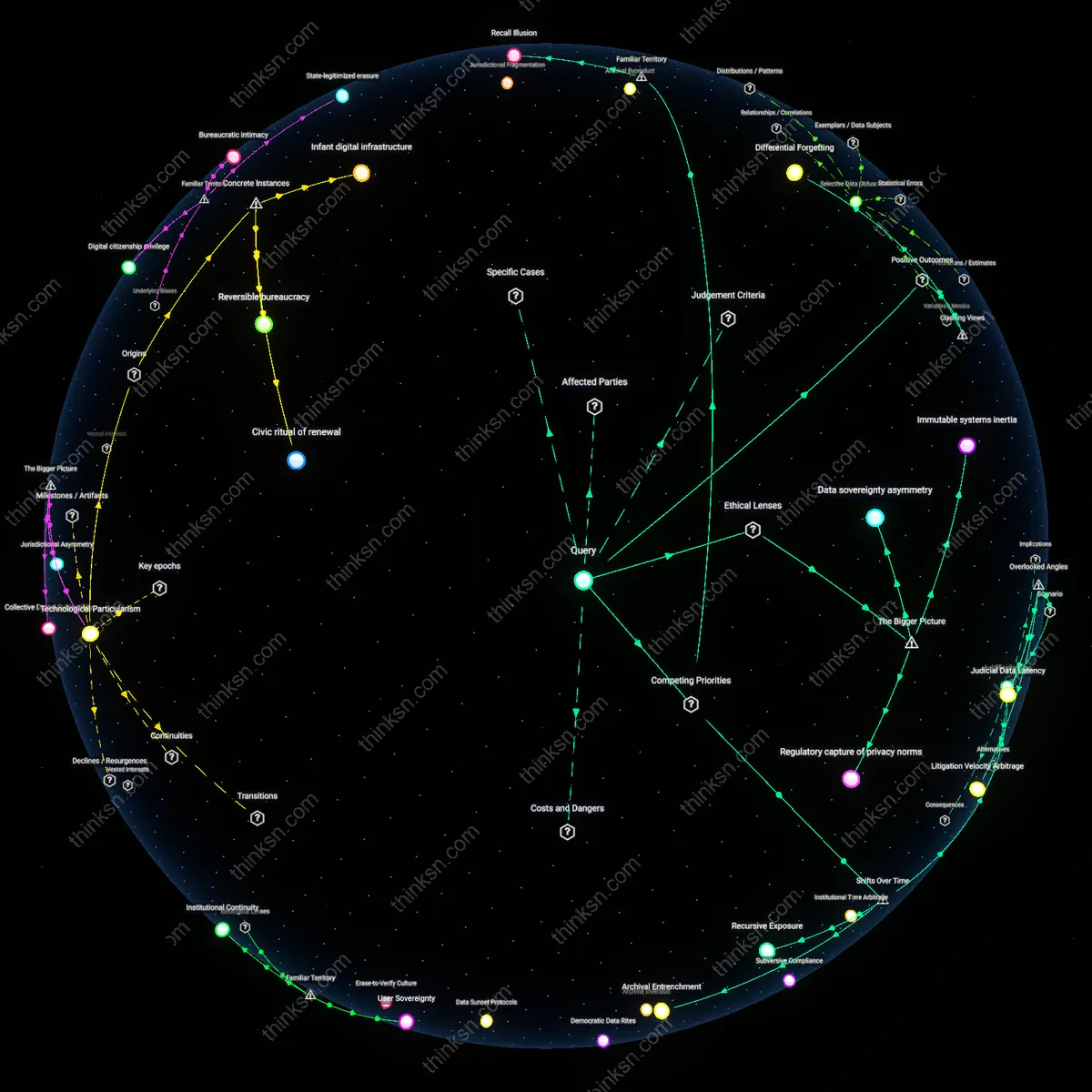
Analysis reveals 8 key thematic connections.
Key Findings
Normative override
The law enables state enforcement to suspend spousal privacy protections when assistance involves cross-border travel for medically prohibited procedures, as seen in jurisdictions criminalizing abortion aid, because state-defined public morality becomes a justificatory basis for overriding marital confidentiality; this mechanism operates through prosecutorial use of communication evidence between spouses, revealing how legal systems prioritize sovereign moral regulation over familial trust when reproductive acts are framed as public threats, a non-obvious shift from privacy as a default marital shield to privacy as a conditional privilege under contested bodily autonomy regimes.
Jurisdictional arbitrage
State enforcement selectively accommodates spousal privacy when travel for prohibited medical care exposes legal asymmetries between regions, such as U.S. state restrictions versus federally protected jurisdictions, because enforcement capacity collapses at geographic boundaries where assisting spouses exploit legal pluralism; this occurs through logistical gaps in tracking interstate movement and medical documentation, highlighting how federalist legal structures unintentionally enable evasion regimes where private marital conduct becomes a vector for circumventing centralized moral bans, a systemic consequence rarely acknowledged in privacy debates focused on surveillance rather than mobility.
Enforcement discretion
Prosecutorial agencies deprioritize spousal privacy violations in travel assistance cases not due to legal exemption but because resource allocation favors high-visibility enforcement over domestic complicity, as seen in low indictment rates for partners aiding abortion access; this pattern emerges from political risk calculus within state attorney offices balancing public backlash against moral legislation with practical limits on investigating intimate networks, exposing how enforcement boundaries are shaped less by statutory clarity than by bureaucratic feasibility and electoral accountability, a causal driver often obscured by legal formalism that treats laws as uniformly actionable.
Sacralized Coherence
In Iran, a husband’s facilitation of his wife’s travel for gender-affirming surgery is legally protected not because of individual privacy rights, but because Islamic jurisprudence frames such acts as fulfilling marital duty under divine law, where the state defers to familial unity when it aligns with religious rehabilitation. The mechanism rests on fatwas from the 1980s issued by Ayatollah Khomeini, which classified gender transition as permissible under sharia if medically verified, thereby transforming spousal assistance into a spiritually sanctioned act rather than a private choice. This reframing undercuts the Western assumption that state enforcement necessarily infringes on spousal autonomy, revealing instead a system where religious authorization enables state non-interference. The non-obvious insight is that privacy can be preserved not through liberal individualism but through doctrinal alignment with state-endorsed morality.
Enforced Complicity
In Poland, when a woman seeks abortion-related travel assistance from her partner under tightened anti-abortion laws post-2020, the state indirectly criminalizes spousal support by treating medical border-crossing as conspiracy, thereby converting intimate cooperation into prosecutable collusion. This operates through selective enforcement by local prosecutors who interpret the Penal Code’s ambiguity on aiding ‘unlawful termination’ to include logistical help, such as booking transportation or paying fees. The result is a legal environment where the state weaponizes marital intimacy against itself, challenging the liberal narrative that privacy and enforcement are in tension—here, the state actively erodes privacy by demanding spousal non-participation as proof of legal compliance. The overlooked reality is that enforcement does not merely intrude upon privacy but structurally redefines loyalty within marriage as a public legal duty.
Institutional Complicity Framework
In Idaho in 2022, when state law criminalized aiding minors in obtaining gender-affirming care, healthcare providers and family members faced legal exposure for facilitating out-of-state treatment, revealing how state enforcement reframes private familial support as institutional collusion; this shift enables the state to extend regulatory reach beyond its borders by redefining spousal or familial assistance as part of a broader prohibited network, thereby dissolving privacy protections under the guise of preventing systemic circumvention. The non-obvious mechanism here is not mere punishment of individuals but the retroactive classification of private caregiving as structured complicity, which licenses state intervention into domestic decision-making under the logic of disrupting illicit care infrastructures.
Jurisdictional Arbitrage Incentive
Following the 2022 overturn of Roe v. Wade, Texas prosecutors signaled intent to investigate women and their partners for out-of-state abortion travel, but airlines and credit card companies—based in states where abortion remains legal—continued enabling such trips, demonstrating how corporate actors exploit jurisdictional fragmentation to resist state encroachment on spousal privacy; these companies operate under conflicting legal regimes and prioritize commercial continuity over compliance with restrictive moral statutes, thereby creating de facto enforcement gaps. The underappreciated dynamic is that private-sector actors, not courts or privacy doctrines, become the material guarantors of transgressive mobility, turning financial and logistical systems into unacknowledged shields for intimate autonomy.
Moral Proxy Enforcement
In Poland, after the Constitutional Tribunal’s 2020 ruling effectively banned most abortions, the ruling Law and Justice party empowered citizen-led monitoring groups to report suspected abortions—including spousal assistance in travel—using public health data and social media, illustrating how the state delegates enforcement to ideologically aligned activists who weaponize domestic intimacy as evidence; this outsourcing shifts the burden of surveillance onto communities, transforming marital trust into a potential informant pipeline. The critical insight is that privacy erosion is not solely top-down but is amplified through grassroots moral policing, where the state achieves compliance without direct intrusion by sanctifying private betrayal as civic duty.