At What Point Does Corporate Funding Undermine Research Integrity?
Analysis reveals 11 key thematic connections.
Key Findings
Epistemic Capture
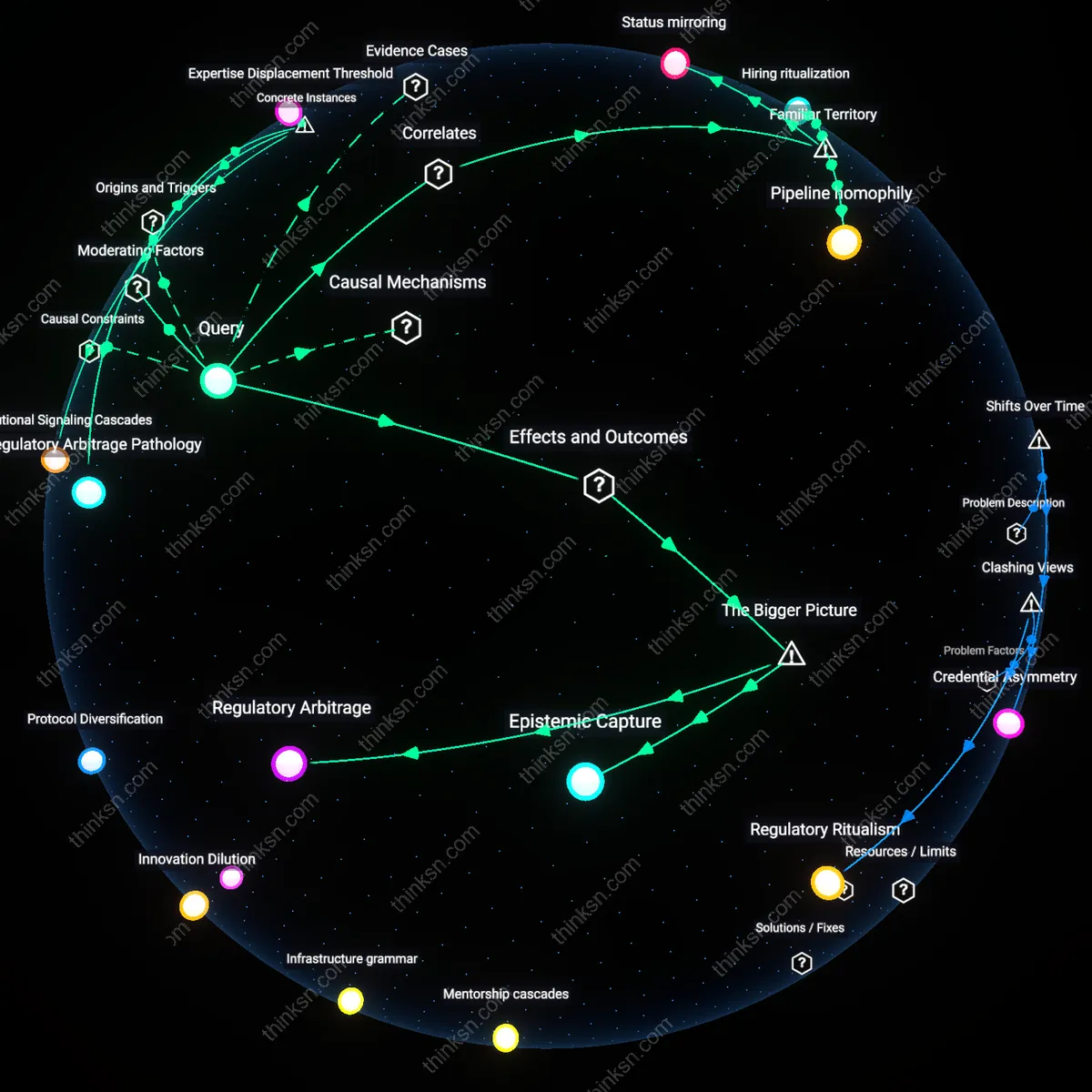
Corporate funding compromises academic credibility when researchers internalize the strategic priorities of sponsors as intellectual defaults, shifting what questions are deemed legitimate or urgent—such as pesticide manufacturers shaping agricultural scientists to focus on yield metrics over ecological resilience. This occurs not through coercion but through gradual alignment of grant-driven career incentives, peer networks, and publication pipelines with corporate R&D agendas, particularly within land-grant universities dependent on agribusiness partnerships. The non-obvious mechanism is not fraud but the silent foreclosure of alternative research paradigms, which undermines policy legitimacy by presenting commercially-aligned findings as scientifically inevitable rather than socially contested.
Regulatory Arbitrage
Credibility is compromised when corporate-funded research is instrumentalized to create evidentiary asymmetries that destabilize democratic policymaking, as seen when fossil fuel companies sponsor climate modeling that emphasizes uncertainty to delay emissions regulation. The key dynamic is the insertion of selective scientific outputs into rulemaking processes where agencies like the EPA must weigh 'credible science' but lack capacity to audit funding influences, allowing well-resourced actors to exploit procedural fairness to legitimize inaction. The underappreciated consequence is not mere bias but the transformation of academic research into a tactical resource in political strategy, where credibility becomes contestable not on scientific grounds but through systemic manipulation of evidentiary standards.
Institutional Dependence
Academic policy recommendations lose credibility when university research infrastructure becomes financially dependent on sustained corporate investment, such as pharmaceutical firms funding entire translational medicine departments with multi-year, unrestricted grants. This creates structural pressure to avoid findings that threaten sponsor interests—not necessarily through direct interference, but through leadership self-censorship and project filtering at the proposal stage, particularly in medical schools facing budget shortfalls. The overlooked dynamic is how financial interdependence alters organizational risk calculus, where reputational harm from contradicting a funder is weighed against public health implications, effectively blending academic judgment with institutional survival logic.
Market-Aligned Research Prioritization
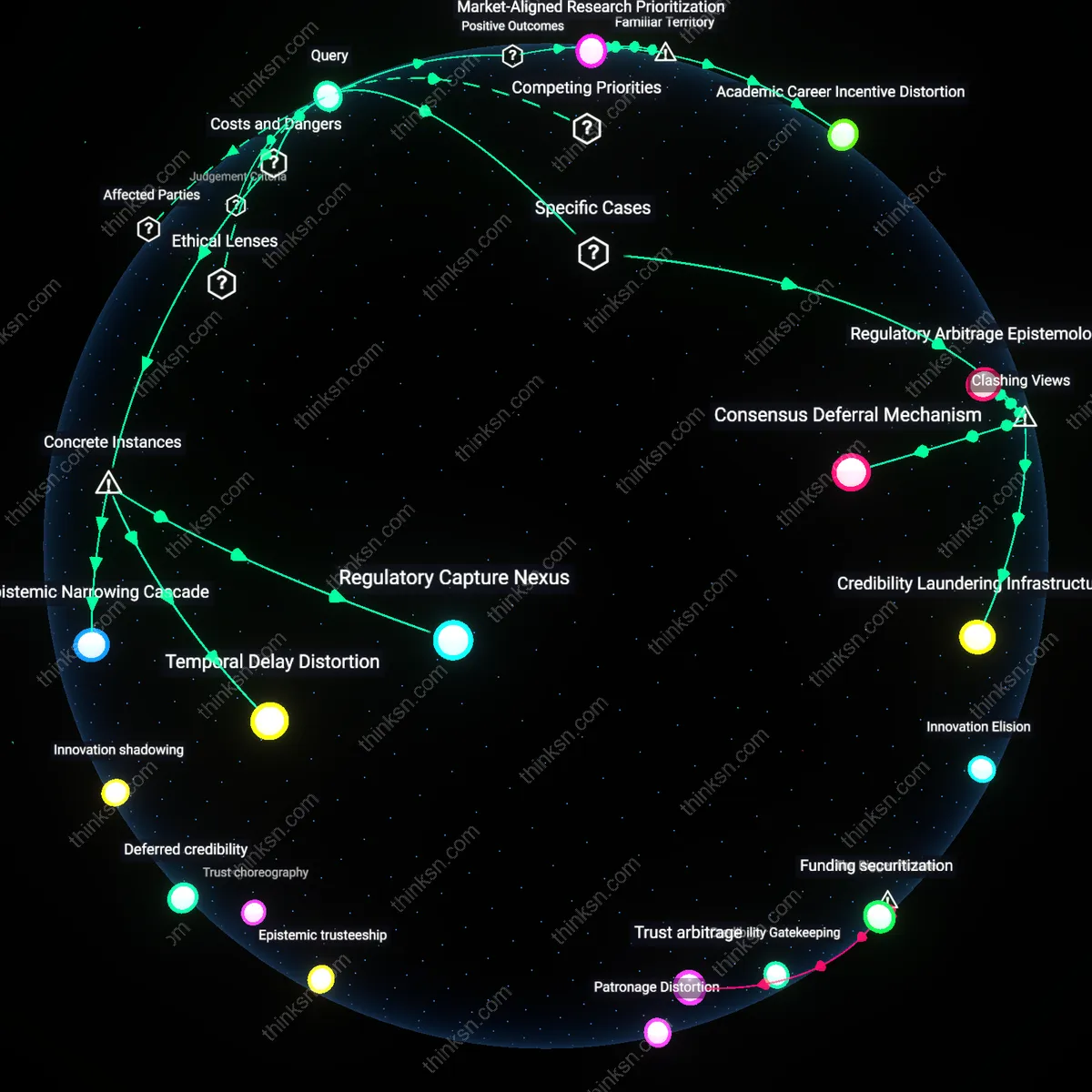
Corporate funding compromises academic credibility when it steers entire research agendas toward commercially viable questions, such as pharmaceutical companies sponsoring only late-stage clinical trials for patentable drugs rather than foundational public health studies. This shift occurs through grant allocation power, where firms selectively fund projects with clear paths to monetization, thereby marginalizing inquiries into preventative care or non-drug interventions. The underappreciated effect under familiar concerns about bias is not falsified results but the invisible curation of which topics get studied at all—shaping policy recommendations to reflect market-compatible solutions even when they are not the most effective.
Academic Career Incentive Distortion
Corporate funding becomes credibility-compromising when success in academia—tenure, lab expansion, prestige—depends on securing industry grants, leading scholars to preemptively align their findings with sponsor expectations, as observed in food science departments historically funded by major beverage companies. This functions through departmental economics and promotion criteria that reward funding volume over critical independence, creating soft pressure to avoid conclusions that might jeopardize future sponsorship. What’s overlooked in common narratives of overt manipulation is how self-censorship emerges structurally, not from directives but from the slow professional calculus of long-term career sustainability.
Regulatory Capture Nexus
Corporate funding compromises academic credibility when researchers depend on industry sponsors to access critical real-world data, as seen in the collaboration between Harvard School of Public Health and the food industry-funded International Life Sciences Institute (ILSI) in shaping dietary guidelines; this dependency created a de facto alignment between academic outputs and industry interests, where the very infrastructure of evidence collection was controlled by entities with vested policy outcomes, undermining impartiality in ways that are structurally invisible but operationally decisive.
Temporal Delay Distortion
Academic policy recommendations lose credibility when corporate funders influence the timing and release of research, exemplified by ExxonMobil’s funding of climate research in the 1980s that confirmed global warming but delayed publication while the company lobbied against emissions regulation; this manipulation of temporal dynamics—producing valid science while suppressing its policy relevance—reveals how funding relationships can weaponize academic legitimacy against urgent public interest without falsifying data.
Epistemic Narrowing Cascade
Credibility is compromised when corporate funding systematically eliminates entire domains of inquiry from academic agendas, as occurred with tobacco industry grants to university-based smoking-and-health research programs in the 1960s, which emphasized individual biochemical responses while excluding social and behavioral studies that might implicate advertising or product design; this subtle shaping of what questions are deemed legitimate constrains policy options not through overt falsification, but by erasing pathways to structural regulation from the outset.
Regulatory Arbitrage Epistemology
Corporate funding compromises policy credibility when researchers design studies to preempt regulation by producing methodologically sound but contextually narrow results that appear independent while systematically excluding real-world usage patterns; this is visible in tobacco industry–sponsored nicotine metabolism studies at Queen Mary University of London, where findings were tailored to challenge public health models of addiction without contradicting pharmacological consensus, revealing how scientific rigor can be weaponized to simulate debate. The non-obvious mechanism is not bias in data collection but the strategic confinement of research scope to generate technically valid knowledge that nonetheless misleads policy by omission—framing regulatory concerns as scientifically unresolved when they are in fact outside the study’s intentional boundaries.
Credibility Laundering Infrastructure
Policy credibility is compromised not when corporate-funded research is falsified, but when it is validated through third-party academic institutions that repackage industry-generated findings as neutral scholarship; this occurred prominently in the Harvard T.H. Chan School of Public Health’s collaboration with Coca-Cola to establish the Global Energy Balance Network, where scientifically accurate statements about exercise and metabolism were used to shift public health focus away from sugar consumption, thereby rehabilitating corporate image under scholarly cover. The dissonance lies in the fact that no fraud was necessary—the epistemic corruption occurs in the selection of research questions and partners, exposing how elite universities function as conduits for credibility laundering rather than checks on influence.
Consensus Deferral Mechanism
Corporate funding distorts policy recommendations when it supports research that promotes incrementalism under the guise of scientific caution, as seen in ExxonMobil’s decades-long sponsorship of climate modeling at Stanford’s Precourt Institute, where work on carbon capture efficiency and methane leakage rates produced legitimate data but consistently deferred systemic interventions by framing emissions reduction as technologically premature. This challenges the common notion that compromised science must involve suppression or distortion—instead, it reveals how funding can preserve corporate prerogatives by reinforcing a culture of 'more research needed,' turning academic prudence into a structural delay tactic that neutralizes urgent policy action.