Do Medical Degrees Really Boost Research Performance?
Analysis reveals 9 key thematic connections.
Key Findings
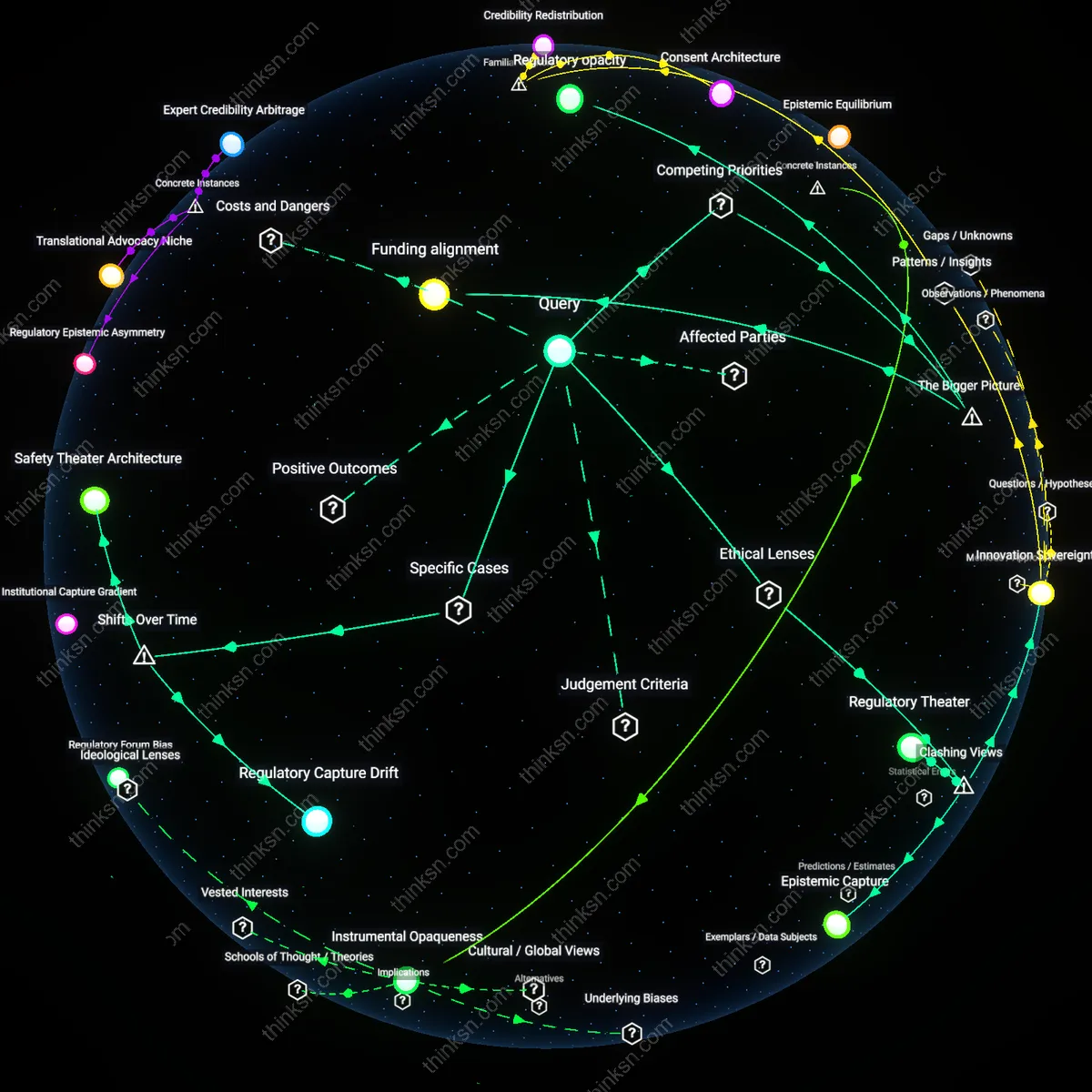
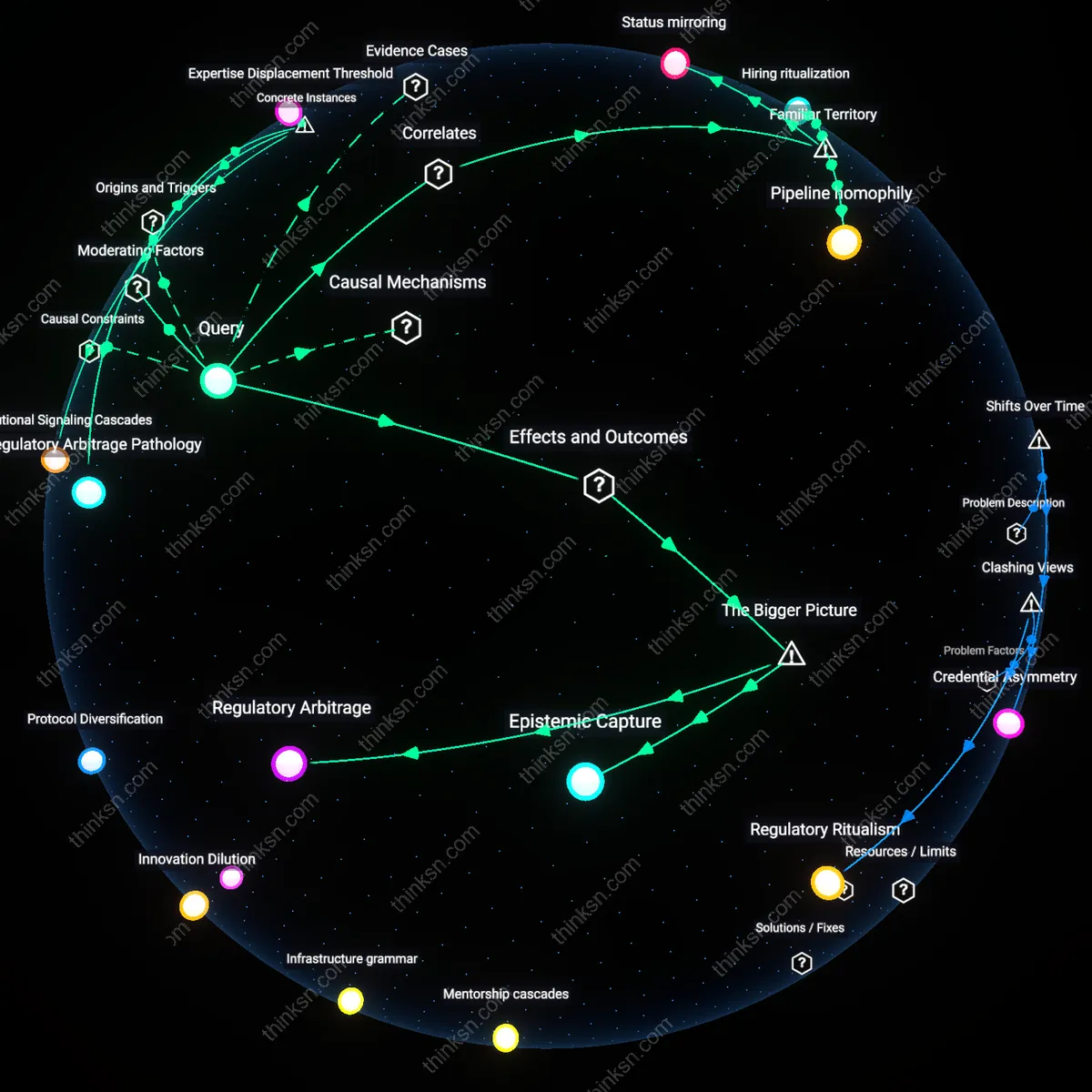
Regulatory Arbitrage
Requiring medical degrees for research roles triggers regulatory arbitrage by incentivizing institutions to exploit credential mismatches, where hiring physicians signals compliance with perceived oversight standards without improving methodological rigor, enabling organizations to substitute credential validation for performance accountability within federally funded research ecosystems.
Epistemic Capture
Mandating medical degrees in non-clinical research entrenches epistemic capture by privileging clinical paradigms over interdisciplinary inquiry, leading research agendas to conform to medically framed questions while marginalizing data scientists and social researchers, a shift enforced by grant review panels dominated by physician-scientists who equate training with expertise regardless of project fit.
Credential Lock-in
The institutional preference for medical-degree holders in research creates credential lock-in by raising entry barriers that deter talent from non-medical STEM fields, reinforcing a self-sustaining cycle where funding bodies and universities treat the MD as a proxy for research competence, even in basic science domains where clinical training offers no operational advantage, thereby distorting labor supply dynamics.
Regulatory Arbitrage Pathology
Mandatory medical degrees for clinical trial leadership in the UK National Health Service amplified credential inflation by redirecting research authority to physicians regardless of methodological expertise, privileging licensure over statistical rigor, as seen when non-MD epidemiologists were excluded from principal investigator roles in the 2010s despite leading study design; this reveals how gatekeeping embedded in professional regulation can detach qualifications from operational competence, producing a systemic preference for hierarchical legitimacy rather than research efficacy.
Institutional Signaling Cascades
When the Indian Council of Medical Research mandated MD qualifications for grant applicants in the early 2000s, it triggered a proliferation of physician-affiliated but methodologically weak studies, as newly credentialized teams prioritized credential-compliant authorship over epistemic robustness, exemplified by the 2013 Delhi Tuberculosis cohort study where physician-led groups misapplied statistical models due to limited epidemiological training; this illustrates how credential mandates can induce signaling conformity that degrades scientific quality under the guise of professional standardization.
Expertise Displacement Threshold
In the U.S. FDA’s pre-2000 drug approval divisions, requiring MDs for senior review roles systematically displaced PhD pharmacologists from leadership despite their superior modeling skills, as demonstrated in the 1998 Vioxx review where cardiovascular risk models were overridden by clinically trained but quantitatively underprepared physicians, leading to delayed safety signals; this case exposes a tipping point where credential-based role allocation disrupts domain-specific expertise, turning regulatory caution into performative compliance.
Hiring ritualization
Requiring a medical degree for research roles functions primarily as a procedural safeguard rather than a performance necessity, reinforcing administrative uniformity across academic hospitals in the U.S. Northeast. This practice persists because grant committees and institutional review boards implicitly equate clinical training with methodological rigor, even when the research involves population genetics or device development with no patient-facing component. The non-obvious consequence is that the credential becomes a gatekeeping artifact maintained by bureaucratic consensus, not scientific validation—what feels like quality control is often just pattern-matching to familiar professional archetypes.
Status mirroring
Research institutions model their hiring standards on elite medical centers like Johns Hopkins or Mayo Clinic, where physician-scientist leadership creates a cultural expectation that all credible investigators hold M.D. degrees. This imitation spreads through academic rankings and faculty promotion benchmarks, causing mid-tier universities to adopt identical requirements despite lacking translational clinical infrastructure. The overlooked dynamic is that prestige attribution substitutes for performance calibration—organizations replicate the trappings of excellence without verifying whether the credential itself contributes to productivity, thereby inflating its symbolic value independent of outcome.
Pipeline homophily
Recruitment panels dominated by physician-researchers systematically favor candidates with medical training because shared educational experience reduces perceived interpersonal risk during collaboration. This preference manifests in peer-reviewed grant evaluations where non-M.D. applicants are rated lower on 'clinical insight'—a criterion often undefined but weighted heavily in selection. The underappreciated effect is that credential inflation arises not from formal policy but from affinity-based judgment cloaked in technical legitimacy, turning the medical degree into a social compatibility signal rather than a competence indicator.