Report Discrimination or Preserve Funding? A Senior Researchers Dilemma
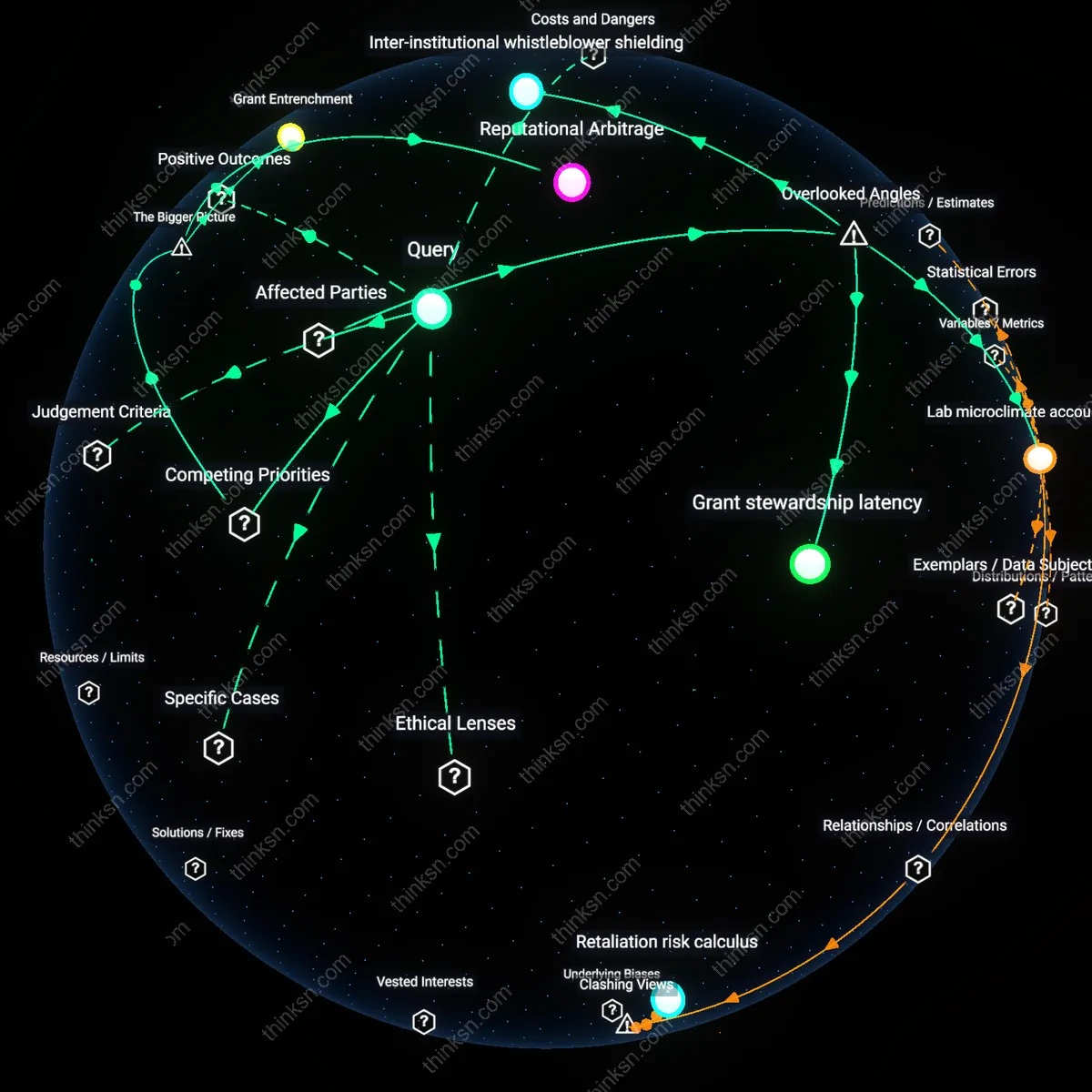
Analysis reveals 6 key thematic connections.
Key Findings
Grant stewardship latency
A senior academic can preserve research funding while reporting discrimination by strategically timing disclosures through the lag between project milestones and grant evaluations, leveraging the inertia in bureaucratic oversight cycles. Program officers and oversight committees rarely audit interpersonal conduct between progress reports, creating a temporal buffer in which ethical reporting can occur without immediate fiscal consequence; this delay allows the researcher to align disclosure with natural review transitions, minimizing real-time scrutiny. The non-obvious insight is that funding dependency is not continuous but episodic—ethical action becomes feasible during inertial gaps most analyses treat as administrative background noise, not strategic opportunity.
Lab microclimate accountability
Senior researchers mitigate ethical-funding conflicts by institutionalizing discrimination reporting within lab governance structures, making equity a co-investigator-level responsibility rather than a personal risk. When junior researchers, postdocs, and lab managers are formally integrated into internal review protocols, patterns of discrimination are documented as collective operational data—not whistleblower accusations—shifting the burden from individual courage to systemic monitoring. This reframes ethics as infrastructural, revealing that the hidden dependency is not on funding institutions but on the immediate research ecosystem’s willingness to codify transparency, a dimension typically erased in macro-level analyses of academic integrity.
Inter-institutional whistleblower shielding
Ethical reporting becomes safer when senior researchers ally with peer institutions through consortium-based ethics pacts that jointly underwrite consequences of discrimination disclosures, dispersing financial risk across multiple funders and academic homes. Networks like the Big Ten Academic Alliance or International Doctoral Consortiums can create mutual aid clauses where one institution’s penalization of a researcher triggers compensatory support or re-integration guarantees from others, effectively insulating the individual through pre-negotiated academic mobility. The overlooked mechanism is that funding insecurity depends on isolation—collective academic diplomacy, not individual prudence, is the unstated precondition for ethical resilience in hierarchical research systems.
Funding Asymmetry
A senior academic researcher can mitigate ethical-funding conflict by leveraging institutional intermediaries to report discrimination, because centralized compliance offices absorb retaliation risks that individual investigators cannot. Universities face reputational and legal penalties for noncompliance with Title IX or civil rights regulations, making them structurally incentivized to act as buffers between whistleblowers and funding bodies; this shifts the burden of confrontation away from the researcher. The non-obvious insight is that the researcher’s individual vulnerability is not due to personal weakness but to the asymmetric dependency between federal grant allocations and localized accountability structures, where the institution—not the investigator—holds negotiable standing with both funders and regulators.
Grant Entrenchment
Delaying or narrowly framing discrimination reports preserves immediate funding continuity by avoiding direct confrontation with powerful principal investigators who control shared grants, as research consortia often embed financial authority in hierarchical networks that resist redistributive accountability. Major federal grants like NIH R01s or NSF centers are awarded to teams led by established figures, whose influence shields misconduct from scrutiny due to program officers’ reliance on scientific productivity metrics over cultural audits. The underappreciated dynamic is that funding agencies outsource ethical oversight to universities while simultaneously rewarding output—creating a system where maintaining team stability becomes a de facto condition of financial viability, even at the cost of equity.
Reputational Arbitrage
Senior researchers can strategically align discrimination reporting with high-profile institutional diversity initiatives to recast ethical action as reputational capital, thereby converting moral risk into competitive advantage in funding landscapes increasingly tied to public accountability. As federal agencies like the NIH and private foundations condition renewal on demonstrated equity practices, researchers who preemptively signal compliance position themselves as low-risk investments. The overlooked mechanism is that ethical reporting is not inherently antagonistic to funding—it can be instrumentally repurposed when timed to coincide with administrative priorities, revealing that moral courage often succeeds not through confrontation but through tactical synchronization with bureaucratic momentum.