When Is Civic Disengagement a Collective Crisis?
Analysis reveals 6 key thematic connections.
Key Findings
Bureaucratic Feedback Erosion
Individual rational disengagement evolves into a collective action problem when citizens cease reporting regulatory violations because they perceive administrative responsiveness to have degraded after the devolution of federal enforcement capacity to under-resourced state agencies in the 1980s. As frontline compliance data stopped flowing from public actors to regulators—due to diminished trust in remedial follow-through—informational circuits necessary for adaptive governance broke down, creating a hidden feedback collapse. This shift reveals how decentralized administrative capacity, once outsourced in the name of efficiency, weakened the epistemic foundations of regulation not immediately visible in policy outputs but critical to long-term institutional viability.
Legitimacy Debt Accumulation
The transition from individual disengagement to collective dysfunction crystallized during the 1990s administrative reforms that prioritized customer satisfaction metrics over participatory deliberation, reframing citizens as service consumers rather than co-stewards of regulatory norms. As agencies optimized for perceived responsiveness to individual complaints while deprioritizing systemic grievances that lacked immediate visibility, a deferred cost built up in eroded civic expectations of mutual accountability. The underappreciated consequence is that this legitimacy debt—accruing silently across decades of streamlined service models—now inhibits mass mobilization even when systemic risks become apparent, because the administrative state is no longer imagined as a shared enterprise.
Institutional Temporal Misalignment
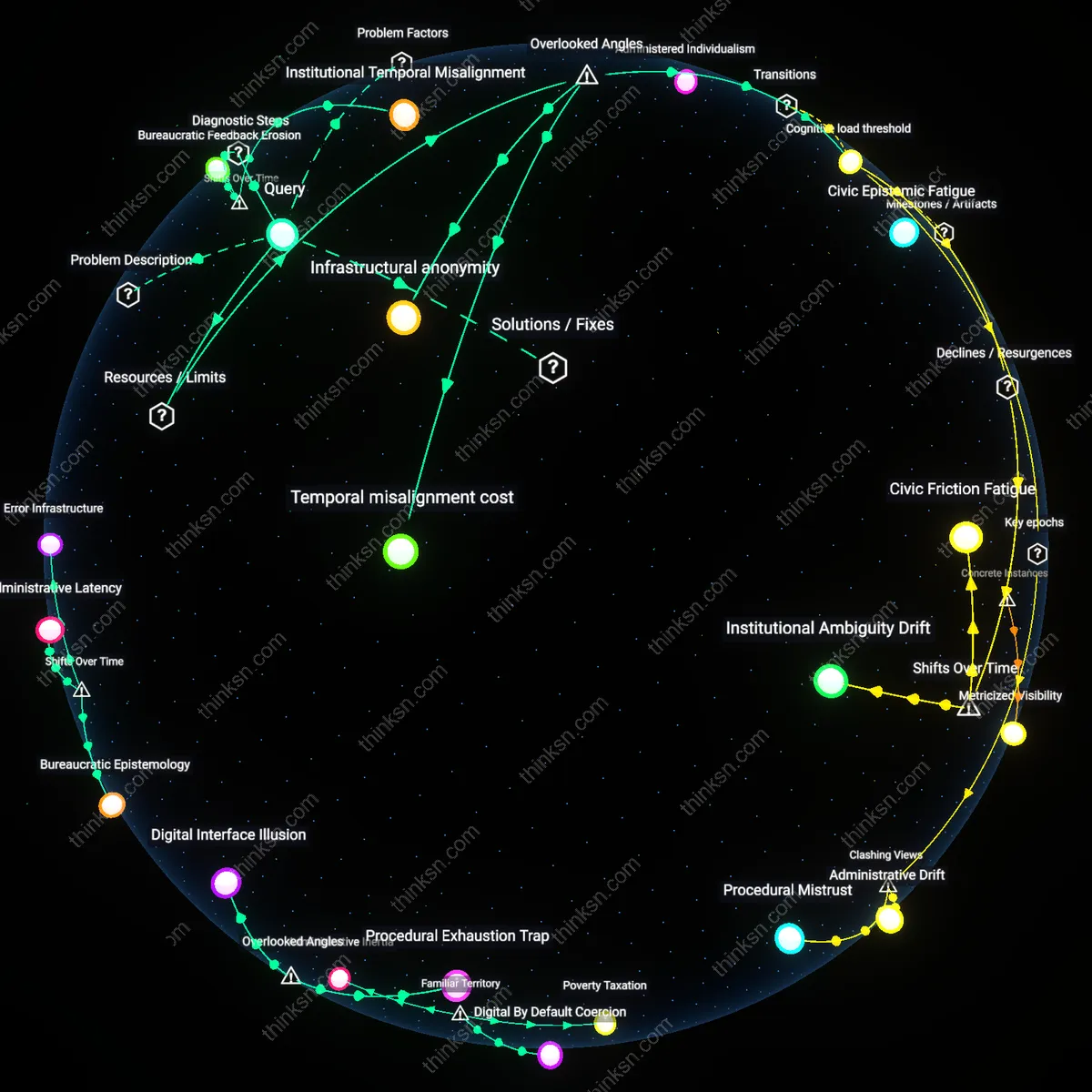
Individual disengagement became collectively destabilizing in the 2010s when algorithmic management systems were embedded into social welfare bureaucracies, accelerating decision timelines in ways that outpaced citizens’ ability to understand, contest, or re-engage with administrative processes. The mechanization of eligibility determinations—layered onto legacy systems designed for paper-based appeals—created a temporal rift between human experiential time and automated administrative time, disabling traditional pathways of redress. The non-obvious outcome is that disengagement is no longer a voluntary choice but an emergent structural exclusion, where rational withdrawal results not from apathy but from synchronization failure with opaque, accelerated institutional rhythms.
Cognitive load threshold
Individual rational disengagement becomes a collective action problem when citizens exceed the cognitive load threshold imposed by fragmented regulatory interfaces, such as when managing interactions with multiple agencies—like the IRS, DMV, and HUD—each requiring distinct documentation, timelines, and protocols. This overload, not lack of concern or resources per se, disables coordinated response because individuals abandon participation not due to apathy but to procedural incoherence, a burden that accumulates silently across mundane transactions. This shifts the standard understanding of disengagement from a motivational deficit to a systemic information-design failure, revealing that administrative complexity acts as an invisible tax on civic coordination.
Temporal misalignment cost
Individual rational disengagement evolves into a collective action problem when the temporal misalignment cost between bureaucratic decision cycles and citizens' urgent life events renders participation futile, such as low-income families facing eviction while awaiting months for housing relief applications to process. The mismatch between the state’s slow temporal rhythm and individual crisis moments erodes trust in engagement as a viable strategy, not because people stop caring but because feedback loops from participation are delayed beyond relevance. This dynamic is overlooked in standard models that assume deliberative timelines, yet it determines whether administrative systems are functionally accessible or effectively absent in critical windows.
Infrastructural anonymity
Individual rational disengagement becomes a collective action problem when citizens encounter infrastructural anonymity—the erasure of accountability in automated administrative systems such as algorithm-driven welfare eligibility platforms where no single official is responsible for outcomes. When errors occur, individuals cannot identify or appeal to a responsible agent, leading to disengagement not from laziness but from the impossibility of meaningful contestation, which in turn prevents the aggregation of grievances necessary for collective mobilization. This hidden dependency on identifiable authority as a precondition for organizing reframes resistance as not merely political but ontologically contingent on visible human agency within systems.