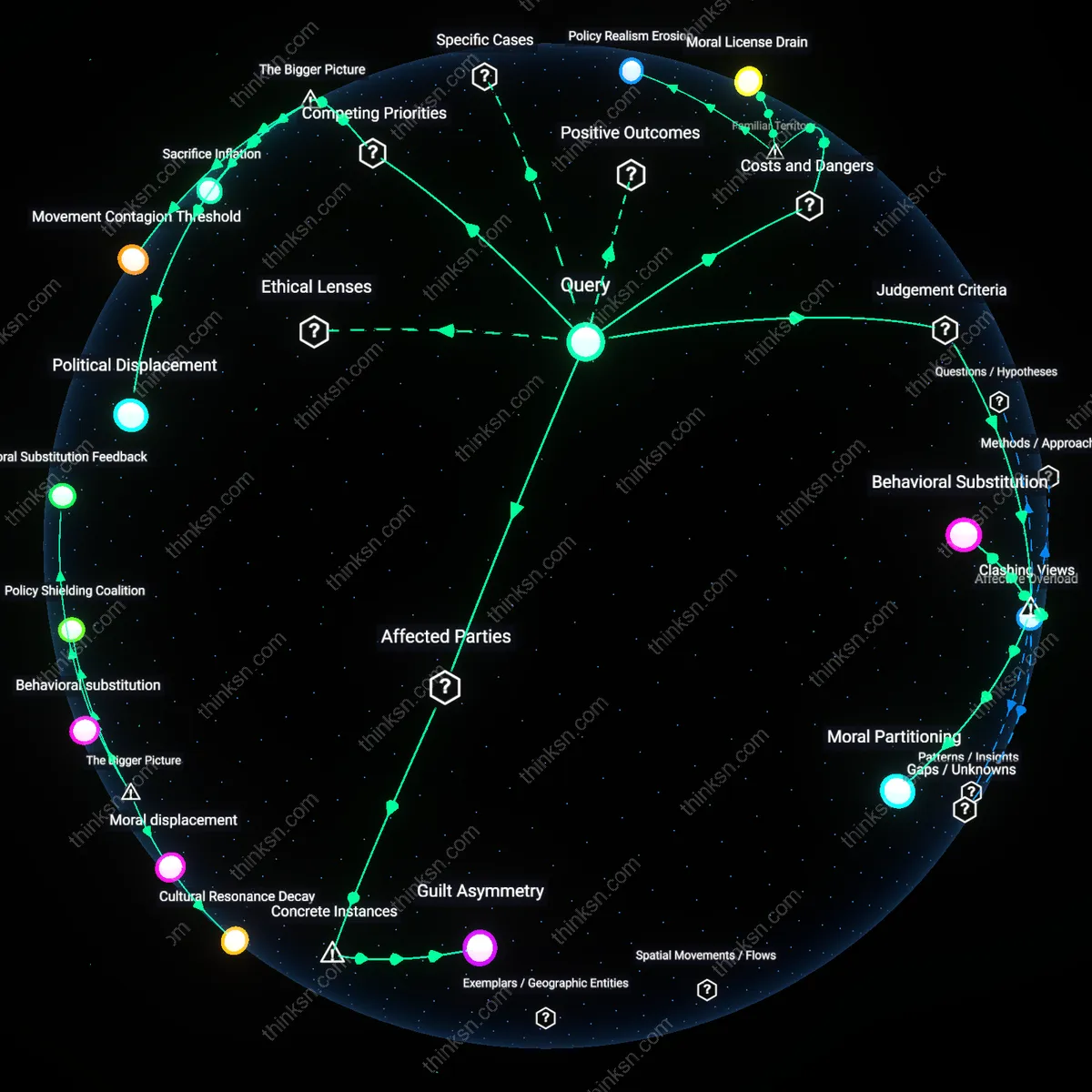
Extreme Climate Lifestyle Changes: Political Boon or Bane?
Analysis reveals 11 key thematic connections.
Key Findings
Moral Displacement
Climate anxiety-driven minimalism among affluent Western individuals undermines collective political action by externalizing systemic responsibility onto personal sacrifice, as seen in the 'flight shame' (flygskam) movement in Sweden, where individual behavioral restraint among middle-class Swedes deflected pressure from aviation regulators and legacy emitters toward consumer choice, thereby stabilizing policy inertia. This moralization of lifestyle shifts positions political responsibility downstream, where self-policing replaces systemic critique, effectively depoliticizing climate discourse and protecting dominant industrial actors from democratic challenge. The non-obvious mechanism here is not reduced emissions but the conversion of systemic demands into personal ethics, which inadvertently secures the status quo by redefining accountability.
Guilt Asymmetry
Bangladesh’s low-carbon emitting population experiences acute climate anxiety primarily as imposed trauma rather than ideological motivation, with rural communities adapting through informal mutual aid rather than lifestyle renunciation, exposing a global ethical distortion in which those least responsible internalize existential dread while elite emitters debate carbon footprints. This anxiety does not translate into corresponding political pressure in high-emission countries, revealing a moral economy where psychological burden is inversely indexed to causal responsibility. The non-obvious insight is that climate anxiety is not a uniform catalyst but a stratified affective resource, unevenly distributed to erode political agency where it is most rational and least actionable.
Behavioral Substitution
Climate anxiety-induced extreme lifestyle change undermines collective political action by redirecting moral agency from systemic reform to individual abstinence, as seen in high-income Western households adopting zero-waste asceticism while disengaging from climate lobbying. This shift operates through the psychological mechanism of behavioral substitution—where the performance of difficult personal sacrifice satisfies the need to act, reducing perceived urgency for collective demands on institutions. The non-obvious consequence is that ethically motivated self-denial can function as a release valve for political tension, preserving the status quo despite radical personal cost.
Affective Overload
Extreme lifestyle responses to climate anxiety impair sustained political engagement by triggering affective overload, a condition wherein the emotional burden of constant self-policing in consumption—such as in veganism, flight abstinence, or off-grid living—depletes cognitive and emotional resources needed for organizing. This dynamic manifests most acutely among youth activists in groups like Extinction Rebellion, who adopt punishing personal standards alongside protest, only to report burnout and withdrawal from campaign work. The counterintuitive insight is that intensifying personal responsibility does not scale political will—it can collapse it through unsustainable emotional taxation.
Moral Partitioning
Radical lifestyle changes driven by climate anxiety enhance political action not by modeling virtue but by creating moral partitioning—where individuals isolate their ecological identity from broader civic roles, enabling more confrontational systemic demands. In Sweden, 'flight shame' (flygskam) advocates who refrain from air travel gain social legitimacy that allows them to demand carbon taxes and aviation regulation without appearing hypocritical, thus hardening their political voice. The overlooked mechanism is that extreme personal acts are not ends in themselves but strategic identity boundaries that strengthen moral authority in policy debates, making uncompromising positions politically legible.
Moral License Drain
Extreme personal climate sacrifices legitimize political inaction by displacing responsibility onto individual virtue. When individuals adopt austere lifestyles—such as zero-waste living or flight abstinence—they reinforce a public narrative that systemic change follows from moral purity, which governments exploit to justify delaying structural reforms. This mechanism operates through media visibility of elite environmentalists, where symbolic acts become substitutes for policy, and the underappreciated risk is that visible sacrifice entrenches the idea that political participation is secondary to personal purity.
Movement Fragmentation Risk
Radical lifestyle shifts fracture climate coalitions by creating unbridgeable credibility hierarchies among activists. When some advocates adopt extreme measures—like off-grid living or veganism as non-negotiable—others are framed as compromised, weakening broad-based organizing across class and culture. This dynamic plays out in local climate assemblies and national NGOs, where lifestyle litmus tests replace policy consensus-building, and the overlooked cost is the erosion of pluralistic advocacy in favor of puritanical identity politics.
Policy Realism Erosion
Widespread climate anxiety driving drastic personal behavior distorts political feasibility by redefining what counts as 'serious' action. As mass adoption of extreme measures—like giving up cars or quitting air travel—enters public discourse as the benchmark of authenticity, policymakers retreat from pragmatic regulation, fearing it will appear insufficient. This occurs in parliamentary debates and media commentary, where the unspoken consequence is that viable intermediate policies are dismissed not on merit but because they fail to match the symbolism of personal renunciation.
Political Displacement
Climate anxiety-induced extreme lifestyle changes undermine collective political action by redirecting finite individual agency from systemic advocacy to privatized acts of survival, thereby depoliticizing climate responsibility; this occurs as middle-class eco-austerity practices in wealthy nations—like zero-waste lifestyles or off-grid living—consume time and identity energy that might otherwise fuel mass mobilization, a shift enabled by neoliberal governance that celebrates individualized solutions while defunding collective infrastructure, making it significant because it reveals how behavioral over-moralization silently evacuates pressure for binding regulatory change.
Movement Contagion Threshold
Climate anxiety-induced extreme lifestyle change enhances collective political action by serving as visible, culturally resonant signals that recalibrate social norms and expand the boundaries of acceptable climate response, as seen in youth-led movements where radical personal commitments—like flight abstinence or veganism—function as entry points to broader systemic demands, a mechanism sustained by peer network dynamics in urban activist clusters where symbolic authenticity lowers psychological barriers to engagement, revealing that extreme behaviors can act as social catalysts when they crystallize diffuse fear into shared identity.
Sacrifice Inflation
Climate anxiety-induced extreme lifestyle change undermines collective political action by raising the perceived cost of participation in climate politics, as early adopters’ drastic measures—such as abandoning car ownership or adopting post-consumerist identities—set implicit benchmarks that deter mainstream constituencies who feel they cannot meet such standards, a dynamic amplified in media ecosystems that spotlight exceptionalism rather than incremental change, making it significant because it demonstrates how well-intentioned exemplars can inadvertently gatekeep movement participation through normative escalation.