Do Public Charge Rules Reinforce Welfare Stigma?
Analysis reveals 6 key thematic connections.
Key Findings
Administrative Deterrence Trap
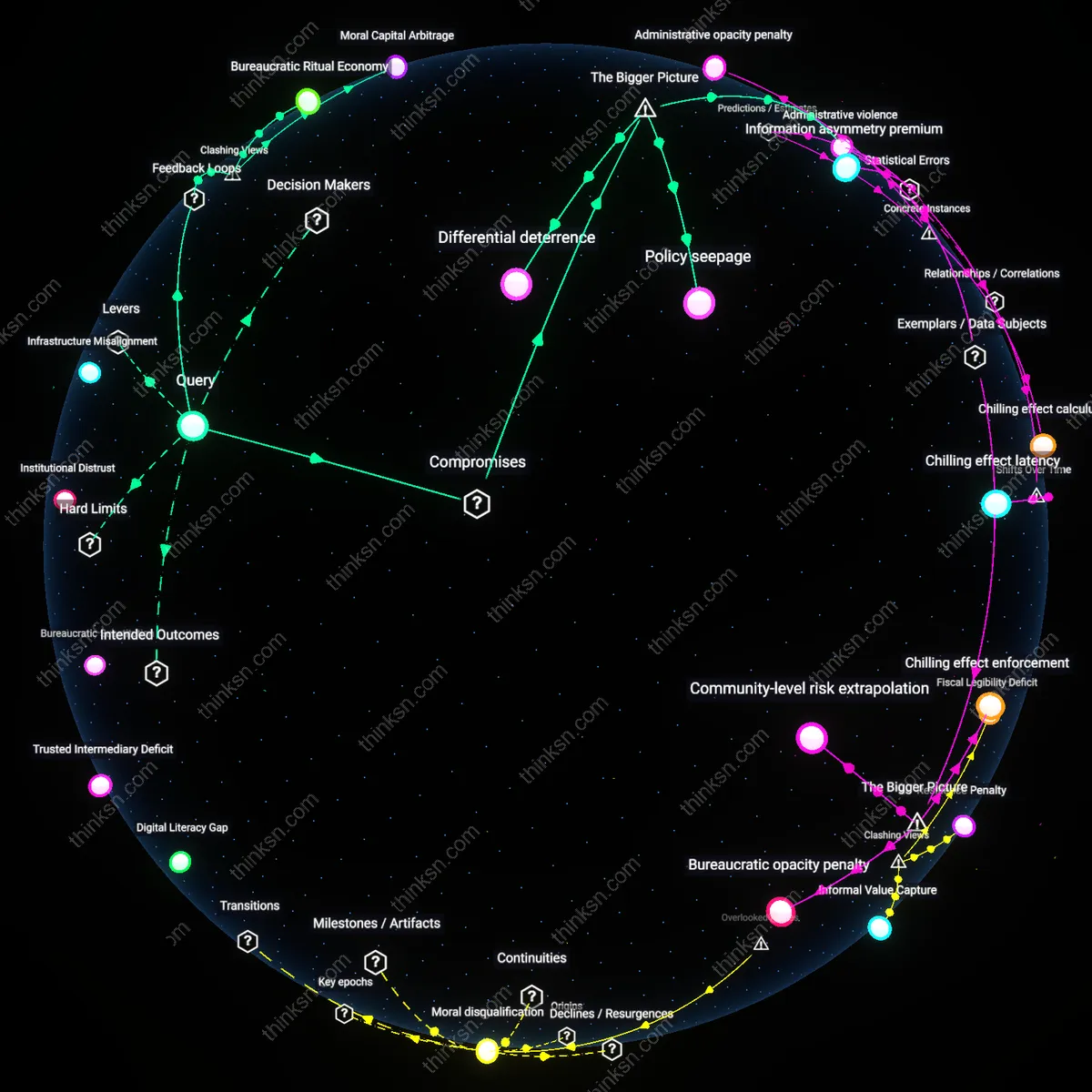
Public charge rules deepen cultural stigma not by increasing denials but by expanding the ritual of self-verification, where immigrant families internalize scrutiny through required documentation of economic self-sufficiency, causing even eligible households to preemptively withdraw from public benefits due to fear of future immigration penalties; this feedback loop is sustained by USCIS policy design that treats benefit caution as compliance, reinforcing stigma as a risk-management tool within immigrant communities rather than eradicating it, revealing that the most corrosive effect of public charge assessments is not exclusion but the systematic incentivization of silent compliance—what public health systems interpret as cultural reluctance is often proceduralized self-censorship.
Moral Capital Arbitrage
Middle-income immigrant entrepreneurs exploit public charge stigma by publicly renouncing welfare participation to accumulate moral legitimacy with local institutions, thereby gaining preferential access to small-business loans and landlord approvals, creating a reinforcing loop where economic advancement becomes tied to visible disengagement from social safety nets; this dynamic flips the standard narrative of stigma as purely repressive, exposing how some actors weaponize cultural shame as a currency for inclusion within formal systems that unofficially reward disaffiliation—a phenomenon obscured when analyses assume stigma only constrains, never enables, mobility.
Bureaucratic Ritual Economy
Local eligibility workers, caught between federal public charge guidelines and community mistrust, routinize ceremonial benefit screenings that produce symbolic compliance without substantive review, maintaining application volumes while quietly waiving deeper inquiries—this balancing loop stabilizes service delivery but entrenches stigma by codifying the appearance of risk assessment over actual evaluation, revealing that the system’s resilience stems not from rigor but from the institutionalization of performative caution, where the ritual of assessment becomes more valued than its outcome.
Administrative violence
Public charge assessments institutionalize cultural stigmas by delegating moral judgments about welfare use to immigration officers, who apply vague economic thresholds that reflect normative assumptions about 'deservingness'—a mechanism enabled by the discretionary authority embedded in the U.S. Department of Homeland Security’s adjudication framework. This convergence transforms welfare avoidance, driven by fear of deportation, into a routine outcome of bureaucratic interpretation rather than explicit policy, with noncitizens in mixed-status families in cities like Houston or Los Angeles self-disenrolling from SNAP or Medicaid even when legally eligible. The non-obvious consequence is that the administrative process itself becomes a site of social control, where documentation requirements and risk-averse counseling by legal service providers amplify stigma through procedural friction, not just ideology.
Policy seepage
Cultural stigmas around welfare infiltrate public charge determinations indirectly through localized implementation practices in safety-net programs, where frontline workers in county health departments in states like Florida and Arizona, anticipating immigration concerns, deliver eligibility screenings with heightened suspicion or withhold outreach to immigrant-adjacent communities. This occurs because federal welfare programs like TANF and Medicaid, while technically off-limits for undocumented immigrants, fund local administrative infrastructures that develop risk-aversion norms across service domains—creating a feedback loop where austerity-minded budget constraints and performance metrics for cost containment incentivize exclusionary behaviors even in programs not subject to public charge rules. The systemic significance lies in how resource limitations and political pressures at the state level reconfigure professional discretion, allowing stigmatized beliefs about dependency to 'seep' across policy boundaries and shape behaviors beyond their formal scope.
Differential deterrence
Public charge rules produce racially and ethnically stratified outcomes not through explicit bias in form design but because the threat of adverse immigration consequences activates unevenly across communities with varying historical experiences of state surveillance, such as Latinx households in rural California versus long-settled Asian immigrant groups in urban New York. This differential deterrence is systemically reinforced by the decentralized nature of legal aid and immigrant-serving nonprofits, whose geographic unevenness means that clarifying guidance about actual eligibility rarely reaches populations most vulnerable to misinformation, thereby allowing cultural stigma to persist as a de facto regulatory force. The underappreciated dynamic is that the U.S. immigration bureaucracy outsources deterrence to community-level trust networks, making compliance with public charge objectives dependent on—and reproduced by—preexisting social fractures rather than legal enforcement alone.