Is Reliance on Elder-Care Charities Hiding Public Policy Gaps?
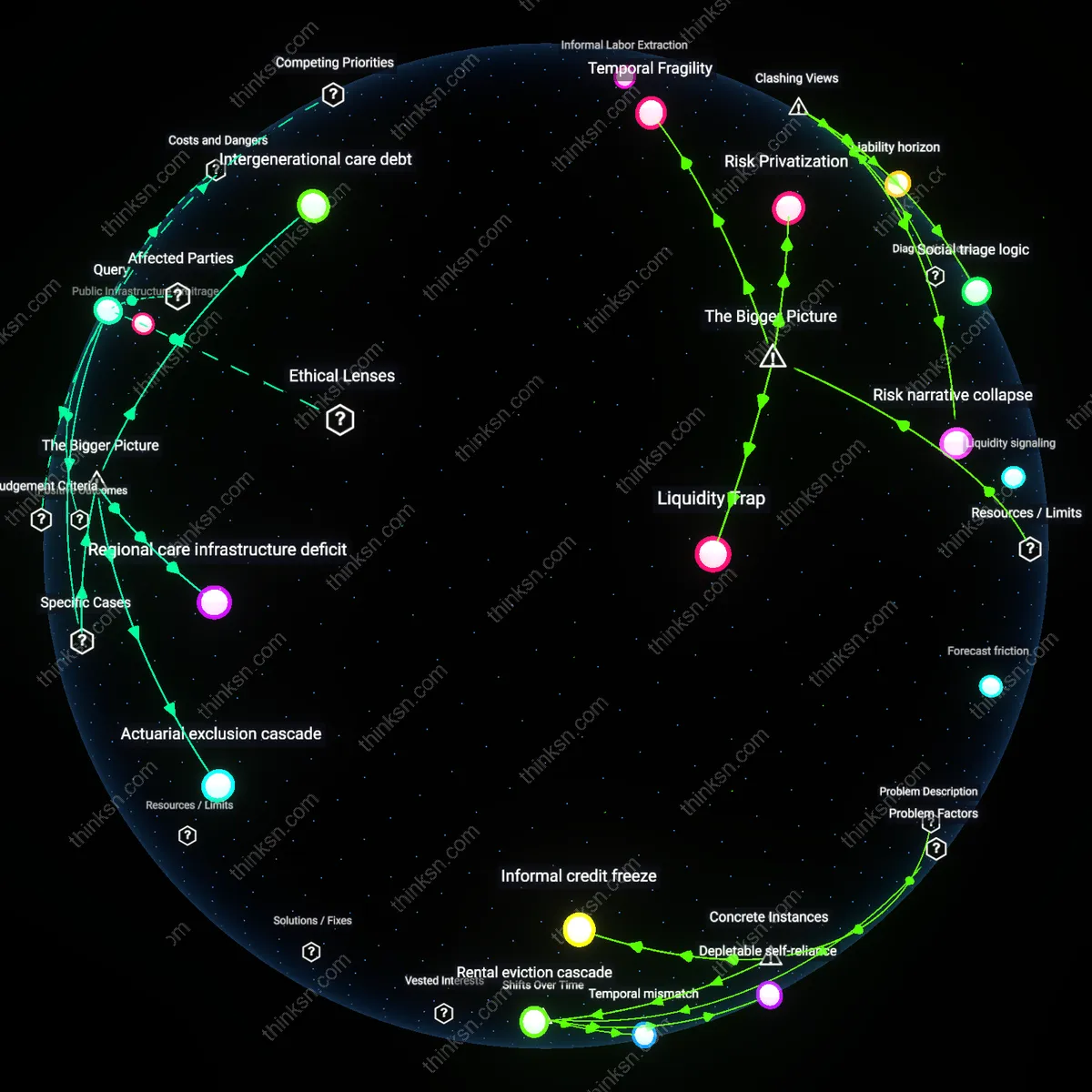
Analysis reveals 6 key thematic connections.
Key Findings
Fiscal Displacement
Dependence on charitable elder-care diverts public scrutiny from state underfunding by absorbing gaps in social provision through private benevolence. Nonprofit care providers and religious organizations fill systemic service voids, enabling municipal governments to maintain low taxation and reduced social spending without immediate political penalty, thereby normalizing austerity. This mechanism entrenches underinvestment in public elder infrastructure because visible crisis is averted, even as long-term population aging accelerates demand—what appears as community resilience becomes a smokescreen for fiscal abdication. The non-obvious consequence is that charity functions not as a supplement but as a political release valve, deferring structural reform.
Intergenerational Risk Transfer
When elder-care relies on charity, families internalize uncertainty about future care access, reshaping household financial decisions across decades. Middle-aged adults delay retirement savings, divert income to informal caregiving, or alter career trajectories to preserve family availability—strategies that reduce aggregate investment in pensions and housing equity. This risk transfer persists because labor markets do not compensate for unpaid care work, and social insurance remains tied to formal employment, leaving care-dependent households exposed to compounded vulnerability. The underappreciated dynamic is that patchwork care provision shifts macroeconomic risk onto kin networks, effectively privatizing a demographic inevitability.
Care Informalization
Charitable elder-care systems institutionalize unpaid labor by legitimizing volunteerism and familial duty as acceptable substitutes for professionalized support. Local faith-based clinics and community drop-in centers operate with minimal oversight or training standards, reinforcing the notion that elder assistance need not be skilled, salaried, or systematically coordinated. This deprofessionalization reduces political demand for care as a labor-intensive public good, weakening unionization efforts and wage standards in elder services. The critical yet overlooked outcome is that charity perpetuates a dual-care economy—one visible, formal, and under-resourced; the other invisible, gendered, and exploited—undermining universal care as a policy objective.
Deferred Fiscal Burden
Public reliance on charitable elder-care shifts long-term financial risk from state systems to families, who must anticipate care gaps and allocate personal savings prematurely. This occurs because inconsistent public funding creates unpredictable care access, forcing households to over-save or delay major life investments, especially in regions with underfunded aging infrastructure like rural Appalachia. What is underappreciated is that this isn’t merely individual planning failure—it reflects families internalizing systemic fiscal instability, mistaking a structural deficit for personal responsibility.
Moral Substitution
When charitable organizations become primary elder-care providers, communities interpret generosity as a sufficient replacement for policy investment, particularly in faith-based networks across the Midwest and South. This moral framing recasts state disengagement as civic virtue, allowing policymakers to cite volunteerism as evidence of system adequacy. The non-obvious consequence is that perceived social cohesion becomes a barrier to reform, as emotional satisfaction with charity masks quantifiable service shortfalls.
Intergenerational Illiquidity
Families delaying home purchases, education funding, or retirement savings to manage elder-care duties through informal or charity-dependent systems experience reduced asset mobility across generations. This is especially acute in urban centers like Los Angeles and New York, where housing costs compound caregiving constraints. What escapes common narratives is that the visible sacrifice—often praised as familial devotion—actually represents a hidden transfer of public obligation into private time and capital, weakening economic resilience over decades.