College or Care? Navigating Parents Inheritance Dilemma
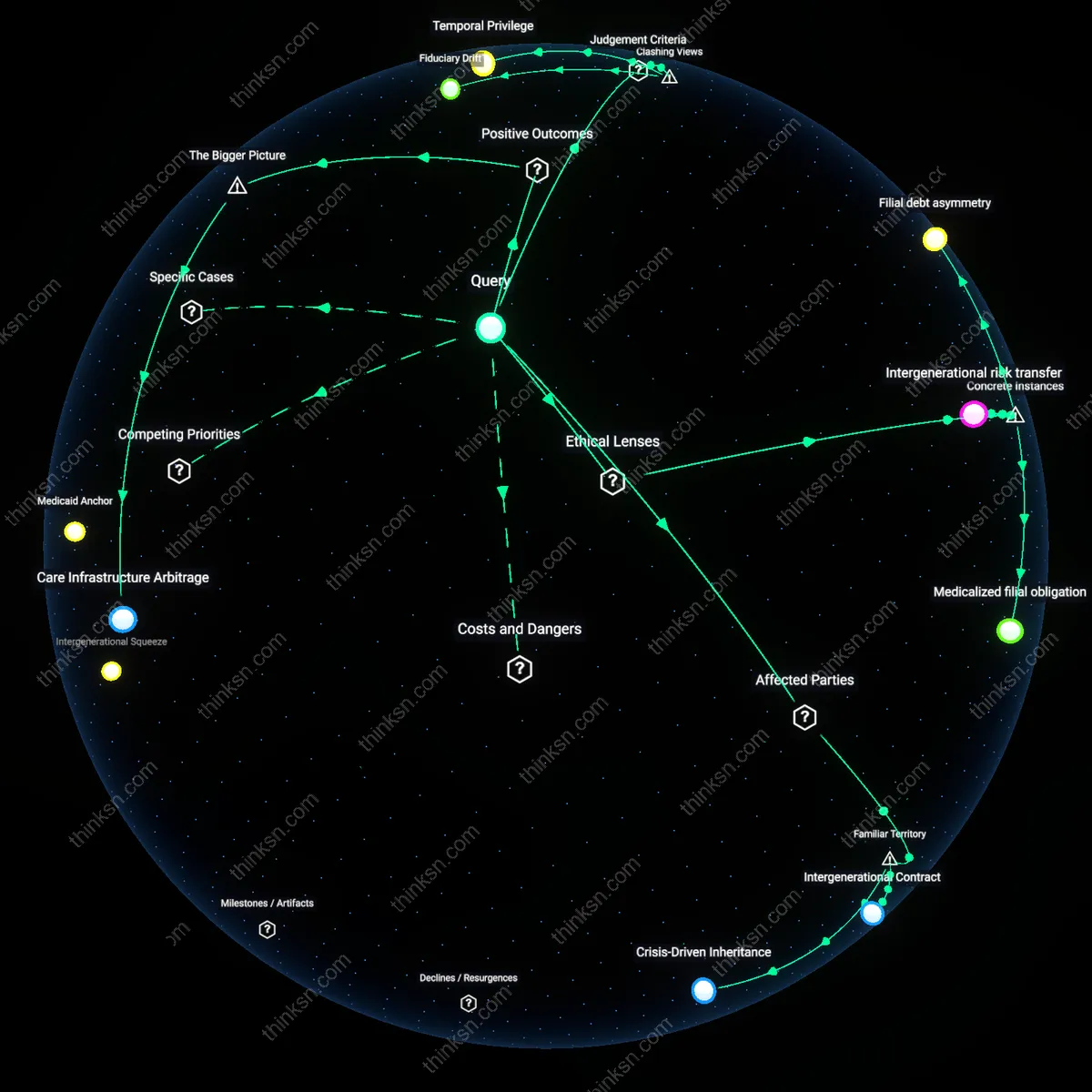
Analysis reveals 8 key thematic connections.
Key Findings
Intergenerational Equity
Families should prioritize parental care funding over sibling education inheritance because elder care prevents public cost externalization onto municipal health systems. When aging parents lack in-home support due to underfunded care, they rely more heavily on emergency services and state-subsidized nursing facilities, particularly in suburban and rural U.S. counties where infrastructure is strained—this shifts financial and labor burdens to taxpayers and healthcare workers, undermining long-term community resilience. This reveals that treating inheritance as a geriatric risk hedge, not just an educational enabler, exposes how private financial decisions directly shape public health capacity, challenging the assumption that educational investment yields unambiguous social returns.
Educational Debt Drag
Prioritizing a sibling’s education through inheritance generates a hidden inter-sibling tax where future care labor falls disproportionately on the non-beneficiary sibling. In many East Asian and Southern European families, the sibling who receives financial support for schooling later inherits less or no estate, but is still culturally expected to provide hands-on elder care—this creates a de facto debt bondage that suppresses geographic and occupational mobility. The non-obvious consequence is that educational financing via inheritance can deepen intrafamilial asymmetry more than it alleviates poverty, revealing inheritance’s role not as a liberatory tool but as a pressure valve that redistributes obligation rather than wealth.
Care Infrastructure Arbitrage
Families can optimize both education and elder care by redirecting inheritance into publicly subsidized care programs, thereby freeing up household income for tuition without direct trade-offs. In Germany and the Netherlands, inheritances deposited into state-certified long-term care trusts unlock matching funds and professionalized home care services, reducing the need for one sibling to forgo career opportunities to provide informal care. This allows education spending to proceed without familial sacrifice, exposing the fallacy of zero-sum allocation—it is not inheritance per se but its placement within underfunded informal care systems that forces false dilemmas, not the scarcity of resources alone.
Sacrificial Sibling
Prioritize parental care funding over sibling education to prevent familial guilt cascades. When one sibling forfeits educational opportunities to preserve elder care reserves, it creates a lived inequity that destabilizes family cohesion—often younger members bear silent costs understood as moral obligations, yet this 'silent burden' is systematically underreported in intergenerational planning. The non-obvious risk is not financial miscalculation but the normalization of one child as the default sacrificer, a role that becomes embedded in family narratives and decision reflexes.
Care Gap Illusion
Assume inheritance must cover future care costs in full, thereby inflating parental dependency forecasts. Families habitually overestimate long-term care expenses based on worst-case scenarios advertised in media and elder-care marketing, leading to premature hoarding of funds that could otherwise support education. The damage lies in treating speculative care timelines as fixed liabilities, which distorts resource prioritization and risks under-investing in human capital during critical developmental windows.
Intergenerational Contract Erosion
Families should prioritize parental care over sibling education when state support for eldercare has receded, because the burden of care has shifted from public systems to kinship networks. In the American Midwest after the 1980s, as Medicare limitations expanded and long-term care privatized, middle-aged adults increasingly diverted inheritances toward assisted living costs rather than younger relatives' tuition, reflecting a reversal of 20th-century patterns where education was the primary inheritance use. This reallocative pressure reveals how retrenchment of the social safety net reconfigures familial obligations, making filial duty the default fiscal liability—what was once a shared societal responsibility is now privately absorbed debt.
Educational Ascent Bargain
Families should favor funding a sibling’s education if upward mobility through credentialing has become the dominant path to economic security, particularly in post-1990s South Korea, where chaebol-dominated labor markets began requiring elite university degrees for stable employment. As elderly care became partially subsidized by national programs like the National Basic Livelihood Security System in the 2000s, inheritances were redirected toward tuition and exam prep for younger siblings, seen as investments in household-level status preservation. This shift marks a departure from Confucian norms prioritizing elder veneration, substituting filial piety with a new moral economy where individual human capital secures collective kinship survival.
Inheritance Temporalization
Families should balance inheritance by deferring both education and care expenditures through financial instruments that restructure time-based claims, as seen among Mexican-American families in California who, since the 2010s, have increasingly used life insurance trusts and reverse mortgages to delay asset liquidation. These tools allow parents’ homes to fund future care via credit while preserving cashflow for younger siblings’ community college enrollment, decoupling inheritance from immediate transfer. The emergence of such mechanisms reflects a broader shift from inheritance as a terminal distribution to a dynamic, staged allocation—revealing the family balance not as ethical dilemma but as temporal engineering under financialization.