Remote Work Health Gains vs Career Stagnation Risks?
Analysis reveals 11 key thematic connections.
Key Findings
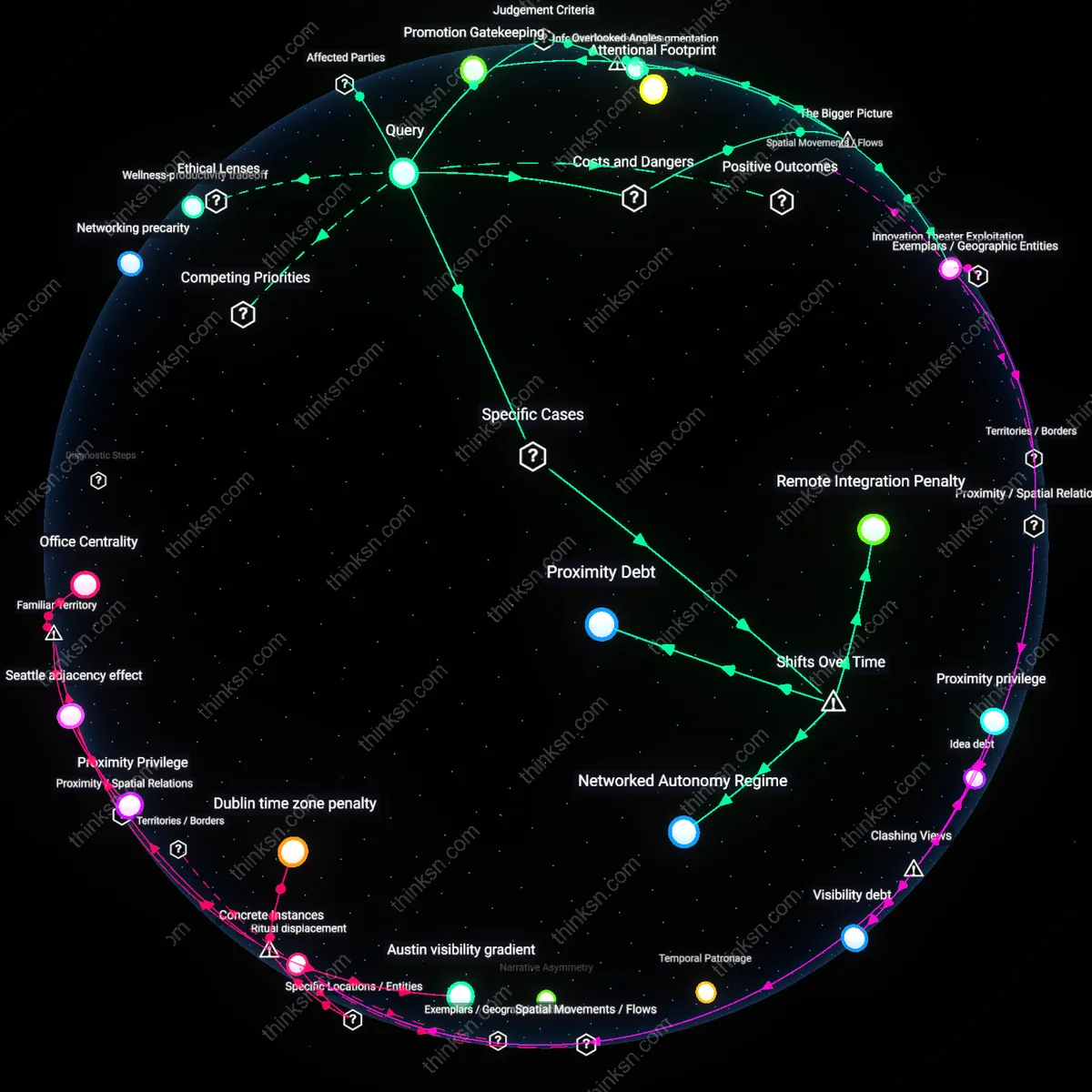
Managerial gatekeeping
Managers should enforce structured in-office days to ensure junior employees gain visibility. Mid-level leaders in tech and finance firms control access to high-impact projects and promotions, and their informal, in-person interactions disproportionately favor those physically present. This mechanism entrenches proximity bias under the guise of operational convenience, making physical presence a silent proxy for commitment—despite remote work’s proven health benefits. The non-obvious consequence is that wellness gains for individuals are systematically traded for organizational inertia that protects managerial discretion.
Networking precarity
Early-career professionals must initiate deliberate digital outreach to offset lost watercooler connections. Young workers in consulting, marketing, and engineering rely on serendipitous mentorship and peer alliances formed in office environments, and remote work erodes these accidental touchpoints that fuel advancement. The shift places disproportionate responsibility on individuals to self-generate professional capital through LinkedIn engagement, virtual coffee chats, and public content posting—activities that mimic but don't replicate trust built through shared physical context. The overlooked reality is that networking is no longer ambient but performative, turning social authenticity into a labor requirement.
Wellness-productivity tradeoff
Companies should measure and reward output rather than availability to reduce presenteeism pressure. Knowledge workers in regulatory-heavy sectors like healthcare and law face strong cultural expectations to be seen in office, even when tasks are digital and solitary. Performance evaluation systems tied to visibility—such as attendance tracking or meeting participation—actively penalize remote employees despite data showing higher focus and lower burnout offsite. The underappreciated dynamic is that organizational risk aversion disguises itself as productivity management, making psychological safety at home contingent on sacrificing career trajectory.
Attentional Footprint
Workers should track and disclose their digital communication patterns—response latency, channel choice, meeting contribution—to make remote collaboration influence legible. In fully remote settings, influence accumulates silently through asynchronous responsiveness and digital presence, creating invisible career escalators that mimic in-person networking but are rarely acknowledged in performance reviews. The overlooked dynamic is that career advancement still depends on being 'top of mind,' but now mediated through data traces rather than hallway encounters; by quantifying one’s attentional footprint, employees can demonstrate strategic engagement despite physical absence. This reframes networking not as presence, but as traceable cognitive allocation.
Project Provenance
Employees should deliberately attach their names to early-stage project concepts in shared digital workspaces to create visible intellectual provenance, compensating for the loss of credit attribution that occurs when brainstorming shifts from meeting rooms to Slack. Remote work obscures authorship because ideas emerge in fragmented, asynchronous threads where contribution blends together, privileging those who restate ideas in meetings over those who originate them quietly. The underappreciated factor is that career progression relies on perceived innovation, not just output, and remote environments dissolve the link between conception and recognition. By timestamping and signing proto-ideas, workers build a verifiable innovation trail that functions as a new form of professional signature.
Promotion Gatekeeping
Remote work entrenches promotion gatekeeping by concentrating advancement opportunities among employees with informal access to decision-makers in headquarters, particularly in firms where visibility correlates with perceived leadership potential. This dynamic widens performance-blind promotion gaps because remote workers—disproportionately in technical or support roles outside core urban offices—lack proximity to the spontaneous interactions that shape executive impressions. The mechanism operates through spatialized social capital in innovation-driven firms, where career progression depends less on output metrics and more on alignment with unspoken cultural cues transmitted in person. The underappreciated consequence is that remote work reproduces hierarchical access even when productivity is equal, turning geography into a proxy for loyalty and ambition.
Informal Knowledge Fragmentation
Remote work accelerates informal knowledge fragmentation by disrupting the lateral diffusion of strategic information that traditionally occurs in unstructured office environments, such as hallway conversations or after-meeting debriefs. In multinational corporations, especially in sectors like consulting or finance, this erosion prevents remote employees from accessing real-time shifts in priorities, client feedback, or internal power dynamics that are rarely documented but essential for high-impact contributions. The system relies on tacit transmission through trusted peer networks, which naturally coalesce around physical hubs, leaving remote staff dependent on formal, delayed channels. The result is not mere isolation but a structural exclusion from the interpretive frameworks that enable proactive career moves and visibility-generating initiatives.
Innovation Theater Exploitation
The shift to remote work enables innovation theater exploitation, wherein organizational leaders emphasize visible, short-term collaboration tools—such as mandatory video calls or digital brainstorming platforms—to simulate engagement while neglecting investment in equitable development pathways. This performance-centric model rewards employees who conform to availability norms during core hours, typically those already in alignment with dominant time zones or managerial expectations, while penalizing asynchronous contributors who generate high-quality work outside surveillance. The dynamic is reinforced by HR analytics that privilege activity metrics over outcomes, aligning with shareholder demands for operational visibility rather than developmental equity. The non-obvious cost is that career mobility becomes contingent on participating in performative rituals, which remote workers cannot access without compromising work-life boundaries or local autonomy.
Remote Integration Penalty
Remote work weakens career mobility in hierarchical corporate cultures where visibility governs advancement, as seen in legacy financial institutions like Goldman Sachs post-2020, where junior employees working remotely experienced slower project assignment and mentorship access despite strong performance metrics. This mechanism operates because pre-pandemic norms equated physical presence with commitment, and although remote productivity held steady during the 2020–2022 hybrid transition, promotion data from 2023 revealed a bias toward in-office staff, exposing how deeply embedded proximity hierarchies resist change. What is non-obvious is that health gains from remote work are negated not by absence of networking per se, but by sustained institutional inertia that interprets availability as attendance.
Networked Autonomy Regime
Tech sector professionals at companies like GitLab and Automattic have redefined career progression by replacing serendipitous office networking with structured asynchronous visibility, such as public contribution logs and documented decision-making, a shift that accelerated after 2017 when fully remote firms began scaling beyond startup size. The mechanism operates through transparent workflows that replace hallway conversations with searchable records of impact, allowing engineers and product managers to build reputations across time zones without in-person presence. What is underappreciated is that the risk of stagnation diminished not because networking improved, but because the criteria for recognition fundamentally changed during the late 2010s, decoupling career momentum from physical co-location.
Proximity Debt
Employees at mid-sized law firms in cities like Chicago and Atlanta who returned to partial office mandates in 2022 accumulated 'proximity debt'—a lag in promotion relative to peers who resumed full in-office schedules—despite equivalent remote productivity, revealing how the post-2021 thaw in office returns created new inequities. This operates through informal sponsorship systems where partners assigned high-visibility cases based on recurring face-to-face interaction, a practice that re-emerged as firms reacted to client concerns about remote oversight, thus reinstating pre-2020 advancement pathways under the cover of 'hybrid balance.' The non-obvious insight is that the health benefits of remote work became a deferred liability when the transition out of pandemic mode reactivated latent cultural preferences for physical presence, not because networking failed, but because legacy advancement rituals were never redesigned.