Is Reddit Worth the Risk for Academic Discussion?
Analysis reveals 11 key thematic connections.
Key Findings
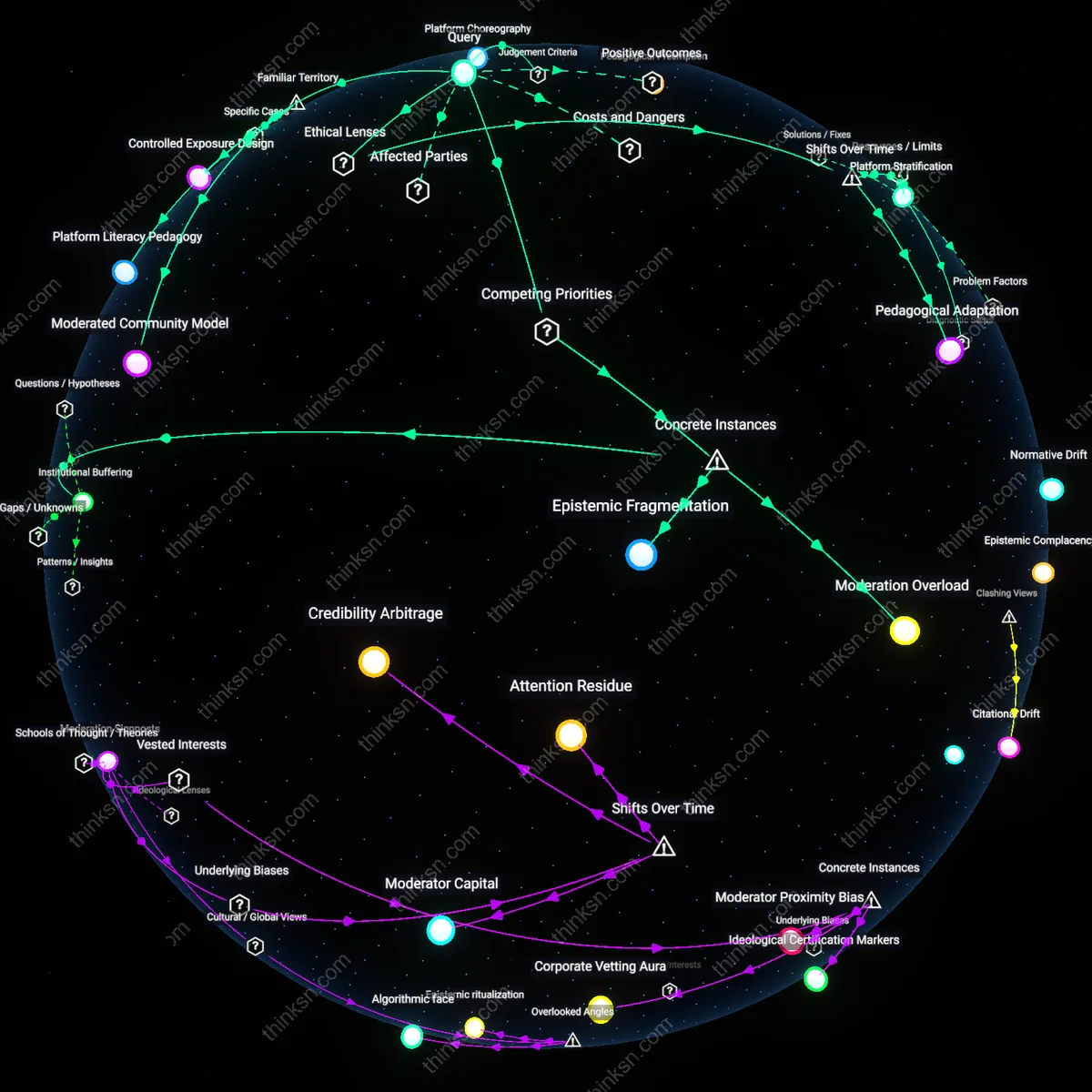
Platform Choreography
A professor should design course assignments around time-locked, subreddit-specific engagement cycles to mitigate harassment risks while preserving intellectual value, because Reddit’s discourse is governed by emergent moderation rhythms that align with academic calendars only when deliberately synchronized. This requires mapping assignment deadlines to the weekday activity peaks and mod-team enforcement windows of disciplinary subreddits—such as r/AskHistorians or r/philosophy—where vigilance against bad-faith actors spikes after weekends, thus reducing exposure to trolling; this choreographic alignment is rarely considered in digital pedagogy, where platform use is treated as statically available rather than dynamically regulated through community-specific temporal patterns that shape both safety and depth of discourse.
Epistemic Ground Rent
A professor can neutralize Reddit’s fragmentation risk by requiring students to cite not just content but also the vote-weighted longevity of posts, because Reddit’s upvote economy inadvertently prices stability of knowledge claims over time, transforming fleeting comments into tenure-like positions within threads. When students must analyze how certain arguments persist due to sustained community endorsement, they engage with a hidden layer of epistemic economics—where credibility accrues not only through argumentative strength but through prolonged survival against counter-discourse and deletion pressures—surfacing a rent-like dynamic where prominent posts extract intellectual attention simply by occupying space longer, a mechanism typically obscured in discussions of online learning equity.
Pedagogical Preemption
A professor should stage mock harassment interventions in private course forums before live Reddit integration, because preparedness for hostile interactions alters students’ cognitive allocation in public spaces—not by reducing participation, but by redistributing their interpretive labor toward pattern recognition rather than emotional reactivity. This preemption functions as a covert curriculum in threat assessment timing, where students learn to identify incipient trolling through syntactic markers practiced weeks earlier, thereby shifting the balance from reactive moderation to anticipatory navigation; this dimension of pedagogical timing is routinely ignored in digital literacy models that focus on content filters rather than on the embodied anticipation of linguistic aggression.
Moderation Overload
A professor at the University of Michigan who integrated Reddit into a political science course in 2016 found that sustained engagement required disproportionate faculty time to filter targeted harassment from legitimate discourse, effectively shifting pedagogical labor from content development to crisis management. The mechanism was an influx of brigading from r/The_Donald during a module on populist rhetoric, which overwhelmed course moderators and forced the instructor to preemptively close threads, thereby reducing student participation. This case reveals that open-platform integration risks displacing intellectual objectives with custodial duties, undermining the very engagement it aims to foster.
Epistemic Fragmentation
When a sociology lecturer at Arizona State University used Reddit discussions on r/TwoXChromosomes and r/MensRights to teach gender theory in 2018, students began citing subreddit-specific norms as authoritative, conflating community echo chambers with scholarly evidence. The dynamic emerged as students replicated rhetorical patterns from each forum without critical distance, mistaking platform-driven polarization for academic debate. This illustrates how decentralized discourse architectures can fragment shared epistemic baselines, turning exposure to diverse views into a liability for developing analytical coherence.
Institutional Buffering
In 2020, a digital literacy professor at the University of California, Irvine, mitigated Reddit’s risks by routing all submissions through an LMS-integrated proxy platform that anonymized and pre-moderated posts before publication to a private subreddit. The system, built using Canvas and Reddit’s API, allowed controlled exposure to Reddit’s discourse mechanics while insulating participants from direct harassment. This case demonstrates that structural mediation—not user vigilance or platform goodwill—is what enables safe pedagogical use of volatile public forums, revealing institutional technical agency as a prerequisite for balanced engagement.
Pedagogical Adaptation
A professor can balance Reddit’s intellectual benefits against its risks by institutionalizing structured engagement protocols that align with evolving digital literacy standards, such as embedding scaffolded Reddit participation within course syllabi alongside critical media analysis. This approach operates through university teaching centers that train faculty in digital civic engagement, transforming ad hoc online interactions into assessed learning outcomes—shifting what was once informal, self-directed student browsing (pre-2010s) into a formalized curriculum component responsive to the rise of social platform governance. The non-obvious insight is that the very instability of Reddit’s discourse—often framed as a liability—becomes pedagogically generative when treated as a case study in decentralized community norms, a transformation made visible by the post-2015 expansion of digital pedagogy offices across R1 universities.
Platform Stratification
A professor mitigates Reddit’s risks by selectively engaging subreddits that have undergone normative consolidation, privileging communities like r/AskHistorians or r/Philosophy over general forums, thereby aligning teaching with a historical shift from Reddit’s early anarchic phase (2008–2012) to its current tiered reputation economy. This strategy functions through differential trust in user-generated credentialing systems, where community moderation and karma thresholds act as de facto peer review mechanisms, enabling professors to treat select subreddits as semi-curated knowledge repositories rather than open venues. The underappreciated dynamic is that this stratification mirrors the 19th-century professionalization of science, where informal coffeehouse debate gave way to journals and societies—Reddit’s epistemic reliability now depends not on platform design alone but on emergent community maturation processes.
Moderated Community Model
A professor can mitigate Reddit’s risks by embedding classroom discussions within subreddits that operate under strict, faculty-moderated governance, such as those modeled after r/AskHistorians. In these spaces, identity-verified academic contributors enforce evidentiary standards and exclude bad-faith actors, transforming organic Reddit toxicity into structured dialectic. The non-obvious insight is that Reddit’s harassment problems are not inherent to its architecture but emerge from moderation deficits—deficits reversed when academic authority replicates its seminar leadership in digital form.
Platform Literacy Pedagogy
Instructors can turn Reddit’s fragmentation into a teaching asset by assigning students to map how a single topic disperses across subreddits like r/science, r/conspiracy, and r/philosophy, treating platform behavior as data. This mirrors how media studies courses at institutions like USC Annenberg use algorithmic divergence to teach epistemic relativism. The overlooked point is that fragmentation isn’t noise—it’s a visible trace of sociocognitive sorting, which becomes a primary text when students are taught to read platform dynamics as cultural syntax.
Controlled Exposure Design
Professors can limit exposure to Reddit’s volatile spaces by using structured assignments that simulate engagement without direct participation, such as analyzing archived threads from r/TwoXChromosomes or r/The_Donald during politically heated periods. This method, akin to how medical educators use case simulations to avoid patient risk, allows students to study harassment patterns and argument decay while insulated from real-time hostility. The critical nuance is that the educational value lies in observational forensics, not immersion—making danger a resource, not a requirement.