Will AI Truly Democratize Legal Advice or Harm Solo Practitioners?
Analysis reveals 9 key thematic connections.
Key Findings
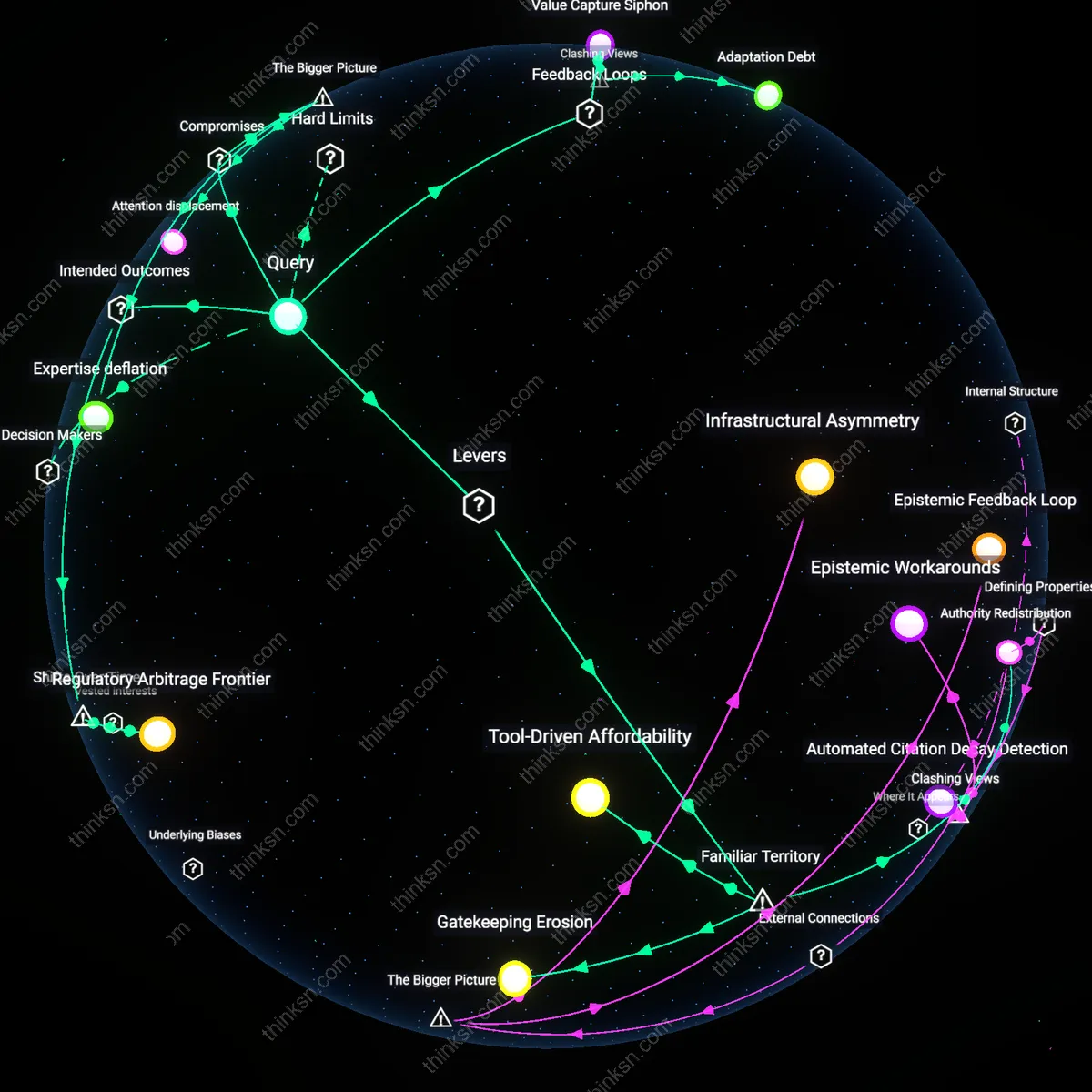
Tool-Driven Affordability
Integrate AI-powered document automation platforms like Clio Draft or LegalZoom’s AI clause generator to reduce time spent on routine drafting, enabling solo practitioners to offer lower-cost services without sacrificing margins. This leverages existing legal tech infrastructure adopted by mainstream small firms, operating through subscription-based SaaS models that convert fixed high-skill labor into variable technical overhead—making quality documentation accessible at scale. The underappreciated shift is that cost democratization now flows not from reduced expertise, but from reallocating attorney effort toward validation and customization, preserving professional standards while expanding reach.
Gatekeeping Erosion
Deploy AI legal chatbots on public-facing websites to provide jurisdiction-specific guidance on issues like eviction defense or small claims, bypassing traditional intake bottlenecks controlled by bar associations and court referral panels. These tools, framed in public discourse as 'digital paralegals,' operate through web-based NLP trained on public records and annotated statutes, allowing non-lawyers to navigate basic legal processes with confidence. What’s rarely acknowledged is that this undermines the profession’s historical control over informational gateways—turning procedural knowledge, once jealously guarded, into a freely navigable terrain shaped by algorithmic inference rather than credential-based access.
Authority Redistribution
Adopt AI-assisted legal research tools such as Casetext’s CoCounsel or Westlaw Edge AI to match or exceed the analytical speed of large firm associates, enabling solo practitioners to cite novel precedents and statutory interpretations in motion writing. This taps into widespread familiarity with 'smart search' and autocomplete—ubiquitous in consumer tech—to disrupt the perceived hierarchy of legal competence based on firm size. The overlooked consequence is that legitimacy in court filings increasingly derives from depth and precision of citation, not institutional pedigree, shifting authority from brand-name law firms to technically fluent independents who master AI-augmented workflows.
Value Capture Siphon
AI tools are concentrating legal value extraction in the hands of proprietary platform owners, not solo practitioners, because automation lowers marginal service costs while reinforcing network effects that favor centralized data brokers over individual providers. This dynamic operates through subscription-based AI legal assistants like Casetext’s CoCounsel or Harvey AI, which capture practitioner dependency by offering faster document review or research while retaining exclusive ownership of usage data—transforming what appears to be democratization into asymmetric data extraction. The non-obvious reality is that access expansion is not decentralizing expertise but creating a new layer of rentiership where independent lawyers pay to feed the very systems displacing them, undercutting the promise of equitable distribution.
Quality Mirage
The proliferation of AI-generated legal advice creates an illusion of parity in advice quality, but actually reinforces a stratified tier system where algorithmic outputs substitute for procedural competence only in low-stakes, high-volume domains like traffic violations or small claims—domains already oversaturated. This occurs through feedback loops in platforms like DoNotPay or online court-filing bots, which reduce error rates for routine tasks while making complex judgment calls less economically viable for solo practitioners to develop. The dissonant finding is that improved access to standardized outputs narrows, rather than widens, the scope of meaningful legal judgment, misleading policymakers into equating automation with empowerment when it actually hollows out the adaptive reasoning skills foundational to authentic legal advocacy.
Adaptation Debt
Solo practitioners who prioritize AI integration over structural legal knowledge deepen their exposure to regulatory obsolescence, because rapid algorithmic updates outpace bar association ethics guidance, creating a liability multiplier when models produce plausible but non-compliant advice. This feedback loop operates as firms adopt tools trained on public data without verifying jurisdictional validity, especially in rapidly changing areas like immigration or eviction law—states such as Texas and California have already seen malpractice claims spike post-AI adoption. The overlooked mechanism is that agility becomes a liability when adaptation is reactive rather than epistemic, rendering the solo bar more fragile despite apparent technological parity, thereby inverting the expectation that automation reduces professional risk.
Expertise deflation
AI-driven legal tools are reshaping market value by commoditizing routine legal tasks, forcing solo practitioners to compromise depth of service for competitive pricing, thereby accelerating the erosion of knowledge-based differentiation. Platforms like DoNotPay and LegalZoom leverage economies of scale and machine learning trained on vast datasets of public filings and precedents, enabling low-cost document generation that undercuts solo lawyers who rely on hourly billing for forms and basic counsel. This dynamic shifts the systemic function of solo practitioners from knowledge gatekeepers to client-intake managers who verify AI outputs, diminishing the return on years of specialized training and pressuring them to adopt hybrid roles that blend technical oversight with customer service—a role transition that goes unnoticed because it occurs incrementally across thousands of small firms adapting individually to aggregated platform competition.
Attention displacement
The proliferation of AI-legal interfaces favors practitioners who optimize for visibility within algorithmic recommendation systems, not those with the highest legal skill, thereby compromising representational depth for digital discoverability. As clients increasingly seek legal help through search engines, social media, and platform marketplaces (e.g., Avvo, UpCounsel), solo lawyers must invest in SEO, user engagement metrics, and platform-compliant content to remain visible, diverting time and resources from case preparation and nuanced client counseling. This systemic shift positions legal expertise as a secondary filter behind algorithmic ranking criteria—such as response time or client ratings—creating a feedback loop where market success depends on gaming visibility infrastructure rather than substantive quality, a consequence largely invisible to end users who assume top-ranked providers are the most qualified.
Regulatory Arbitrage Frontier
The uneven adoption of AI by state bars and licensing bodies since 2023 has created a patchwork compliance environment that inadvertently favors tech-literate solos who can exploit jurisdictional flexibility, shifting the axis of advantage from geographic proximity to regulatory navigation. As states like Arizona and Utah initiated sandbox programs permitting alternative legal service providers, early-adopter solo practitioners began deploying AI-assisted platforms under new licensing structures, bypassing traditional firm hierarchies to offer narrowly scoped, high-efficiency services across state lines. This transition—from localized practice bounded by physical courts to modular, AI-driven compliance modules tuned to specific regulatory regimes—enables agile solos to deliver standardized quality at lower cost where rules allow, while incumbents remain constrained by legacy ethics opinions and risk-averse governance. The overlooked outcome is not broad democratization, but the emergence of juridical edge zones where AI-enabled solos function as de facto policy entrepreneurs, testing the limits of what constitutes authorized practice.