Does One-Day-Office Policy Punish Remote Workers?
Analysis reveals 11 key thematic connections.
Key Findings
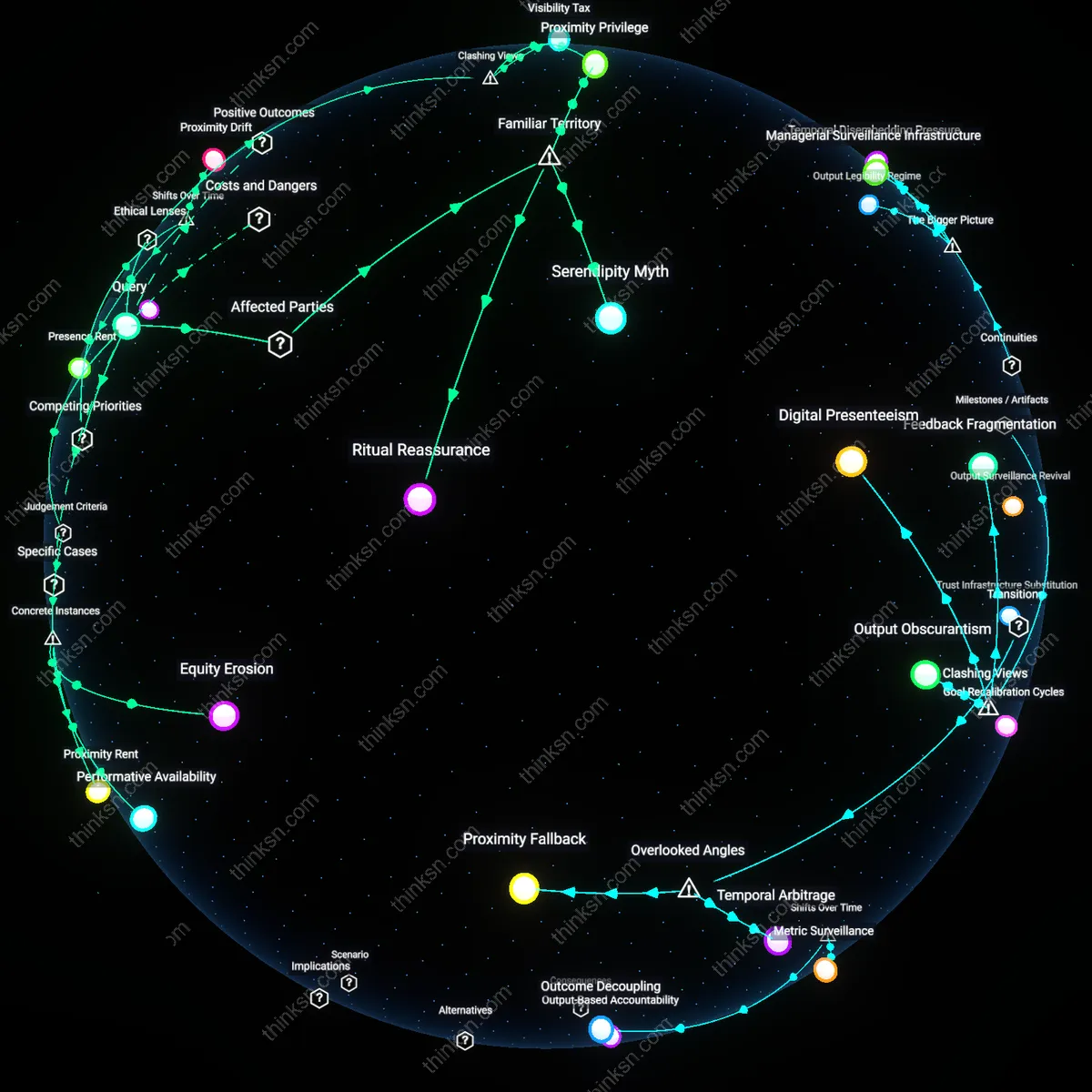
Proximity Privilege
A one-day-in-office mandate functions as a visibility test because managers in corporate headquarters consistently assign higher performance ratings to employees they see more often, even when remote workers produce equivalent or better results; this mechanism is embedded in firms like Google or JPMorgan Chase where evaluation cycles rely on subjective supervisor assessments rather than calibrated output metrics, and the disadvantage emerges from the unconscious assumption that physical presence signifies commitment. The dynamic reproduces workplace hierarchies based on access to HQ locations, disadvantaging employees in remote-friendly roles or time zones, which makes the policy’s effect non-obvious to leaders who perceive it as a neutral compromise rather than a reassertion of geographic bias in promotion systems.
Ritual Reassurance
When a hybrid policy mandates office attendance once a week, it primarily serves as a visible reaffirmation of organizational loyalty, because leaders equate attendance with cultural stewardship, particularly in legacy industries like banking or law where tradition-laden office norms persist; the function isn’t productivity but the psychological comfort of replicating pre-pandemic routines, especially among executives socialized in centralized workplaces, so employees who remain fully remote are interpreted not just as less visible but less committed, even if work quality is identical. The underappreciated consequence is that performance becomes conflated with symbolic participation, elevating ritual over results in ways that feel normal to management but create invisible barriers for remote staff.
Serendipity Myth
The requirement to come to the office one day per week operates as a visibility gate by privileging spontaneous interactions, because innovation and advancement opportunities in companies like Apple or McKinsey are believed to emerge primarily from hallway conversations and impromptu meetings that remote employees cannot access; this belief fuels decisions about project inclusion, mentorship, and promotions, even though evidence of such serendipity’s actual impact is anecdotal, and the system systematically excludes distributed teams from informal networks. The non-obvious insight is that the policy doesn’t just make remote workers less visible—it actively constructs visibility as a proxy for innovation potential, embedding a myth that shapes real career outcomes while feeling intuitively correct in elite urban workplaces.
Equity Erosion
A weekly office mandate at Google in 2022 functioned as a visibility test because managers in Mountain View disproportionately assigned high-impact projects to employees physically present, disadvantaging remote team members from marginalized regions such as South Africa and Malaysia, where full-time remote work was officially permitted. This created a de facto hierarchy of access where career advancement hinged not on output but on corporeal presence, exploiting proximity bias within performance evaluation systems. The non-obvious insight is that even neutral attendance rules amplify inequality when embedded in cultures where informal recognition determines opportunity.
Performative Availability
At Shopify in 2023, the enforcement of one day of office attendance in Ottawa became a ritual of loyalty signaling after public statements by CEO Tobias Lütke emphasized 'camaraderie' as a strategic value, transforming attendance into a performative act that remote employees could not replicate. Managers began interpreting consistent office presence as evidence of commitment, despite identical productivity metrics across work modes. The overlooked mechanism is how symbolic requirements, when culturally reinforced, become operational proxies for trustworthiness, regardless of actual performance.
Proximity Rent
When IBM rolled out hybrid mandates in 2021 across its Austin campuses, remote engineers in Dublin and Hyderabad found their technical proposals deprioritized in cross-site review panels composed mainly of U.S.-based staff who met weekly in person, creating an information arbitrage where proximity enabled faster consensus-building and agenda control. The real disadvantage emerged not from discrimination but from coordination economies that favored colocated groups in shaping project trajectories. This reveals how geographic clustering extracts invisible rents from distributed workers even in ostensibly meritocratic systems.
Presence Rent
Requiring one in-office day per week became a visibility test after the normalization of asynchronous remote collaboration post-2020, when managerial trust shifted from output verification to proximity-based reassurance. Before the pandemic, remote work was rare and tightly monitored, but during the shift to full remote, firms developed tools and practices that proved productivity could decouple from location—yet as hybrid policies emerged in 2022–2023, the mandated office day ceased to be about operational necessity and instead evolved into a recurring ritual of visibility where attendance signaled commitment. This redefined office presence not as a productive act but as a performative tax paid to remain in the organizational mainstream, disadvantaging those who could not or would not comply due to geography, care responsibilities, or disability—thus institutionalizing a new form of access inequality masked as flexibility.
Temporal Gatekeeping
The single required office day functions as a visibility filter after the erosion of synchronized work hours during the remote era, when companies abandoned rigid schedules in favor of global, asynchronous workflows between 2020 and 2022. In that period, performance was temporarily judged by contribution timing and clarity rather than availability, but as hybrid models solidified in 2023–2024, firms reintroduced synchronicity—not for task coordination, but to gate access to spontaneous decision-making and informal mentorship that cluster around that one shared day. This re-centralization of critical micro-interactions into a compressed temporal window excludes remote employees from the rhythm of visibility, not because they lack productivity, but because they are structurally absent from the socially dense moments that now carry disproportionate influence—revealing time itself as a mechanism of inclusion.
Proximity Drift
The one-day mandate began privileging office attendees after promotion criteria subtly shifted from documented performance to perceived leadership potential during the post-2022 hybrid transition, when managers—accustomed to remote evaluation—returned to offices and unconsciously calibrated assessments using proximity-based cues. Before 2020, visibility was uniformly high; between 2020 and 2021, it was uniformly low; but the uneven reintroduction of face time after 2022 created a drifting perceptual gap, where those physically present accrued subtle advantages in recognition, sponsorship, and informal feedback. This drift did not reflect deliberate bias but emerged from cognitive heuristics rewired by intermittent exposure, privileging those who occupied shared space even briefly—thus converting occasional presence into cumulative advantage and rendering full remoteness a career penalty by gradual exclusion.
Visibility Tax
A hybrid work policy requiring one office day per week functions as a visibility test when proximate employees receive disproportionate access to impromptu mentorship, leadership recognition, and career-advancing assignments, mechanisms embedded in habitual in-person interaction at firms like Goldman Sachs or McKinsey where 'face time' correlates with promotion velocity; this operates through informal networks of trust that replicate pre-pandemic corporate hierarchies, revealing how ostensibly neutral attendance rules perpetuate covert status advantages—what is underappreciated is that presence becomes a performative currency, not a productivity metric, disproportionately taxing remote workers who must compensate for absence through heightened output to achieve parity.
Institutional Presentism
A weekly office requirement functions as a visibility test when firms use attendance data as a de facto performance indicator in performance reviews, a practice observed in Amazon’s 'justification culture' where tangible behaviors are over-indexed due to metricization pressures; this operates through bureaucratic risk-aversion in performance evaluation systems that favor observable actions over distributed outcomes, reinforcing an ethical framework of procedural fairness that inadvertently penalizes remote workers not by intent but through evidentiary scarcity—what is non-obvious is that the policy becomes a ritual of institutional presentism, where being seen is not supplementary but constitutive of legitimacy, exposing a doctrinal conflict between meritocratic ideals and visibility-based proof regimes.