Are Scheduling Algorithms Undermining Predictive Scheduling Laws?
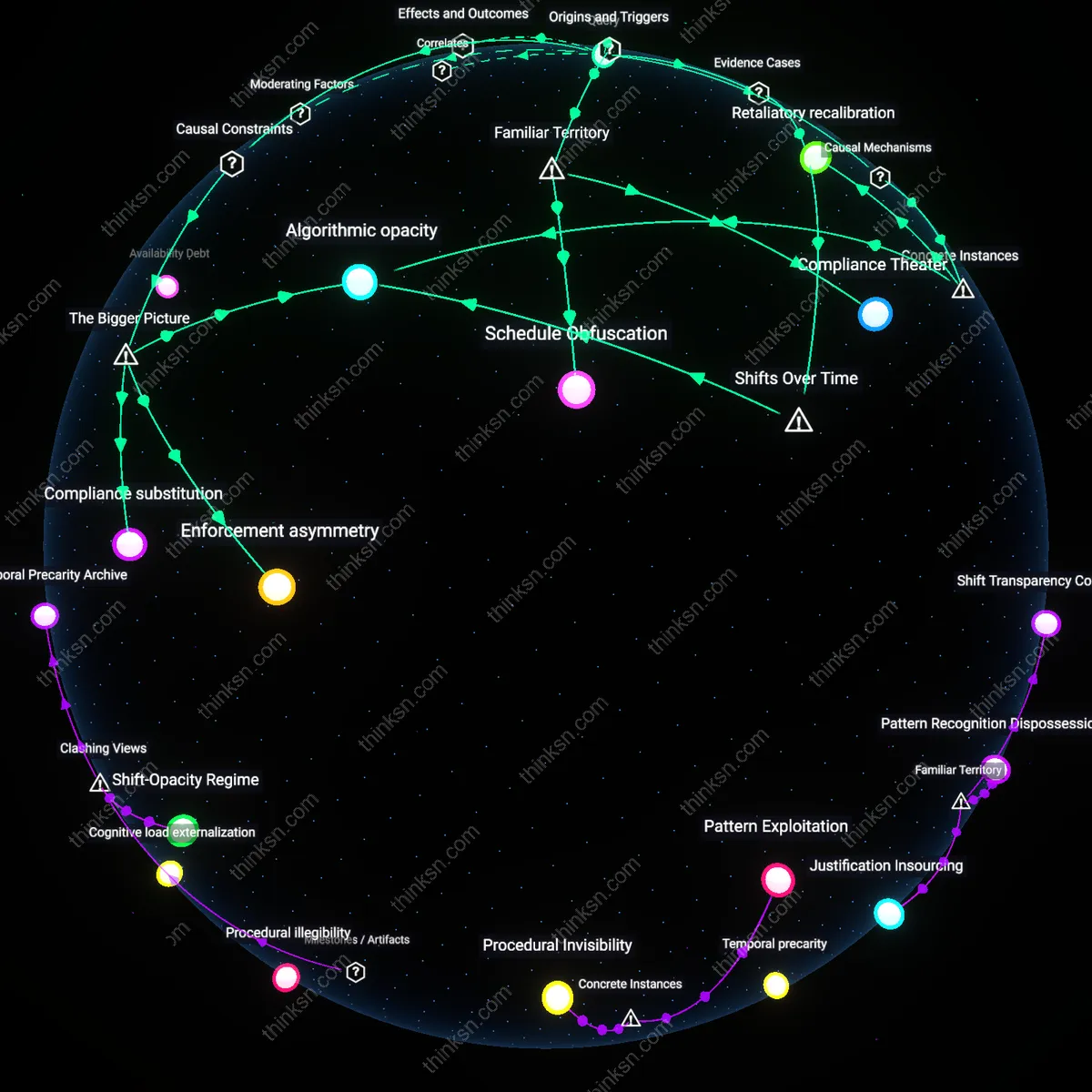
Analysis reveals 7 key thematic connections.
Key Findings
Schedule Obfuscation
Employer-controlled scheduling algorithms obscure shift availability and changes behind opaque digital interfaces, preventing workers from documenting violations necessary to trigger predictive scheduling law protections. Managers use algorithmically generated, last-minute shift adjustments delivered through apps like HotSchedules or Kronos to create plausible deniability, where workers struggle to prove scheduled changes were preventable—transforming technical opacity into a compliance shield. This mechanism shifts the burden of proof onto workers, who lack institutional access to the algorithm’s decision trail, making enforcement dependent on data they cannot obtain—revealing how interface design becomes a regulatory barrier disguised as technical neutrality.
Temporal Precarity
Predictive scheduling laws assume workers have consistent access to schedules far enough in advance to plan legally protected actions like securing child care or rejecting unfair shifts, but employer-controlled algorithms fragment time through rapid reassignments and drop-shift functionalities, compressing decision windows below the law’s effective threshold. Platforms like 7shifts or Deputy allow managers to exploit permissible exceptions—‘voluntary’ shifts or ‘unforeseen business needs’—to systematically bypass mandated predictability, rendering rights temporally inaccessible even when formally intact. The non-obvious insight is that predictability is not destroyed outright but eroded through micro-disruptions that feel incidental but cumulatively disable enforcement capacity—making time itself a contested resource in labor compliance.
Compliance Theater
Hospitality employers deploy scheduling algorithms to produce the appearance of adherence to predictive scheduling laws while maintaining operational control through adjustable variables like shift bidding, availability self-reporting, and dynamic penalty scoring. Workers must navigate these systems to claim rights, yet their inputs—like marking availability—are algorithmically deprioritized, creating a feedback loop where non-compliance is masked as individual worker non-participation. The underappreciated dynamic is that the law’s enforcement infrastructure is co-opted by the employer’s digital workflow, turning compliance into a performance measured by system logs rather than equitable outcomes—making the appearance of rights fulfillment functionally indistinguishable from actual rights denial.
Algorithmic opacity
Employer-controlled scheduling algorithms at ShiftPixy in California obscure input parameters and output logic, preventing workers from verifying compliance with predictive scheduling mandates. The algorithm’s proprietary design shields how shift assignments are generated, making it impossible for employees to trace whether sudden changes constitute violations or are automated responses to demand forecasts, thereby neutralizing their capacity to file accurate complaints with labor authorities. This mechanism illustrates how technical obscurity functions as a barrier to legal enforcement, a non-obvious constraint because the law assumes transparency of scheduling decisions.
Retaliatory recalibration
When baristas at a Starbucks in Seattle attempted to assert predictive scheduling rights under city ordinance, the employer adjusted algorithmic inputs to systematically reduce their predicted demand scores, resulting in fewer shifts. The scheduling system, managed through IBM Talent Management solutions, used performance-adjacent metrics like 'customer engagement time' to justify lower hours, masking retribution within neutral algorithmic logic. This case reveals how enforcement attempts can trigger covert system adjustments that punish workers without direct confrontation, a risk unaccounted for in current labor protections.
Enforcement asymmetry
Predictive scheduling laws assume equal access to scheduling data, but employer-controlled algorithms centralize data collection and control while dispersing worker monitoring, creating a structural imbalance in enforcement capacity. Managers and corporate systems automatically log algorithmic outputs and employee responses, while workers receive only fragmented shift notifications without historical or comparative context, leaving them unable to document patterns of noncompliance. This data asymmetry is exacerbated by app-mediated communication, which records employee actions more thoroughly than employer decisions, turning digital infrastructure into a tool of compliance deflection. The key dynamic is not just control over algorithms, but the systemic design of information flow that positions the employer as the sole credible narrator of scheduling events.
Compliance substitution
Employers use algorithmic adherence to narrow legal templates as proof of compliance, even when broader worker rights—like stable hours or predictable income—are undermined by dynamic rescheduling features built into the same system. The algorithm may technically satisfy notice period requirements, but its integration with real-time demand forecasting enables continual marginal adjustments that erode practical predictability, which the law intends but does not explicitly protect. This occurs within performance-driven franchise and corporate management systems that prioritize labor cost variance reduction above all other operational metrics, reframing legal compliance as procedural checkbox rather than substantive fairness. The critical yet hidden mechanism is the reinterpretation of legal intent through operational efficiency metrics, allowing technical compliance to mask systemic rights erosion.