Does Consumer Convenience Outweigh Privacy Risks in Aggregated Transaction Data?
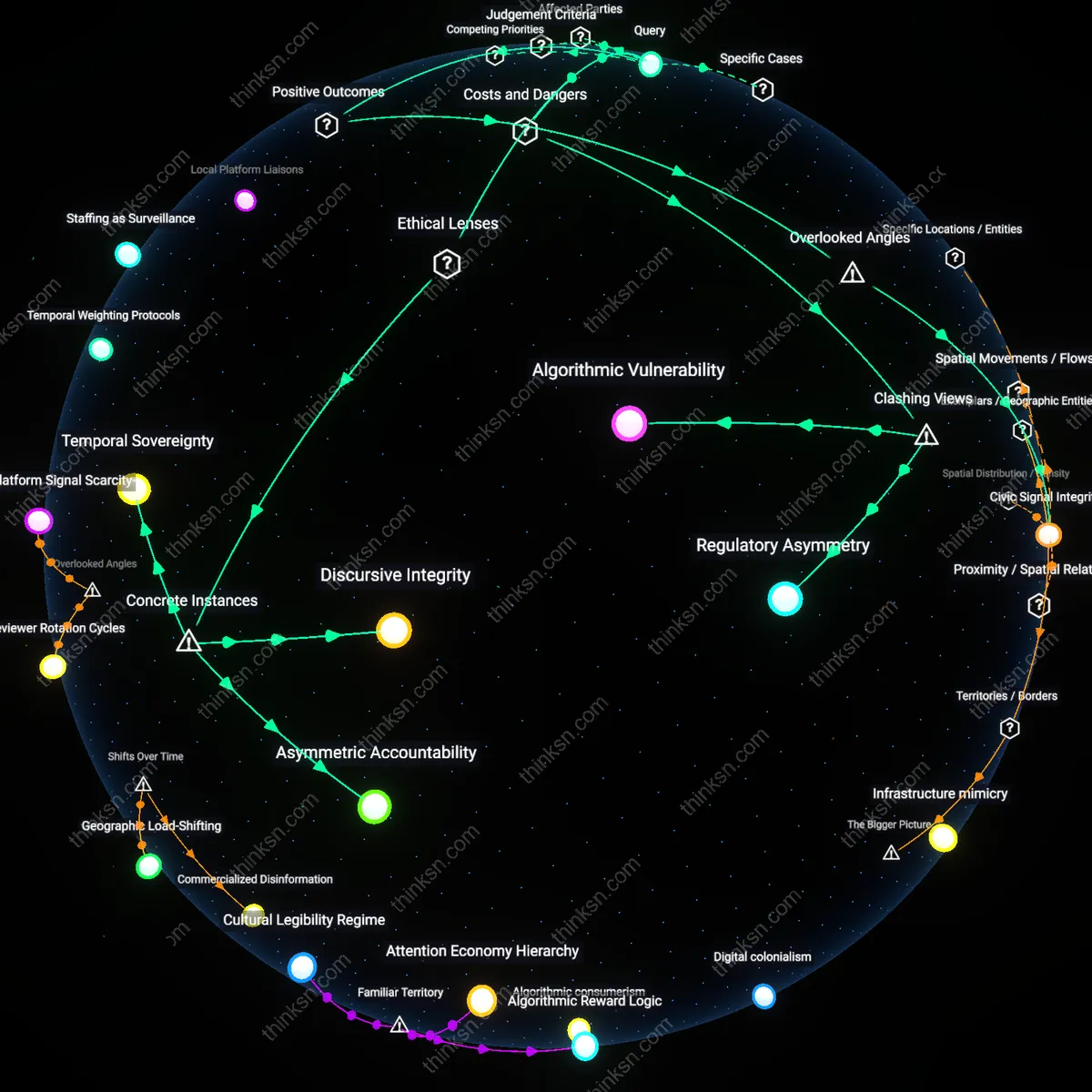
Analysis reveals 10 key thematic connections.
Key Findings
Friction Elimination
Aggregated transaction data reduces consumer decision-making latency by enabling one-click purchasing and predictive service delivery across sectors, directly increasing participation in digital economies. This compression of choice architecture—driven by platform algorithms that synthesize spending patterns from retail, transportation, and entertainment—allows payment platforms like Alipay or Mercado Pago to act as behavioral orchestrators, reducing user effort while systematically privileging their own ecosystem of services. The underappreciated mechanism is that friction reduction does not merely increment utility but reshapes market entry conditions, making third-party offerings dependent on platform-side data affordances rather than price or quality.
Surveillance Infrastructure
Consumer convenience from aggregated transaction data entrenches permanent surveillance infrastructure. Payment platforms like Stripe or PayPal compile cross-sector spending behaviors into persistent user profiles, enabling real-time tracking not just by merchants but by third-party data brokers and government agencies through legal backdoors or breaches; the mechanism operates through standardized API integrations that make de-anonymization inevitable over time, rendering privacy opt-outs functionally meaningless. What’s underappreciated is that the public associates data aggregation with targeted ads, but the deeper cost is the normalization of an always-on monitoring apparatus that operates independently of individual consent.
Platform Lock-in
Aggregation-driven convenience leads directly to platform lock-in, where users and merchants become dependent on dominant payment ecosystems like Alipay or Apple Pay due to seamless cross-service integration. The mechanism operates through network effects—more merchants attract more users, which in turn forces smaller competitors to adopt the same platform’s restrictive terms or face obsolescence—creating de facto monopolies that can dictate pricing, data access, and compliance. While most people recognize inconvenience as a barrier, the systemic danger lies in how convenience masks irreversible dependency, eliminating viable exit options even when privacy or fairness deteriorates.
Consent Theater
The illusion of user control over data reinforces consent theater, where platforms like Google Pay present lengthy terms and toggle switches that simulate choice while structuring options to nudge acceptance. This operates through standardized UX patterns—pre-checked boxes, dark patterns, and legal jargon—that exploit predictable cognitive biases, making refusal costly in time or functionality. The underappreciated harm is that people believe they are making decisions, but the system is designed so that opting out means abandoning essential services, reducing consent to a ritual that legitimizes exploitation without meaningful resistance.
Data Fiduciary Duty
Payment platforms that aggregate transaction data across sectors function as de facto financial curators, creating an obligation to act in users' best interests, as seen in the European Central Bank’s scrutiny of Visa’s expansion into non-payment data services by 2020, which triggered regulatory invocation of the GDPR’s data minimization principle to challenge data reuse beyond consent scope; this mechanism reveals that convenience creates a perceived stewardship role which regulators increasingly interpret as a binding fiduciary-like responsibility, despite no formal legal designation—highlighting that the ethical asymmetry between consumer benefit and privacy erosion activates legal personhood logics typically reserved for trusts or institutions.
Monetary Sovereignty Erosion
In China, Alipay’s integration of payment data across retail, transportation, health, and social services has enabled Ant Group to shape creditworthiness assessments beyond traditional banking channels, culminating in the 2020 derailment of its IPO by central regulators concerned about systemic risk and diminished state control over monetary policy levers; this instance shows how aggregated transaction data enables private platforms to usurp public financial authority under the guise of efficiency, illustrating that convenience functions as ideological camouflage for the privatization of economic governance—an underappreciated shift where market dominance becomes indistinguishable from monetary power.
Consumer Coercion Paradox
When Facebook (now Meta) launched WhatsApp Pay in India, leveraging its messaging dominance to push a payments system promising seamless transactions, it faced regulatory resistance from the Reserve Bank of India over data localization and anti-competitive bundling, revealing that cross-sector aggregation exploits network effects to reframe optional convenience as essential utility; the paradox lies in the ethical inversion where consumer choice is expanded in service form but contracted in data autonomy, exposing how libertarian paternalism in tech-driven markets produces compliance not through force but through engineered dependency.
Data Friction Arbitrage
Consumer convenience from cross-sector transaction data aggregation does not justify market power or privacy losses because dominant platforms like Alipay in China exploit regulatory asymmetries to repurpose financial transaction data for scoring in non-financial sectors—such as housing and employment—through backend integration with public services, thereby transforming convenience into coercive participation; this mechanism reveals that the real value of aggregation lies not in user experience but in the platform’s ability to arbitrage data friction across regulated domains, an underappreciated engine of silent surveillance expansion.
Consent Illusion Economy
The convenience of aggregated transaction data on platforms such as Brazil’s PicPay fails to justify resulting power imbalances because user 'consent' is structurally coerced through bundled service design, where access to essential fintech utilities like instant credit or bill-splitting requires unconditional data sharing across sectors—including retail, telecom, and health—revealing that privacy loss is not a byproduct but a prerequisite of the service model, which destabilizes the common assumption that users trade privacy voluntarily for utility.
Platformized Public Good
In India, the integration of UPI transaction data with private platforms like PhonePe and Google Pay does not merely enhance convenience but redefines essential financial infrastructure as a proprietary behavioral dataset, where the state’s promotion of digital payments enables private actors to accumulate monopolistic insights on citizen spending patterns; this blurs the line between public utility and corporate asset, exposing how convenience justifies privatization of social goods under the guise of innovation, a shift that bypasses antitrust scrutiny by framing dominance as systemic necessity.