Do CDNs Fast Lane Services Threaten Democratic Fairness?
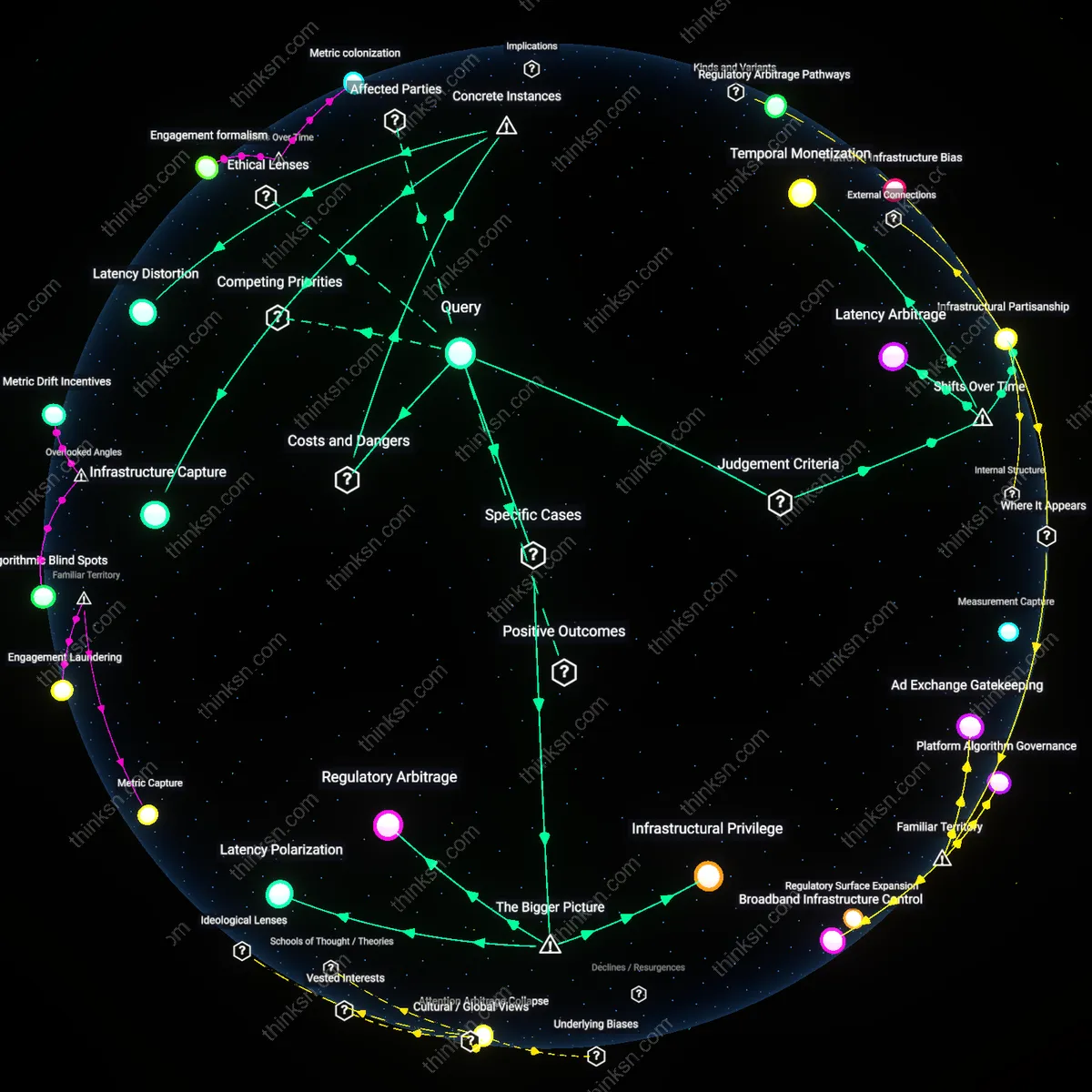
Analysis reveals 9 key thematic connections.
Key Findings
Infrastructural Partisanship
CDN fast lanes for political advertisers introduce infrastructural bias, where network performance advantages amplify certain political voices—this is judged by principles of democratic justice and political equality. The shift from non-discriminatory data transmission under early internet governance (e.g., pre-2000s end-to-end design) to tiered service models under commercialized content delivery reveals how privatized infrastructure now embeds political valuations. The mechanism—prioritized caching and reduced latency sold as a service by CDNs like Akamai or Cloudflare—systematically advantages well-funded parties, distorting fair access to public attention. What is underappreciated is that discrimination now occurs not at the point of content but at the level of delivery infrastructure, making regulatory visibility harder.
Temporal Monetization
The sale of speed by CDNs to political advertisers undermines democratic fairness by monetizing temporal advantage in information diffusion, assessed against the moral principle of equal civic opportunity. Historically, political messaging operated under roughly symmetric latency conditions during broadcast (1950s–1990s); the shift came with real-time web analytics and microtargeting in the 2010s, where milliseconds in load time directly affect conversion rates and voter engagement. The mechanism—commercial performance metrics repurposed for electoral influence—transforms political reach into a function of bidding power within content delivery ecosystems. This reveals how democratic timing, once a shared public good, has become a privatized, auctioned variable.
Latency Arbitrage
CDN fast lanes enable political actors to engage in latency arbitrage—gaining competitive electoral advantage through microseconds of delivery speed, evaluated against the practical criterion of electoral integrity. This emerges from the shift in the 2020s, when political campaigns began treating digital delivery not as publication but as high-frequency signaling, akin to financial trading infrastructures where timing determines impact. The mechanism relies on distributed edge networks that allow geofenced, speed-optimized ad bursts timed to news cycles or voting windows, operated through contractual tiers between campaign tech vendors and CDNs. The underappreciated point is that speed differentials function as covert amplification tools, escaping current campaign finance and broadcasting regulations designed for static media.
Bandwidth Asymmetry
When Facebook prioritized delivery of political ads through its fast-loading infrastructure during the 2016 U.S. presidential election, campaigns with greater financial resources gained disproportionate visibility and engagement, effectively creating a tiered speech market. This mechanism privileged well-funded actors not through content quality but through engineered speed and reach, subverting voter exposure to equitable discourse. The non-obvious risk lies in how neutral technical services like content delivery can become covert amplifiers of political inequality when performance differentials are weaponized by campaign budgets.
Infrastructure Capture
During India’s 2019 general election, Reliance Jio, which controls both a dominant cellular network and a major content platform, offered zero-rated political content for BJP-aligned campaigns while imposing data costs on opposition messaging. This convergence allowed infrastructure owners to shape electoral attention under the guise of consumer benefits, embedding partisan advantage into access conditions. The underappreciated danger is not overt censorship but the structural privileging of allies through integrated network and content control, transforming digital pipes into political levers.
Latency Distortion
In Brazil’s 2018 election, Bolsonaro’s campaign secured preferential CDN routing from local providers like TIM and Claro, ensuring viral videos loaded faster than fact-checks or critiques from mainstream media, which relied on standard delivery. This temporal advantage allowed disinformation to solidify in public discourse before corrective content arrived, distorting the epistemic timeline of voter judgment. The overlooked cost is how microseconds of delivery delay can degrade democratic deliberation by disrupting the synchrony of rebuttal and response.
Infrastructural Privilege
CDN fast lanes granted to political advertisers during the 2020 U.S. federal elections enabled entities like Republican-aligned super PACs such as America First Action to achieve near-instantaneous content delivery across major platforms, while lower-funded progressive groups faced algorithmic deprioritization due to bandwidth constraints; this asymmetry was sustained not by overt censorship but by the technical preference systems embedded in Akamai and Cloudflare’s edge servers, which prioritize content based on commercial SLAs rather than public interest. This mechanism reconfigures democratic parity not through visible suppression but through differential speed in information propagation, which shapes voter perception and media momentum—a dynamic rarely scrutinized in campaign finance or broadcasting law. The overlooked force here is how neutral technical protocols, when governed by private contract, become vectors of political advantage, pivoting electoral fairness on infrastructure-tier decisions made outside public view.
Regulatory Arbitrage
When Cloudflare extended priority caching services to political operatives during Brazil’s 2022 presidential election, including those aligned with Bolsonaro’s campaign, the service operated under the legal premise of neutral platform provision, circumventing Brazil’s electoral broadcast equity laws that regulate TV and radio airtime but lack jurisdiction over content delivery speed; this created a de facto fast lane unaddressable by existing oversight bodies like the Superior Electoral Court, which lacks authority over foreign-based digital infrastructure firms. The unseen consequence is that democratic safeguards evolved for linear media fail to bind new forms of distributional control—where latency becomes power—enabling campaigns to exploit jurisdictional gaps between national election law and transnational CDN governance. This reveals how regulatory fragmentation across layers of digital infrastructure enables political actors to bypass fairness mandates through technical, not legal, innovation.
Latency Polarization
During India’s 2019 general election, BJP-affiliated digital agencies leveraged exclusive peering agreements with CDNs such as Google’s Cloud CDN to reduce packet loss and accelerate video ad delivery across rural networks, where connectivity delays typically hinder opposition messaging, effectively skewing voter exposure toward incumbent narratives before challengers could mobilize responses; because the speed disparity was embedded in network topology rather than content, it escaped scrutiny under the Election Commission’s code of conduct, which does not regulate technical performance metrics. This erosion of temporal parity—where latency systematically disadvantages under-resourced parties—demonstrates how infrastructure-performance gradients can silently deepen political asymmetry, reframing fairness not as a question of access but of timing adequacy in attention economies.