Hate Speech Rules vs Merchant Rights on Payment Networks?
Analysis reveals 12 key thematic connections.
Key Findings
Merchant Platform Liability
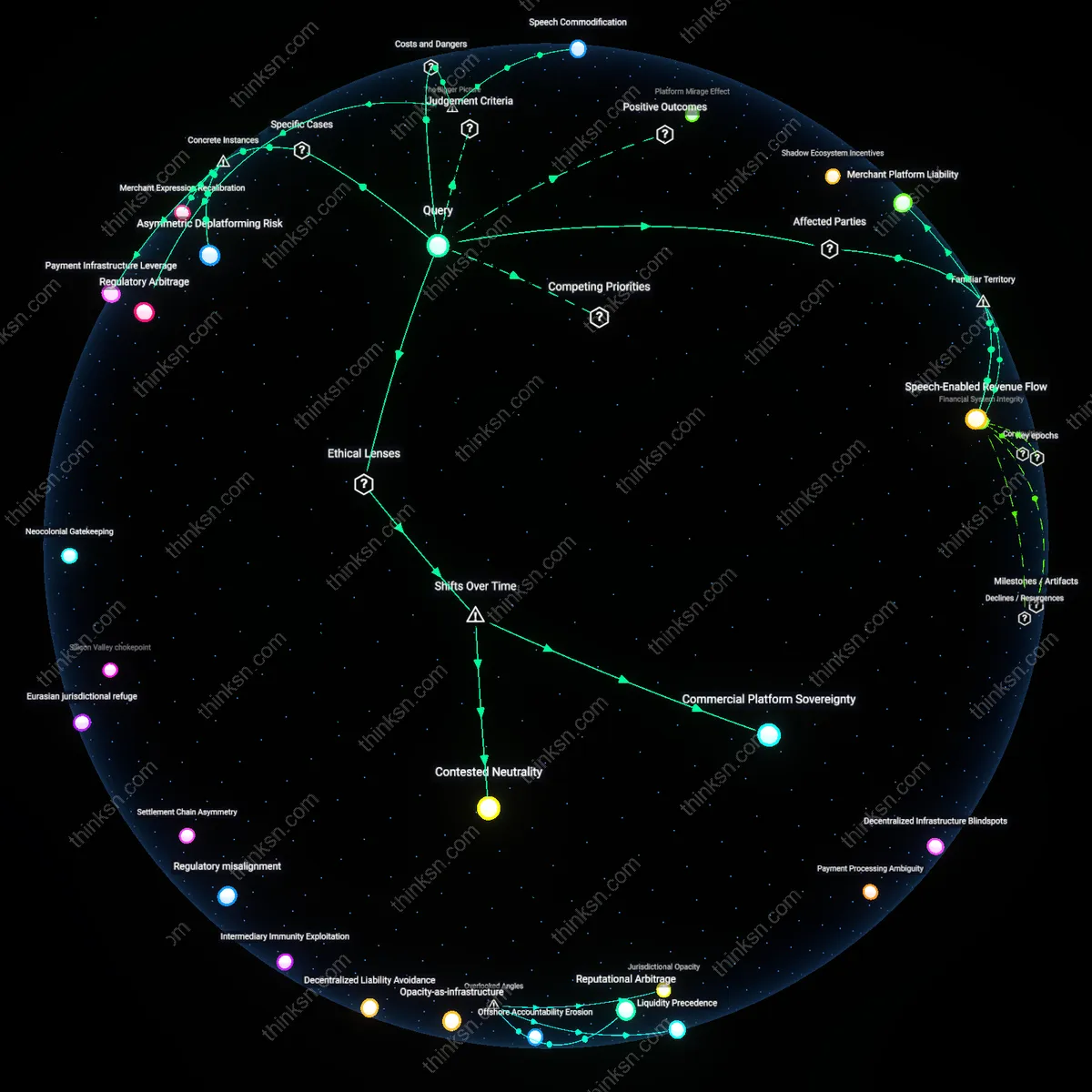
Payment networks should limit hate speech when it directly enables financial participation in harmful ecosystems, because platforms like Stripe or PayPal function as de facto gatekeepers to commerce and amplify reach through integration—unlike public forums, these systems embed speech within transactional legitimacy, making neutrality a form of endorsement; the underappreciated point is that allowing controversial views is not the same as enabling them through seamless financial infrastructure, which confers operational viability.
Speech-Enabled Revenue Flow
The benefit of reducing hate speech outweighs individual merchant expression when that speech is tied to monetization at scale, because payment processing transforms rhetoric into economic power—groups like extremist publishers or conspiracy-driven retailers rely on automated payment routing not just to speak, but to sustain; people intuitively associate payment systems with neutrality, but miss how processing payments for hate-based businesses institutionalizes their influence beyond what mere visibility could achieve.
Financial System Integrity
Payment networks must prioritize systemic trust over individual expression because their stability depends on broad public confidence that transactions aren’t supporting societally condemned behaviors—this is why networks like Visa and Mastercard discontinue services to controversial platforms after public backlash; most people associate free speech rights with platforms or speech hosts, but overlook that financial intermediaries operate under reputational and regulatory constraints more akin to banks than social media, where facilitating transactions implies risk endorsement.
Speech Commodification
Monetizing content moderation on a payment network transforms free expression into a tiered, economically enforced privilege, where the ability to process transactions determines whose speech is viable. Financial intermediaries like Stripe or PayPal become de facto regulators of acceptable discourse, not through legal mandate but through risk-based policies tied to brand safety and investor liability—pressures amplified by systemic exposure to boycotts or regulatory scrutiny. This shift is underappreciated because it frames censorship not as state suppression but as market-driven selection, where the cost of enabling controversial speech is internalized by private actors optimizing for stability over pluralism.
Merchant Radicalization
Suppressing controversial political viewpoints through payment denial can accelerate the radicalization of affected merchants by validating narratives of systemic exclusion and fueling decentralized, less accountable financial alternatives. When businesses tied to fringe ideologies lose access to mainstream processors—such as far-right vendors removed from Shopify or PayPal—evidence indicates they migrate to parallel networks like cryptocurrency platforms or niche processors that lack transparency or oversight, increasing the risk of illicit financial flows. This consequence emerges from a feedback loop between corporate compliance norms and identity-based resistance, where moderation triggers deeper entrenchment rather than compliance, destabilizing long-term regulatory coherence.
Regulatory Arbitrage
Allowing payment networks to police hate speech creates a jurisdictional loophole where platforms outsource content governance to avoid liability under laws that protect free expression, such as Section 230 or the First Amendment. By framing deplatforming as a terms-of-service issue rather than editorial suppression, companies like PayPal shift normative burdens onto private discretion while immunizing themselves from legal challenge—enabling a patchwork of enforcement driven more by reputational risk than consistent principle. This dynamic reflects a deeper systemic drift toward governance abstraction, where accountability evaporates not because rules are absent, but because enforcement is embedded in opaque operational policies.
Commercial Platform Sovereignty
Payment networks should prioritize reducing hate speech over merchants’ controversial political expression because their evolution from neutral transaction processors into de facto public utilities has transformed them into regulators of acceptable discourse. As private actors managing critical infrastructure—like Visa and Mastercard during the 2021Parler deplatforming—they now exercise discretionary control traditionally reserved for states, justified through neoliberal governance models that delegate public order functions to corporations. This shift, crystallized after the 2016–2020 escalation in online radicalization, reveals how the privatization of speech governance has quietly normalized corporate authority over political expression, making Commercial Platform Sovereignty the unspoken outcome.
Contested Neutrality
The balance must tilt toward preserving space for controversial political views because payment infrastructure was historically designed as a neutral economic conduit, not a speech gatekeeper, a principle rooted in common carriage doctrines upheld in U.S. telecommunications law until the early 2000s. Since the post-9/11 financial surveillance expansion and intensified after the 2017 alt-tech migration, however, networks like PayPal have selectively enforced content policies influenced by securitization logic, transforming neutrality from a technical standard into a politically contested one. This transition exposed how the erosion of presumed fungibility in digital payments has turned financial intermediaries into ideological filters, producing Contested Neutrality as a structural condition rather than a policy choice.
Speech-Liability Asymmetry
Merchants’ rights to express controversial views should be subordinated to hate speech reduction because the liability landscape for online platforms shifted fundamentally after Section 230’s uneven application to financial intermediaries, unlike social media hosts, leaving payment processors uniquely exposed to civil and reputational risk. Following the 2012 Stop Online Piracy Act debates and amplified by the 2017-2020 deplatforming campaigns, banks and payment firms began pre-emptively distancing themselves from politically toxic clients not due to legal mandate but fear of accessory liability and ESG investor backlash. This created a Speech-Liability Asymmetry where payment networks bear disproportionate consequences for enabling speech compared to other intermediaries, reshaping their role from passive enablers to preemptive censors.
Payment Infrastructure Leverage
When PayPal restricted payments to Alex Jones’s InfoWars in 2018, it effectively curtailed the distribution capacity of a controversial political outlet not through content removal, but by withdrawing financial infrastructure, demonstrating that payment networks can shape speech ecosystems by selectively enabling or disabling monetization. This case reveals how intermediaries, operating beyond traditional editorial or platform moderation roles, exercise influence through backend financial controls that are less visible but more decisive than speech regulation, making their policies a de facto governance mechanism. The significance lies in the underappreciated reality that financial gatekeeping, not content takedowns, often constitutes the most effective constraint on hate-adjacent discourse in digital economies.
Merchant Expression Recalibration
In 2020, Patreon suspended far-right podcaster Lauren Southern for violating its hate content policy, prompting backlash from conservative creators who claimed political censorship, yet the platform’s private status and terms of service insulated it from free speech claims, illustrating how private payment networks can recalibrate the boundaries of acceptable expression by redefining commercial eligibility rather than engaging in public speech debates. This instance shows that the enforcement of expressive limits occurs not through legal compulsion but through contractual discretion, where the right to host controversial views is contingent on alignment with commercial brand safety standards. The non-obvious insight is that expression is increasingly regulated not by law or public norms, but by the internal risk calculus of payment-dependent platforms.
Asymmetric Deplatforming Risk
After the 2021 Capitol riot, Stripe discontinued processing donations for the Republican National Committee over concerns about incitement, marking a rare instance where a payment processor targeted a major political institution, thus exposing how hate speech mitigation policies can generate asymmetric consequences when applied across ideological lines due to risk-averse corporate decision-making. This case reveals that financial deplatforming is not evenly distributed but disproportionately affects actors perceived as high-risk, regardless of formal political status, due to automated compliance systems and reputational exposure. The critical insight is that payment networks, in seeking to avoid association with extremism, may inadvertently penalize legitimate political speech when their enforcement mechanisms lack political neutrality.