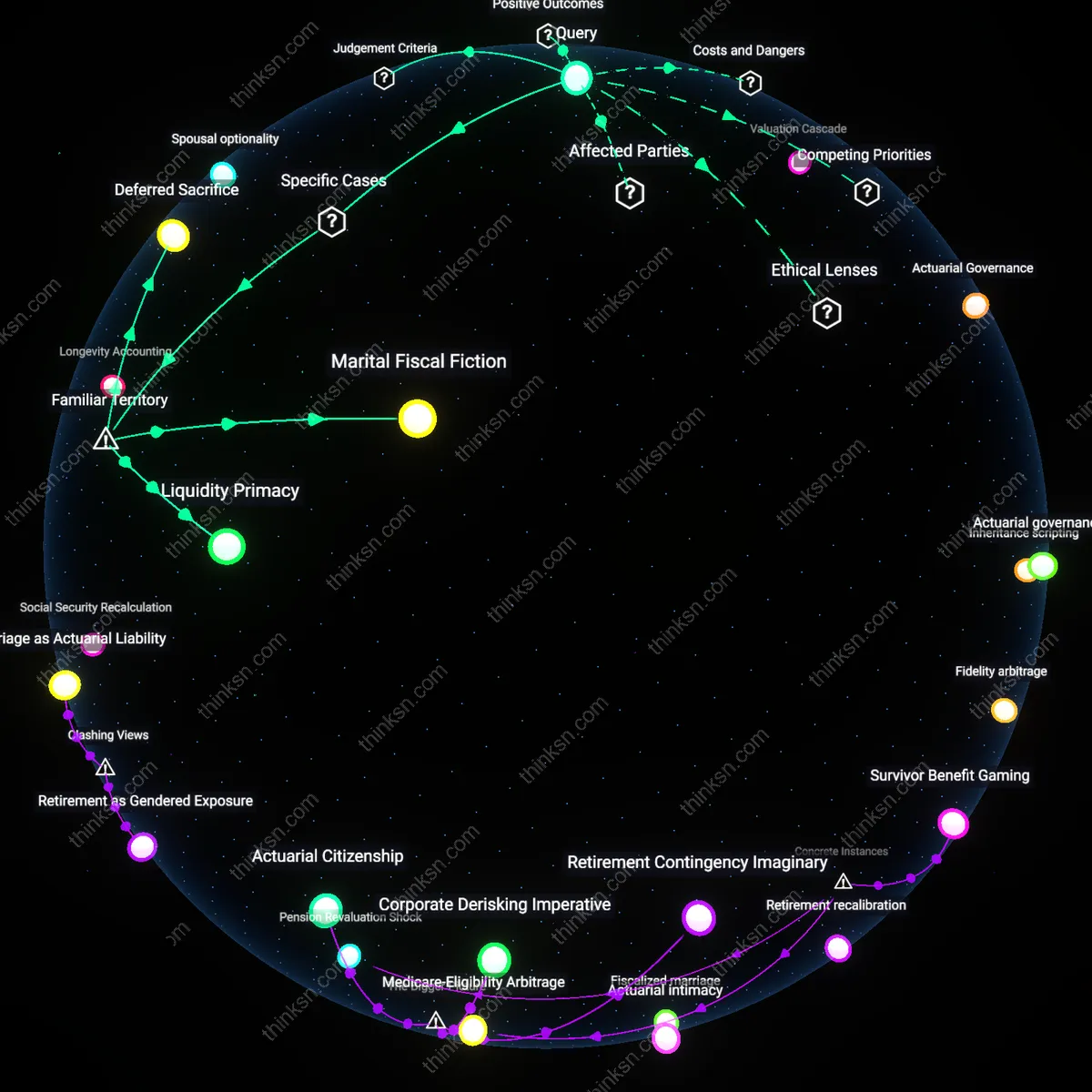
Actuarial Citizenship
The shift began in 1972 with the U.S. Social Security Amendments that formally indexed spousal benefits to work histories and longevity expectations, transforming entitlements from marital status guarantees into statistically priced obligations—this recalibration emerged from the integration of actuarial models into federal policy design, driven by Treasury Department economists and the Office of Management and Budget, who reframed dependents’ claims as calculable liabilities rather than automatic rights. By embedding demographic risk projections into benefit formulas, the state redefined the spouse as an actuarial category, altering how households assess retirement exposure not through moral entitlement but probabilistic forecasting, a change largely invisible to the public but structurally decisive in privatizing risk onto families. The non-obvious insight is that citizenship, once tied to status-based claims, now quietly hinges on statistical conformity to modeled life paths, making marital and retirement planning subject to risk governance regimes not social contracts.
Corporate Derisking Imperative
Beginning in the 1980s, Fortune 500 companies systematically shifted from defined benefit pensions to 401(k) plans following the Employee Retirement Income Security Act (ERISA) of 1974 and subsequent IRS regulatory interpretations, which financially incentivized employers to treat spousal annuities as contingent liabilities rather than stable obligations—this pivot was operationalized by corporate CFOs and benefits consultants who adopted financial risk management frameworks from capital markets, thereby aligning human resource planning with balance sheet optimization. As pension fund underfunding risks became quantifiable and legally enforceable, firms externalized spousal security onto individual investment accounts, compelling families to anticipate longevity gaps, market swings, and divorce risks as personal financial variables rather than societal assurances. The underappreciated consequence is that corporate balance sheet discipline, not demographic change or individual choice, became the primary engine reshaping domestic retirement behavior, revealing how private capital allocation logic colonized intimate life planning.
Retirement Contingency Imaginary
The transformation crystallized in the 1990s through the rise of financial advisory software like Quicken and later digital forecasting tools from Fidelity and Vanguard, which began incorporating spousal benefit scenarios as adjustable risk parameters—this technological shift was propelled by financial services firms that reframed retirement planning as a simulation of probabilistic outcomes, where surviving spouse needs became inputs in Monte Carlo models rather than preset entitlements. These tools, designed by data scientists and behavioral economists, normalized the idea that marriage duration, health differentials, and earnings disparities must be actively modeled, not assumed, thereby installing a new cognitive framework in which families treat retirement as a managed exposure. The overlooked dynamic is that the interface between code and domestic life—through algorithms embedded in consumer finance platforms—became the primary site where social promises were algorithmically dissolved into personalized risk profiles, making the future of spousal support a computational exercise in scenario stress-testing rather than a claim on collective provision.
Pension Revaluation Shock
The 1974 ERISA legislation recalibrated spousal benefits by mandating joint-and-survivor annuities in private pension plans, forcing families to treat marital longevity as a financial liability rather than a social guarantee, exposing them to actuarial risk in retirement planning for the first time; this legal-engineered shift made divorce risk and spousal mortality visible actuarial inputs in household financial models, revealing how federal risk-shifting policies recalibrated domestic life into quantifiable exposure.
Medicare-Eligibility Arbitrage
Beginning in the 1990s, dual-earner couples in metropolitan areas like Boulder and Cambridge began strategically timing divorces to preserve ex-spousal Medicare and Social Security benefits while minimizing cohabitation costs, treating marital duration as a regulatory arbitrage window rather than a lifelong commitment; this emergence of 'gray divorce' as a financial instrument reveals how benefits cliffs transformed marriage into a time-bound compliance structure optimized through legal exit strategies.
Survivor Benefit Gaming
In 2008, U.S. military retirees in San Antonio began structuring SBP (Survivor Benefit Plan) enrollments based on expected spousal mortality and secondary marriage plans, treating the benefit not as a promise but as an insurance bet against spousal survival; this localized pattern exposed how state-managed spousal benefits, when made opt-in and actuarially priced, incentivize families to model marriage durations probabilistically, introducing speculative logic into intimate life planning.
Actuarial governance
The shift from social promise to calculated risk reframed marital benefits as contingent on actuarial projections, altering family retirement planning through institutional risk calibration rather than moral obligation. Pension administrators and federal actuaries began embedding stochastic modeling into spousal entitlement formulas in the 1980s, treating longevity differentials between spouses as liabilities to be priced, not dignities to be honored—this converted the marital unit into a biometric portfolio subject to discount rates and survival probabilities. The non-obvious mechanism here is the quiet displacement of equity-based entitlement logic by probabilistic finance logic within federal benefit administration, which families then mimicked in private planning, adopting financial behaviors designed for risk pooling, not relational solidarity.
Inheritance scripting
Retirement planning began to prioritize transferability of assets over shared consumption, as spousal benefits were no longer assumed and thus forced couples to engineer inheritance paths through life insurance, trusts, and beneficiary designations. Wealth managers and estate attorneys, particularly in dual-income households in metropolitan corridors like Boston and Chicago, quietly replaced pension reliance with cascading title arrangements and conditional disbursements that treated the surviving spouse less as heir and more as risk-mitigated beneficiary. This scripting—structuring ownership so that death triggers automatic, optimized transitions—reveals how retirement strategy absorbed estate logic earlier and more pervasively than recognized, shifting temporal planning from life-course rhythm to contingency automation.
Fidelity arbitrage
As spousal benefits became uncertain, marital duration acquired financial option value, leading some couples to strategically time divorce or reconciliation to maximize discrete entitlement thresholds tied to marriage length. Women in mid-tier income brackets, especially in Sun Belt states with community property laws, sometimes maintained legally married status past emotional separation to preserve 10-year pension-sharing eligibility under ERISA, a practice rarely discussed in policy debates but widely acknowledged among divorce mediators and retirement advisors. This reveals a clandestine financial calculus where affective legitimacy is leveraged to extract actuarial rents, demonstrating that personal relationship choices have been covertly financialized through benefit cliff edges, a dynamic absent from mainstream retirement discourse.
Retirement recalibration
The shift from viewing spousal benefits as a guaranteed social promise to a contingent financial risk forced households to actively model survivorship income gaps in retirement planning, particularly affecting dual-earner couples who began treating one partner’s delayed claiming as a form of longevity insurance. This recalibration emerged with the 1983 Social Security Amendments, which codified differential accrual by gender but also introduced actuarial neutrality, making timing a strategic variable rather than a default pathway. What is underappreciated is how this transformed marital coordination into a temporal investment decision, embedding pension logic into domestic time management.
Fiscalized marriage
Beginning in the 1990s, as pension systems shifted from defined benefit to defined contribution models, spousal entitlements ceased to be administered as expressions of marital solidarity and became subject to household-level risk assessment in financial planning. This converted marriage into a fiscal unit whose stability was measured not by social recognition but by its capacity to absorb income shocks upon retirement or death. The analytical significance lies in the quiet displacement of social trust with financial surveillance within the family, where fidelity to retirement solvency often outweighs formal benefit knowledge.
Actuarial intimacy
Since the 2000s, financial advisors and robo-planning platforms have institutionalized probabilistic thinking about spousal survivor benefits, prompting couples to make decisions based on life expectancy algorithms, gendered mortality tables, and tax-efficiency simulations. This has introduced actuarial logic into personal relationship choices, such as when to retire or who should claim first, making intimate partnerships sites of risk pooling akin to insurance underwriting. The underappreciated shift is that emotional decisions about interdependence are now filtered through statistical normalcy, redefining spousal care as preemptive loss mitigation.
Retirement as Gendered Exposure
The reclassification of spousal benefits from guaranteed support to actuarial risk shifted retirement planning into a covert mechanism of gendered financial exposure, where women’s economic vulnerability in later life became statistically priced but socially obscured. Insurance models and pension reforms post-1970s increasingly treated marital longevity as probabilistic risk rather than social obligation, embedding actuarial logic into 401(k) designs and Social Security optimization algorithms that privilege dual-earner couples. This created a hidden architecture of exposure where single-earner spouses—disproportionately women—were structurally underprotected, not due to policy neglect but because risk models treated their dependency as a calculable liability rather than a social duty, thereby normalizing gender asymmetry in retirement outcomes as an actuarial outcome rather than a political choice. The non-obvious consequence is that gender equity in retirement eroded not through overt exclusion but through the technical neutralization of care work within financialized risk frameworks.
Marriage as Actuarial Liability
As employers and policymakers transitioned from defined benefit pensions to defined contribution plans in the 1980s, spousal benefits ceased to function as a deferred wage for homemaking and instead became an actuarial burden to be minimized in retirement modeling. Firms like Fidelity and Vanguard integrated ‘spousal discount factors’ into their retirement simulators, where marital duration and survivorship were projected based on population-level divorce and mortality rates, effectively pricing marriage as a volatile variable rather than a stable commitment. This reframing caused households to strategize marriage duration tactically—delaying spousal claims, divorcing before survivor benefits vested, or structuring IRAs to bypass marital defaults—revealing that the economic rationality of marriage itself was being recalibrated by back-end risk algorithms. The dissonance lies in the fact that spousal planning became less about interdependence and more about liability management, undermining the cultural ideal of marriage as a shared retirement project.
Defined Benefit Erosion
The dismantling of defined benefit pension plans after the 1970s replaced guaranteed spousal annuities with individual account risk, shifting retirement planning from interdependence to financial self-reliance. Employers, insurers, and the federal government—through ERISA and later pension deregulation—created incentives to move risk onto workers by codifying portability and individual ownership of retirement assets, which weakened the automatic entitlement of spouses to lifetime income. This mechanism reframed marriage as a financial arrangement subject to actuarial calculation rather than social obligation, an institutional shift most people overlook when recalling pensions as simply 'employer promises.'
Social Security Recalculation
The progressive actuarial adjustments to Social Security spousal benefits beginning in the 1980s—especially the Family Maximum and provisions like Public Law 98-369—required families to model marital longevity and earnings differentials as probabilistic inputs, not assumptions. As planners, couples, and financial advisors began running 'claiming strategy' simulations, they treated marriage duration and survivorship as variables in an optimization algorithm, embedded in software tools like Maximize My Social Security. This turn to computational modeling, now a common ritual in middle-class retirement prep, reveals how a once-stable entitlement became a contingent outcome—something most associate with 'financial advice' but not with the erosion of marital entitlements.