Retirement Savings at Risk: Post-Nup or Court Odds?
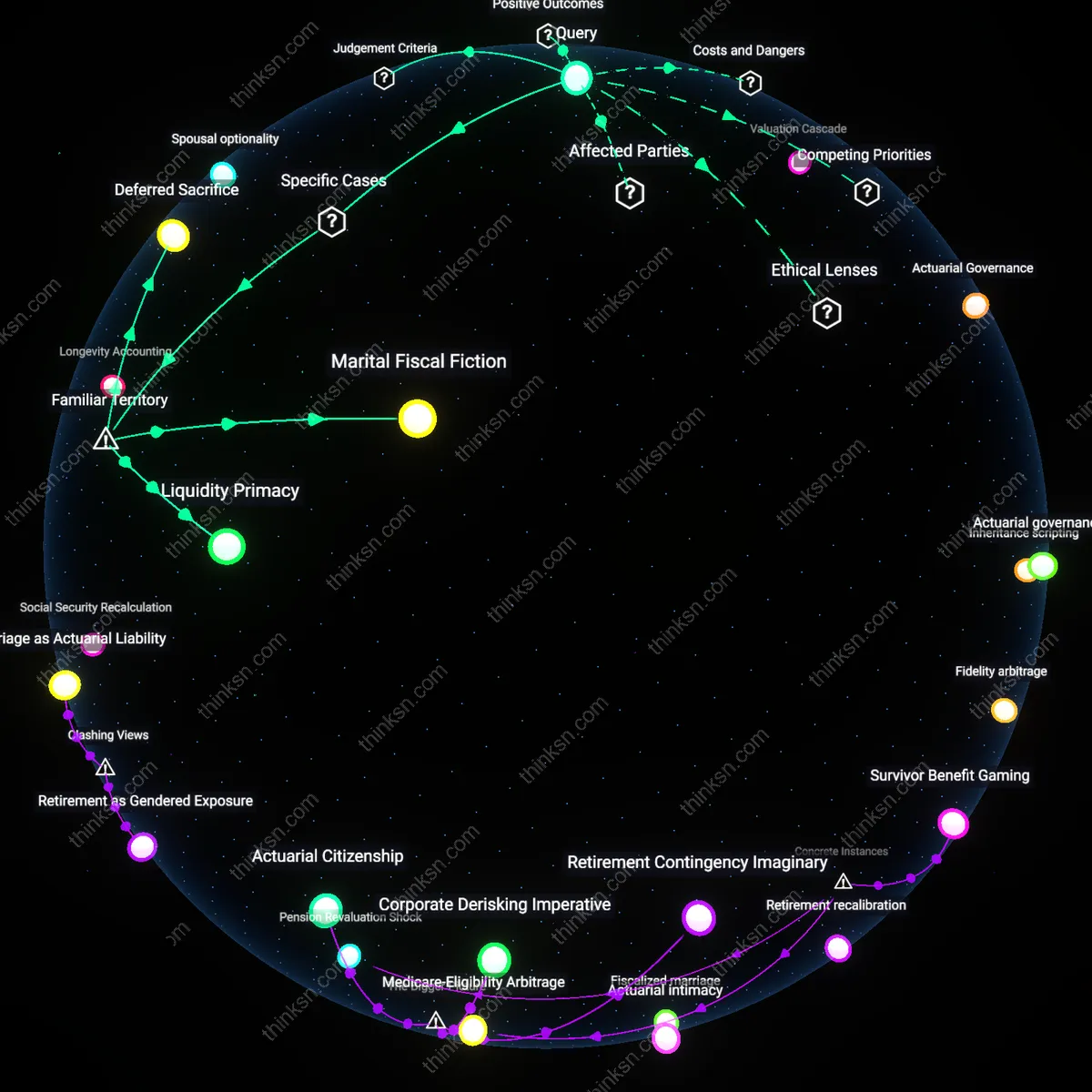
Analysis reveals 7 key thematic connections.
Key Findings
Fiduciary Erosion
One should assess the balance by recognizing that post-nuptial agreements shift retirement security from collective legal safeguards into privatized financial instruments, thereby weakening the fiduciary obligations of family and state. Courts historically enforce asset division to protect vulnerable spouses, particularly women over 50 who may have sacrificed careers for caregiving, but post-nuptial contracts preempt this by institutionalizing asset retention as a marital norm. This creates a mechanism where retirement protection becomes contingent on negotiation power within marriage rather than statutory equity, which disproportionately benefits higher-earning partners. The non-obvious consequence is not greater security but the quiet dismantling of shared responsibility under the guise of planning—revealing how private agreements can erode public expectations of spousal care.
Institutional Displacement
One should assess the balance by seeing post-nuptial agreements as displacing judicial discretion into the hands of estate planners, private mediators, and financial advisors who lack accountability to marital equity. Unlike courts, which weigh fairness, need, and contribution within a public legal framework, private actors optimize for asset preservation, tax efficiency, and client mandate—transforming retirement protection into a technical exercise detached from relational justice. This shift moves decision-making from transparent, appealable forums to opaque backrooms where norms of care are irrelevant. The overlooked reality is that unpredictability in court rulings is not a flaw to be eliminated but a feature that allows adaptation to lived inequities—replaced by a supposedly stable system that entrenches existing power.
Marital Property Industrialization
One should prioritize a post-nuptial agreement to lock in retirement savings because modern family law since the 1970s has shifted from fault-based adjudication to equitable distribution regimes, particularly after the divorce rate peak in the 1980s, making court outcomes less predictable due to judicial discretion in dividing assets; this mechanism, embedded in U.S. state-level family courts, transforms marriage into a financial partnership subject to probabilistic outcomes, rendering preemptive contractual clarity ethically necessary under utilitarian principles that minimize future harm and uncertainty. The non-obvious insight is that post-nuptial agreements are not signs of distrust but rational responses to the bureaucratization of marital dissolution, where standardized legal frameworks unintentionally increase financial volatility for long-term assets like pensions.
Fiduciary Temporal Asymmetry
One should assess the balance by recognizing that since the rise of no-fault divorce in the 1970s, the ethical duty within marriage has subtly shifted from a covenantal model to a fiduciary one, where spouses are expected to manage mutual economic interests with foresight, particularly as retirement spans lengthened in the late 20th century; under deontological ethics, this creates a temporal asymmetry—decisions made during marital stability (e.g., post-nups) carry disproportionate weight over those made under duress during dissolution, which courts struggle to resolve fairly. The underappreciated dynamic is that post-nuptial agreements, once seen as adversarial, now serve a restorative justice function by preserving agency and preventing future power imbalances that arise from aging and declining earning capacity.
Retirement Securitization Paradigm
One should favor post-nuptial protection of retirement savings because the transition from defined-benefit to defined-contribution plans after the Employee Retirement Income Security Act (ERISA) of 1974 has individualized financial risk, making retirement assets more volatile and court-division less predictable under community property systems; within neoliberal governance, this shift redefines spousal claims not as moral rights but as negotiable exposures subject to risk management, aligning with contractualist ethics that frame fair division as pre-agreed allocation rather than judicial redistribution. The overlooked consequence is that post-nuptial agreements have become instruments of financialized marital governance, where asset protection reflects not distrust but a rational adaptation to the privatization of old-age security.
Marital Financial Stratification
Wealthy couples in high-earnings jurisdictions like California increasingly use post-nuptial agreements to insulate retirement portfolios from speculative divorce rulings, not because courts are inconsistent, but because family law in community property states creates predictable redistribution pressures that incentivize preemptive asset segregation. This mechanism is amplified by the interplay between retirement account growth under market volatility and statutory presumptions of equal division, making post-nuptial terms a form of risk arbitrage against future judicial discretion. The non-obvious insight is that these agreements do not merely reflect distrust—they function as structural adaptations to the formal predictability, not unpredictability, of court-ordered division, revealing how legal certainty can drive private contractual insulation among economic elites.
Retirement Regime Arbitrage
Federal employees with CSRS or FERS pensions in states such as Virginia often enter post-nuptial agreements to override default state division rules that would otherwise entitle a spouse to survivor benefits or a portion of annuity payments, not because divorce outcomes are uncertain, but because the intergovernmental tension between federal retirement schemes and state marital authority creates a known risk of automatic benefit forfeiture unless contractually managed. This condition arises from the supremacy of federal statutes in governing civil service benefits, yet state courts retain jurisdiction over marital division, producing a jurisdictional seam that informed parties exploit through nuptial contracts. The overlooked reality is that the 'unpredictability' feared is not judicial caprice but the mechanical operation of cross-jurisdictional rules, turning post-nuptial agreements into instruments of bureaucratic navigation rather than personal contingency planning.