How a Forensic Accounting Gap Skews Divorce Asset Fairness?
Analysis reveals 11 key thematic connections.
Key Findings
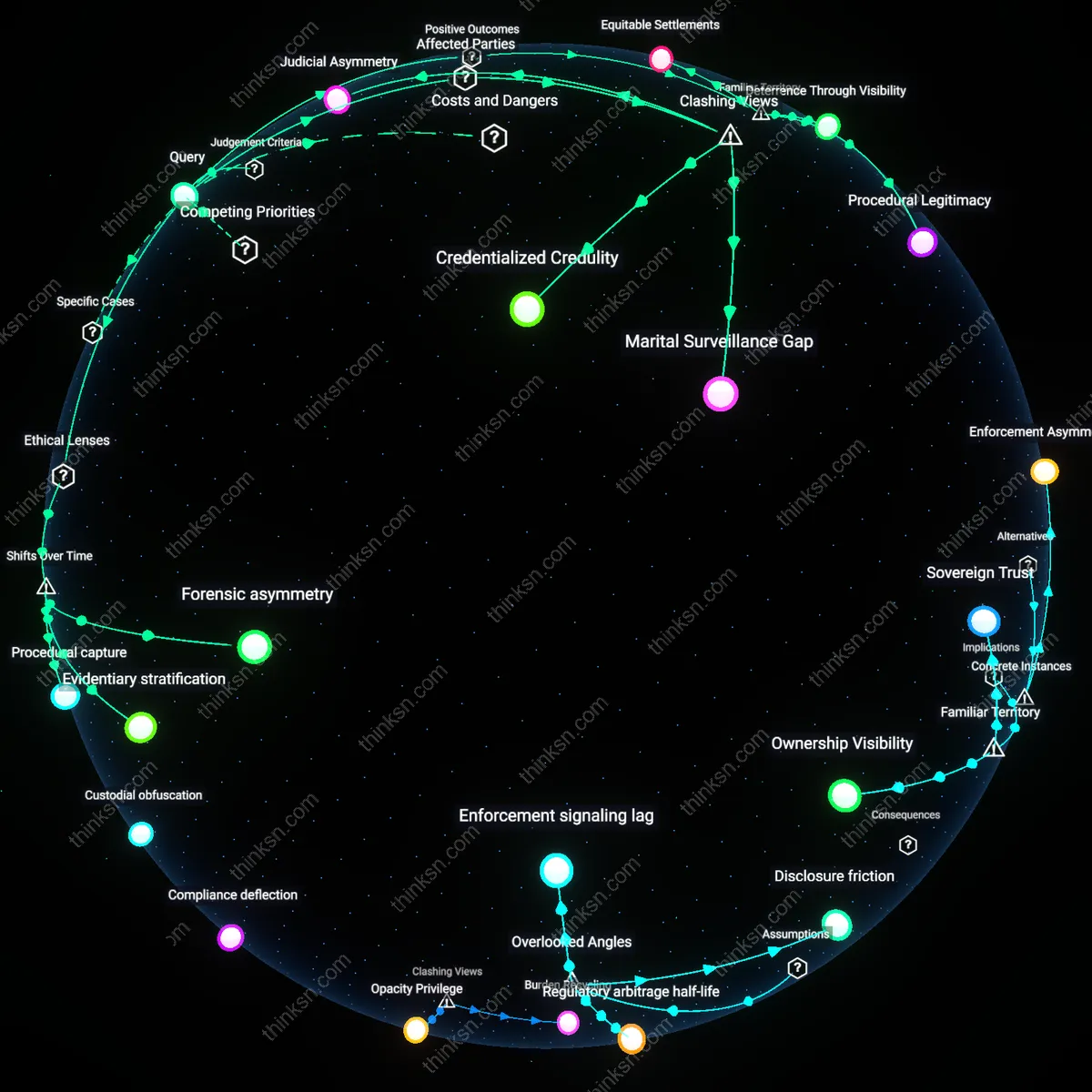
Judicial Asymmetry
Disparity in forensic accounting access entrenches power imbalances not between litigants alone, but within the courtroom itself, where judges unknowingly adjudicate contested financial realities using incomplete data. Courts in New York and London routinely admit forensic reports from one side while the opposing party lacks funds to commission counter-analyses, transforming judicial determinations into de facto validations of the wealthier party’s narrative. This dynamic operates through procedural rules that privilege timely expert submission, disadvantaging defendants reliant on public defenders or pro bono firms lacking forensic capacity—making equitable discovery a function of tribunal resource distribution rather than legal principle. The non-obvious consequence is that forensic gaps recalibrate not just outcomes, but the epistemic authority of the judiciary, shifting factual determination toward unilateral presentation masked as adjudication.
Marital Surveillance Gap
The assumed transparency of marital finances during divorce proceedings collapses when only high-net-worth individuals can afford forensic accountants to trace hidden assets, leaving middle-income litigants unable to verify disclosures. In family courts across California and Ontario, self-reported financial statements are often accepted without scrutiny due to lack of opposing forensic scrutiny, enabling strategic obfuscation through offshore entities or undervalued businesses. This works through a system where discovery obligations are enforced passively, relying on adversarial challenge rather than proactive verification—meaning inequality in expertise creates zones of financial opacity that the law cannot penetrate. The dissonant finding is that forensic inaccessibility doesn’t just distort justice; it produces legally sanctioned invisibility, where hidden assets persist not through crime, but through procedural tolerance of unverified claims.
Credentialized Credulity
Forensic accounting expertise has become a gatekeeping ritual in asset disputes, where courts equate methodological rigor with legitimacy, yet this legitimacy is only available to those who can pay for it—transforming technical analysis into a credential that drowns out non-forensic claims regardless of their validity. In Australian commercial litigation, courts have dismissed detailed spreadsheets and bank trails submitted by unrepresented litigants because they lacked formal forensic certification, while accepting chain-of-custody narratives from forensic firms with standardized, often generic, methodologies. This operates through evidentiary hierarchies that privilege institutional forms of knowledge, reinforcing the idea that financial truth must be professionally certified rather than empirically demonstrated. The overlooked result is that forensic disparity doesn’t merely limit access—it redefines truth-telling itself as a service commodity, where credibility is outsourced to those who can afford its performance.
Shadow Infrastructure
Unequal access to forensic accounting entrenches a clandestine financial infrastructure that operates parallel to legal adjudication, enabling capital preservation among elites during divorce or insolvency proceedings. High-net-worth individuals routinely engage forensic accountants not just to analyze but to architect complex ownership structures—offshore trusts, layered SPVs, and cryptocurrency holdings—that obscure traceability, while opposing parties without equivalent expertise cannot reconstruct financial flows. This dynamic is amplified by weak regulatory harmonization across jurisdictions, particularly in offshore financial centers like the Cayman Islands or Luxembourg, where opacity is institutionalized. The underappreciated reality is that forensic accounting does not merely uncover assets—it actively shapes the material conditions of accountability, rendering law reactive to forensic capacity rather than foundational to it.
Evidentiary Gatekeeping
The scarcity of publicly funded forensic accounting expertise functions as a de facto barrier to procedural justice in family and bankruptcy courts, particularly in underfunded judicial districts across the U.S. Sun Belt and rural Midwest. Without state-provided forensic support, courts rely on adversarial submissions, allowing financially dominant parties to control the evidentiary narrative through selectively disclosed financial records. This creates a condition where discovery is not a mutual process but a resource-intensive contest, in which judges—lacking technical capacity to independently verify asset disclosures—must defer to whichever party presents seemingly authoritative forensic reports. The overlooked mechanism is that forensic accountants, rather than serving as neutral experts, become agents of epistemic control, determining not just what is known but what can be recognized as evidence.
Equitable Settlements
Greater access to forensic accounting expertise leads to more accurate identification of hidden assets in divorce and litigation, particularly in high-net-worth cases. This accuracy enables courts to enforce fairer distributions by uncovering off-book transfers, shell company holdings, or understated income flows, especially in jurisdictions like New York or California where complex financial disclosures are routine. The non-obvious benefit within this familiar context is that equitable outcomes depend not on legal statutes alone, but on the technical capacity to interpret financial behavior—transforming accounting skill into a proxy for justice.
Deterrence Through Visibility
When parties anticipate that forensic accounting scrutiny is likely, they are less inclined to conceal assets or manipulate financial records during legal proceedings. This deterrent effect operates prominently in corporate divorce cases in places like Delaware’s Court of Chancery, where litigants know forensic examiners regularly trace intercompany transactions and valuation discrepancies. What often goes unspoken is that the mere perception of forensic capability—regardless of actual deployment—alters strategic behavior, making transparency a default tactic rather than an enforced correction.
Procedural Legitimacy
Forensic accounting strengthens public trust in legal outcomes by reinforcing the perception that financial disputes are resolved through factual precision rather than negotiation power. In family courts across states like Texas and Florida, where self-represented litigants are common, the introduction of forensic analysis—even selectively—signals institutional rigor and reduces perceptions of arbitrary rulings. The underappreciated dynamic is that legitimacy accrues not from equal access itself, but from the visible presence of technical verification, which anchors confidence in the system even when access is uneven.
Forensic asymmetry
The professionalization of forensic accounting after the Sarbanes-Oxley Act (2002) entrenched institutional access disparities, privileging corporate litigants with capital to retain credentialed experts over individuals in civil or family courts. This shift transformed forensic accounting from an ad hoc audit function into a gatekept discipline, where the accreditation and cost barriers systematically exclude under-resourced parties from challenging hidden asset claims. As a result, the legitimacy of asset discovery now depends not on factual transparency but on the ability to purchase forensic capacity—revealing how post-Enron reforms, while designed to increase accountability, inadvertently codified unequal evidentiary power in civil proceedings. What remains underappreciated is that the very mechanisms meant to enhance financial integrity now reproduce inequity by design.
Evidentiary stratification
The digitization of financial records since the mid-2000s has shifted forensic accounting from paper trails to data analytics, disadvantaging legal aid providers and public defenders who lack access to forensic software and technical labor. While high-end firms deploy AI-driven transaction mapping and blockchain tracing, publicly funded actors rely on manual reconstruction—slower, less comprehensive, and often insufficient to meet evidentiary thresholds. This technological stratification has produced a de facto two-tier system in asset discovery, where outcomes are increasingly determined by access to digital forensic infrastructure rather than procedural fairness. The non-obvious consequence is that equity in civil procedure now hinges on computational literacy and software access, a shift obscured by legal doctrines still rooted in analog evidentiary norms.
Procedural capture
Beginning in the 1990s, the rise of alternative dispute resolution (ADR) in family and commercial law outsourced asset verification to private mediators who lack subpoena power and standardize minimal forensic scrutiny—favoring swift settlements over full disclosure. This transition reframed asset division as a consensual process, effectively disempowering parties without independent forensic support to detect concealment, particularly in high-conflict divorces involving offshore holdings. The ethical doctrine of autonomy, prioritized in ADR, thereby enables strategic opacity when paired with unequal access to forensic expertise. The underappreciated effect is that procedural efficiency has become a conduit for the quiet legitimization of hidden assets, normalizing partial disclosure as legally sufficient.