Core-Periphery Liquidity Recycling
The primary hubs of crypto liquidity during quantitative easing are located in offshore financial centers such as the Cayman Islands and Switzerland, where traditional asset managers repackage Fed-induced dollar surpluses into crypto-based financial products accessible only to accredited investors. These locations do not circumvent capital controls but instead operationalize them by creating tiered access layers—domestic populations in capital-controlled countries like China or India are excluded, while their wealthy elites participate through offshore trusts. This system functions as a sanctioned leakage mechanism, where strict capital controls in emerging markets inadvertently reinforce the centrality of Eurodollar markets in recycling speculative liquidity via blockchain intermediaries. Contrary to the belief that crypto undermines capital controls, it often reinforces the hierarchical geography of global finance by legitimizing elite bypass while preserving outward compliance.
Infrastructure Capture
The real hubs of crypto activity during QE shifts are not geographies of lax regulation but U.S.-aligned technical chokepoints such as AWS-hosted nodes in Northern Virginia and payment rail integrations in New York-based stablecoin issuers like Circle and Paxos. These locations control the underlying infrastructure layer—data hosting, dollar on-ramps, and compliance APIs—that determines which blockchain transactions gain financial legitimacy, regardless of where miners or traders are located. Even when capital flows appear to route around China’s capital controls via decentralized exchanges, they remain dependent on U.S.-jurisdictional infrastructure for price discovery and settlement in USD. This reframes the global crypto network not as a distributed alternative to controlled financial centers but as a technically centralized system where control is exerted through infrastructural dominance, not geographic exclusion.
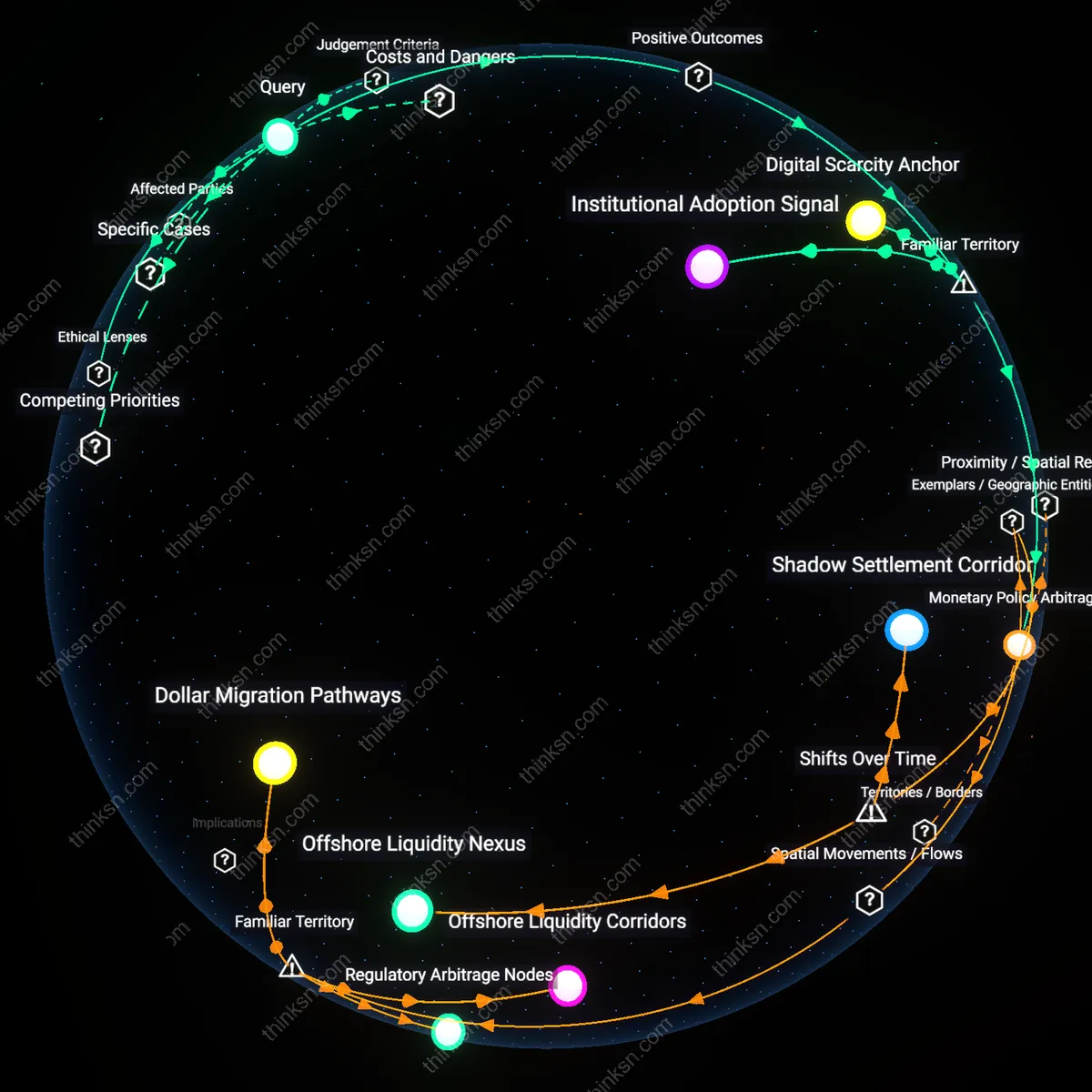
Offshore Liquidity Corridors
Crypto liquidity surges toward offshore financial hubs like the Cayman Islands and Singapore when quantitative easing floods Western markets with capital. These hubs act as conduits where newly abundant dollar liquidity intersects with lenient regulatory postures, enabling crypto exchanges, hedge funds, and trading desks to amplify leverage and arbitrage opportunities globally. What is underappreciated is that these flows do not just seek tax efficiency but operational proximity to cleared dollar funding channels—connecting directly to New York and London markets—while functionally bypassing capital-constrained jurisdictions such as China or India, which reinforces the perception of crypto as a shadow extension of core monetary centers rather than a decentralized alternative.
Regulatory Arbitrage Nodes
During periods of quantitative easing, crypto activity consolidates in cities like Dubai, Zug, and Seoul, where local policymakers allow financial experimentation while maintaining openness to global capital. These nodes become destinations for institutional crypto capital not because they generate innovation intrinsically, but because they offer bounded permissiveness—allowing compliance-adjacent operations that mirror the functions of traditional financial centers while evading direct oversight. The non-obvious truth is that these locations do not disrupt the hierarchy of global finance but instead reproduce its logic in miniature, acting as pressure valves for capital that cannot freely move through tightly regulated systems like those in Beijing or Frankfurt.
Dollar Migration Pathways
U.S. dollar-denominated stablecoin issuance expands rapidly from primary hubs like New York and San Francisco into secondary nodes such as Buenos Aires, Lagos, and Istanbul during rounds of quantitative easing, tracking the search for yield under capital-constrained regimes. These pathways form circuits where dollar liquidity, disguised as crypto, flows outward to cities with depreciating local currencies and restricted access to offshore banking, effectively shadowing the reach of federal reserve policy abroad. The overlooked dynamic is that these flows are not purely demand-driven but structurally enabled by onramps tied to U.S.-based payment processors and exchanges, making even seemingly autonomous crypto networks dependent on the geographic core of the dollar system.
Offshore Liquidity Nexus
Crypto hubs shift toward offshore financial jurisdictions during periods of quantitative easing, exemplified by the rise of crypto trading and stablecoin issuance in the Cayman Islands and Singapore as U.S. monetary expansion increases dollar liquidity. Global macro traders and hedge funds channel excess liquidity into crypto markets through entities domiciled in these jurisdictions, exploiting regulatory latitude and integration with dollar funding markets; this dynamic intensifies when U.S. capital controls or reporting requirements tighten, pushing activity toward nodes that mirror traditional offshore banking logic. The non-obvious insight is that these hubs are not driven solely by technological innovation but by deliberate alignment with financial plumbing established in the 1980s Eurodollar system, repurposed for crypto-native instruments.
Shadow Settlement Corridor
Following the 2022 sanctions on Russia, crypto hubs in Dubai and Armenia emerged as critical nodes connecting sanctioned entities to global financial markets, leveraging the influx of U.S. dollar liquidity from prior QE cycles to establish alternative settlements using USDT and non-KYC exchanges. Russian technologists and oligarch-linked firms migrated to these locales, transforming them from peripheral crypto outposts into structured conduits for converting crypto into real estate, equity, and trade finance, circumventing SWIFT and traditional correspondent banking. The shift—from speculative trading centers to institutionalized bypass mechanisms—marks a qualitative evolution in which QE-fueled crypto markets become embedded in state-contested financial sovereignty, revealing their function not as speculative bubbles but as proto-settlement layers under geopolitical strain.