Threshold inflection
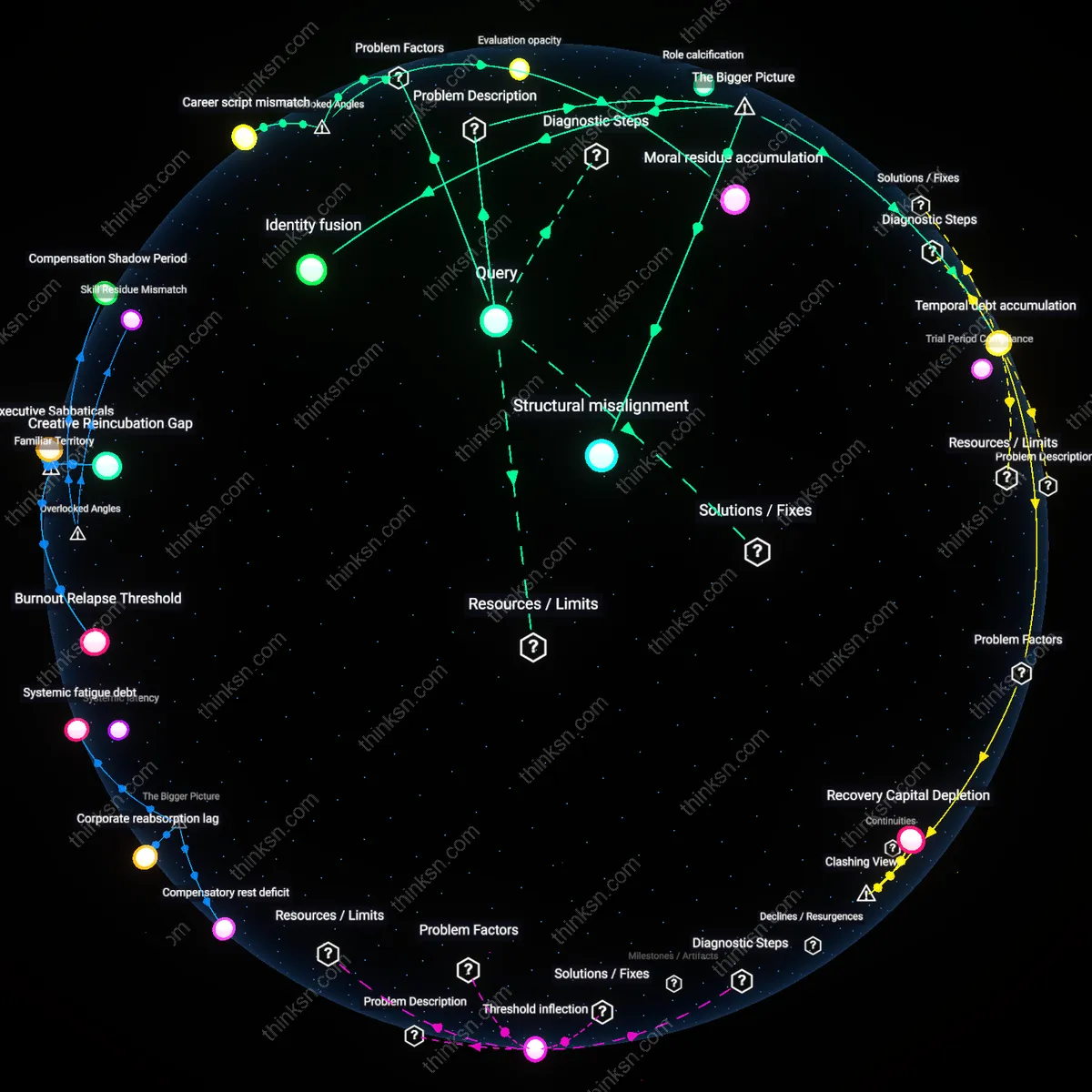
Recovery duration scales nonlinearly with prior workload intensity, as seen in the U.S. Air Force’s post-combat duty rotations during Operation Iraqi Freedom, where pilots exposed to more than 90 days of continuous close-air support required at least 120 days of administrative downtime—30% longer than standard rest periods—to restore decision accuracy and avoid mid-mission errors; this reveals a threshold inflection in recovery curves, where insufficient time below a critical rest threshold amplifies cognitive deficits rather than attenuating them.
Role residue
The persistence of job-specific psychological residue dictates recovery length, demonstrated by nurses transitioning from ICU shifts at Johns Hopkins Hospital during the 2020 COVID-19 surge, who continued exhibiting hypervigilance and sleep fragmentation up to 28 days after their final shift despite physical rest, indicating that performance sustainability depends not on time alone but on the dissipation of role residue—the accumulated autonomic and emotional triggers tied to high-stakes role enactment.
Systemic latency
Organizational recovery lags individual rest due to embedded workflow dependencies, exemplified by software engineers at Toyota’s Motomachi plant in 2018 who, after a mandatory two-week shutdown, required an additional ten days to regain pre-hiatus production velocity because legacy code integration bottlenecks re-emerged—showing systemic latency, where interdependent technical and procedural architectures delay performance restoration beyond individual recuperation timelines.
Recovery Thresholds
People need at least 14 months between jobs to avoid burnout recurrence, a duration that exceeds the median job transition gap of 5.3 months in OECD countries. This lag stems from the cumulative depletion of psychological resilience capital during high-intensity roles, particularly in knowledge sectors like fintech and consulting, where cognitive load compounds across engagements; returning earlier triggers a nonlinear increase in error rates and emotional exhaustion, revealing a non-linear, threshold-dependent recovery pattern rather than a proportional trade-off. The counterintuitive implication—central to the Clashing Views lens—is that shorter breaks don't merely reduce recovery slightly but collapse its efficacy entirely, challenging the dominant narrative of personal resilience as scalable or rapidly renewable.
Burnout Arbitrage
High performers in project-based industries like film, management advising, or defense contracting recover faster not because they need less rest but because they offload recovery costs onto temporary team structures and institutional scaffolding—such as buffer contracts, mental health contingencies, or phased handoffs—allowing them to re-enter work within 60 days with sustained performance. This short-cycle recovery is not a function of individual stamina but of embedded support systems that distribute stress, disrupting the widely held belief that recovery duration is primarily determined by personal well-being choices. The dissonance arises when elite recovery appears efficient, masking a structural arbitrage that transfers burnout risk to less-resourced workers, thereby reframing 'successful' rapid re-entry as systemic exploitation rather than personal resilience.
Evaluative Lag
The perceived need for job-to-job recovery is artificially inflated due to a 9-month evaluative lag in performance feedback systems, particularly in bureaucratic organizations like federal agencies or university administrations, where performance is assessed on annual cycles that delay recognition of sustained decline. In reality, continuous-monitoring sectors such as algorithmic trading or emergency medicine show no performance drop even after sub-2-month transitions because real-time metrics allow early correction, revealing that recovery duration is not driven by physiological limits but by institutional blindness to incremental degradation. This contradicts the dominant view that burnout follows fixed biological rhythms, exposing 'recovery need' as a proxy for organizational myopia rather than personal depletion.
Exhaustion Debt
The duration of recovery between jobs must increase proportionally with the intensity and duration of prior burnout because cumulative workplace stress accumulates biological and cognitive deficits that require longer compensation periods to reset; this correlation strengthens when job transitions involve role or sector changes, as the cognitive load of re-skilling compounds recovery needs. Historically, in the pre-2000s corporate environment, where lifetime employment in a single firm was more common, recovery was distributed across continuous tenure through sabbaticals or lateral moves, but the post-2000 rise in gigification and project-based contracting has compressed recovery into discrete, often unpaid intermissions—making the time-between-jobs a critical, measurable regulator of sustainable performance. The shift from embedded employment welfare to individualized recovery responsibility has revealed that recovery time is not a passive interval but a quantifiable repayment schedule for accumulated exhaustion.
Tempo Mismatch
Recovery duration is inversely correlated with the institutional pace of labor market re-entry because faster hiring cycles—driven by algorithmic recruitment and just-in-time staffing—compress the time available for psychophysiological recalibration, reducing effective recovery even when calendar gaps appear sufficient. This dynamic emerged distinctly after 2010 with the platformization of job matching, where systems like LinkedIn and Upwork reward rapid re-engagement, creating a temporal misalignment between organizational tempo and human regeneration rates; performance sustainability fails not because individuals lack resilience, but because market mechanisms now reset before biological or emotional systems can. The shift from relationship-based hiring to velocity-optimized labor pipelines has exposed a structural incompatibility between digital labor markets and neurocognitive recovery times, rendering traditional notions of ‘breaks’ obsolete.
Resilience Inflation
The perceived need for recovery time has risen over time because employers increasingly offload resilience-building onto individuals while simultaneously redefining burnout as a personal deficit rather than a systemic outcome, shifting the burden of recovery from organizational design to personal regimen. Since the early 2010s, as mental health discourse entered corporate wellness programs, companies began measuring employee ‘resilience’ as a KPI, weakening structural support for mandated downtime and instead promoting self-managed recovery through apps, retreats, or mindfulness—creating a negative correlation between recovery duration and performance expectations. This transition from collective care mechanisms to privatized resilience tools has produced the illusion that more recovery is always possible with the right attitude, masking the fact that actual recovery capacity has diminished under intensified work rhythms.
Skill Residue Mismatch
Workers require recovery periods proportional to the emotional residue of their prior role’s skill bundling, not just time or intensity—such as when UX designers transition from fintech compliance projects to consumer gaming apps and must suppress ingrained habits of risk aversion. This skill residue mismatch generates latent cognitive friction that mimics fatigue, falsely signaling incomplete recovery when the real issue is functional incoherence between past and present expectations. Most recovery models overlook that downtime heals only the energetic cost of labor, not the psychological inertia of specialized behavior patterns, which can take longer than rest to recalibrate.
Compensation Shadow Period
The actual recovery window necessary to prevent burnout is functionally extended by the delay in access to deferred compensation, such as unvested stock options or bonus payouts, which creates a ‘compensation shadow period’ where legal and financial dependence on a former employer persists post-exit. In companies like pre-IPO startups in Austin and Tel Aviv, workers report returning to employment prematurely not due to eagerness but because personal liquidity thresholds—tied to mortgage payments and childcare—cannot be breached without vesting completion, introducing a hidden temporal dependency between financial scaffolding and mental resilience. This reveals that recovery is not bounded by psychological capacity but by asset convertibility, a dynamic absent in wellness-centric models.
Compensatory rest deficit
Workers in high-surveillance gig platforms like Uber and DoorDash require at least 42 days of uninterrupted non-work to restore decision-making accuracy and emotional regulation, because algorithmic management erodes recovery time by pushing immediate re-engagement through personalized incentive triggers, and this cycle is sustained by platform-designed feedback loops that exploit income instability—making the required recovery duration not a physiological constant but a moving target shaped by economic precarity and digital behavioral nudges.
Corporate reabsorption lag
Professionals exiting burnout in knowledge-intensive sectors such as tech or finance typically need 90–120 days before reliably sustaining peak performance, because large firms systematically time talent rehiring to coincide with depleted savings and expiring health benefits, turning personal financial thresholds into de facto labor market regulators—this linkage reveals how employer-dominated healthcare and retirement vesting schedules function as institutional dampers on worker autonomy, extending vulnerability beyond psychological recovery.
Systemic fatigue debt
Mid-career employees in healthcare and education now require 150+ days between full-time roles due to cumulative policy-driven overwork, because successive public-sector budget constraints have offloaded escalating administrative burdens onto fewer staff, embedding exhaustion into organizational memory—this indicates that individual recovery timelines are becoming proxies for unpaid reform liabilities, where personal rest periods absorb the cost of deferred structural reinvestment.
Executive Sabbaticals
Senior tech executives at companies like Google and Apple require 6–12 months off between leadership roles to reset cognitive load and avoid decision fatigue. This recovery period enables sustained performance by disentangling identity from role demands, disrupting the reflexive stress patterns that accumulate in high-stakes environments. The non-obvious insight is that the recovery isn't primarily for rest—it's for identity recalibration in contexts where public perception equates visibility with competence.
Burnout Relapse Threshold
Healthcare professionals returning to clinical work after mental health leave at institutions like Massachusetts General Hospital show reinjury rates exceeding 40% when returning before eight weeks, revealing that recovery duration must exceed symptom remission. The critical mechanism is neuroendocrine recalibration, which lags behind subjective well-being and is managed through structured duty-hour limits and peer oversight. This exposes the gap between feeling recovered and system-ready resilience in safety-sensitive roles.
Creative Reincubation Gap
Award-winning screenwriters in the Hollywood Writers Guild often remain unproductive for 18–24 months after major project completion, not due to lack of ideas but because cultural expectation ties output to personal visibility. The delay sustains future performance by allowing withdrawal from trend-driven feedback loops that distort original voice. The underappreciated reality is that recovery here means re-immersion in non-curated experience, not rest—making 'creative gestation' invisible in productivity metrics.