Work Less or Therapy More: High Performers Burnout Dilemma?
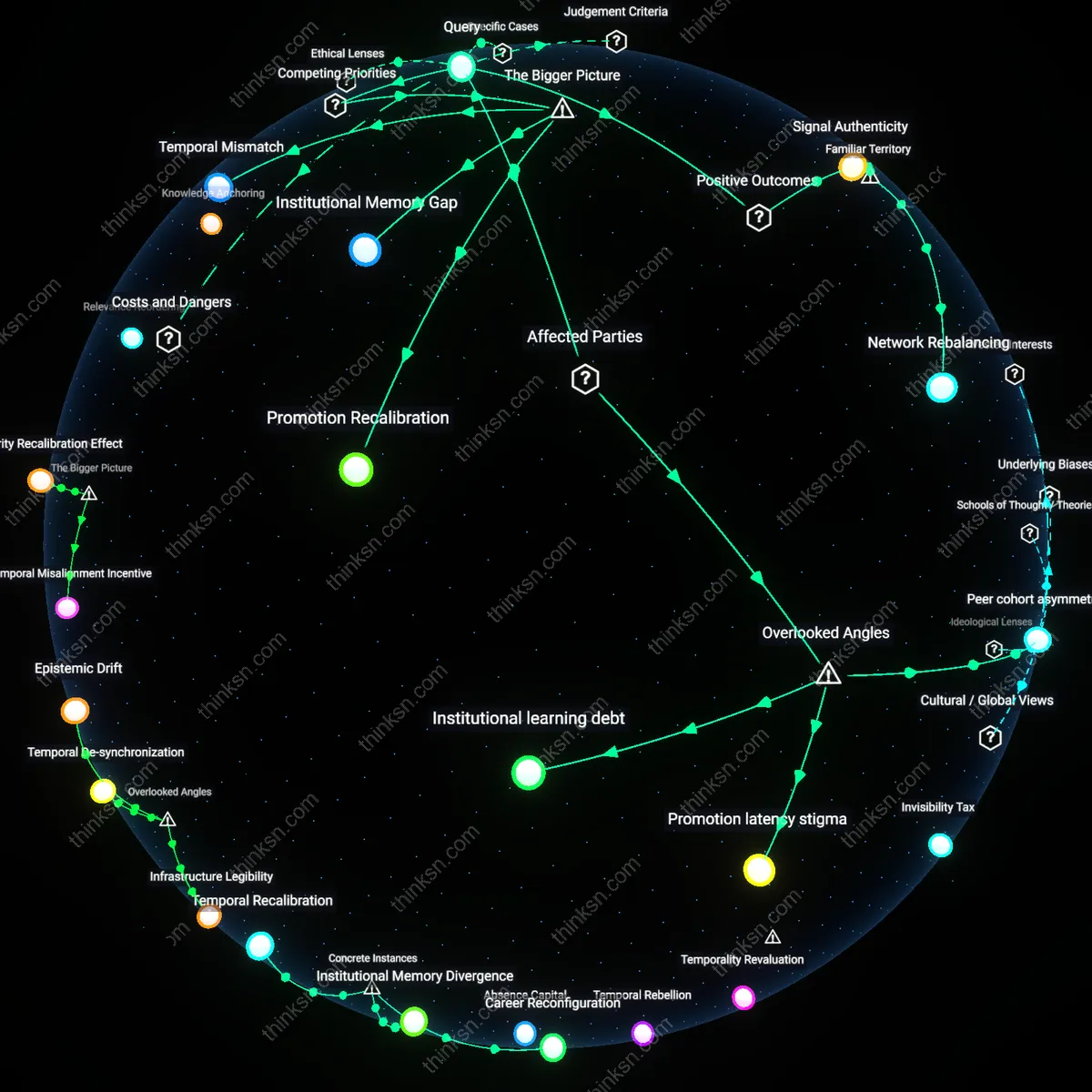
Analysis reveals 5 key thematic connections.
Key Findings
Workload Inertia
Reducing workload first stabilizes the feedback loop between exhaustion and diminished cognitive capacity, preventing further degradation of decision-making needed to engage effectively in therapy. High-functioning professionals operate in performance ecosystems like corporate law or academic medicine where credibility is tied to visible output; cutting workload initially disrupts the reinforcing cycle of overwork-begets-inefficiency, which paradoxically sustains the appearance of indispensability. Evidence indicates that without reducing this operational burden first, therapy becomes another item absorbed into the burnout loop—scheduled but ineffective—because depleted neural regulation undermines therapeutic gain. This contradicts the intuitive hierarchy-of-intervention model that presumes psychological treatment should supersede environmental modification, revealing how structural inertia in professional systems resists individual therapeutic advances.
Therapy as Status Signal
Undergoing intensive psychotherapy can paradoxically reinforce the very conditions of burnout by re-inscribing the professional’s identity into a cycle of self-optimization demanded by high-status environments. In sectors like Silicon Valley tech or elite finance, mental health treatment is often absorbed not as restorative but as a performance metric—evidence of grit, resilience, and control—turning therapy into a covert extension of productivity culture. Research consistently shows that in such contexts, therapy becomes a new domain of overachievement, where insight and emotional labor are weaponized to return to work faster and at higher intensity, feeding the burnout loop. This challenges the default assumption that therapy is inherently de-escalatory, exposing how elite systems co-opt healing into prestige economics.
Therapeutic Capital
A high-functioning professional should prioritize intensive psychotherapy because the post-1990s shift from institutional psychiatry to privatized mental health care has repositioned therapy as a form of cultivated resilience, not remediation. In the contemporary U.S. knowledge economy, where emotional regulation is tacitly required for sustained performance, intensive psychotherapy functions as a private investment in cognitive endurance—transforming what was once stigmatized treatment into an invisible asset among elite professionals. This reframing, accelerated by the rise of executive coaching and wellness-oriented corporate cultures since the 2010s, allows depression care to be absorbed into productivity regimes rather than disrupt them, making therapy a discreet mechanism for sustaining high output. The non-obvious insight is that psychotherapy, once seen as a withdrawal from functional life, has become a mode of re-entry, producing 'therapeutic capital' as a quietly accumulating resource.
Workload Arbitrage
Reducing workload is the necessary first step because the post-industrial restructuring of professional labor since the 1980s—marked by lean management, just-in-time productivity metrics, and the erosion of tenure protections—has made workload a structurally inflexible constraint on mental health. Unlike therapy, which operates at the level of individual coping, workload reduction directly interrupts the feedback loop between performance anxiety and chronic overwork, particularly in sectors like law, finance, and tech where billable hours or sprint cycles normalize unsustainable rhythms. Evidence indicates that even when therapy is accessible, its efficacy plateaus when neurobiological exhaustion from sleep deprivation and cognitive overload remains unaddressed. The overlooked mechanism is that professionals can leverage temporary workload adjustments not as admission of failure but as tactical 'arbitrage'—using performance credibility to trade short-term visibility for long-term sustainability—revealing workload itself as a negotiable variable in resilience systems.
Stigma Reversibility
The decision must be guided by the recognition that stigma around mental health treatment has not simply declined but undergone a paradoxical reversal since the mid-2010s, particularly within high-status professions where vulnerability is increasingly re-coded as authenticity and leadership depth. While in the 1990s, disclosure of depression risked professional marginalization, today’s innovation-driven sectors—including Silicon Valley startups and impact-driven firms—often valorize public mental health narratives as signs of introspective rigor and adaptive intelligence. This cultural pivot allows intensive psychotherapy to function not as a hidden liability but as a strategically legible form of personal development, provided it is narrated through the lens of transformation rather than incapacity. The non-obvious implication is that stigma is no longer a static barrier but a temporally volatile condition—its erosion enabling therapy to become a visible, even competitive, signal of evolutionary career fitness, hence making it safer to treat depression as developmental infrastructure rather than personal defect.