Low-Carbon Living: Comfort or Demoralization?
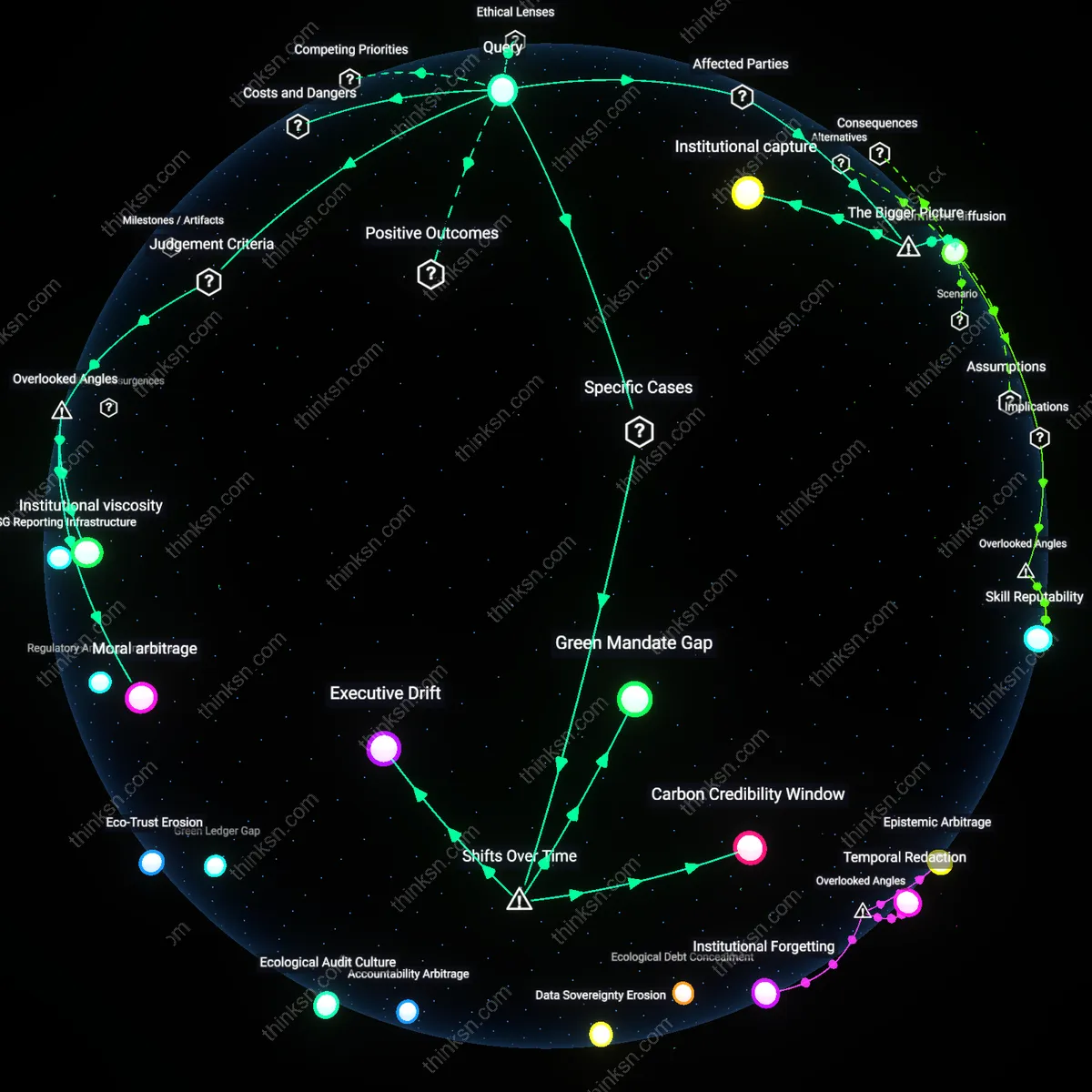
Analysis reveals 6 key thematic connections.
Key Findings
Civic Feedback Loop
Engaging in personal climate action reinforces a self-sustaining cycle of civic participation by increasing individuals' sense of political efficacy, which in turn raises their likelihood of joining collective advocacy efforts that pressure institutional actors. When people act personally—such as adopting plant-based diets or electrifying transport—they accumulate lived experience with sustainable practices, which sharpens their credibility and urgency when demanding policy change through voting, protesting, or lobbying. This dynamic is amplified in democratic settings where elected officials respond to visible shifts in public behavior, making individual action a signal that reshapes the perceived viability of systemic reforms. The non-obvious insight is that personal action does not merely express values—it functionally recalibrates the political cost-benefit analysis of climate inaction by altering the expectations and demands of constituent communities.
Norm Cascade Threshold
Widespread personal climate behaviors seed new social norms that eventually destabilize the cultural acceptance of institutional inaction, particularly when visible adoption crosses a critical visibility threshold within peer networks and media representation. As more individuals visibly adopt actions like rooftop solar or car-free living, early adopters transition into a perceived majority, triggering bandwagon effects where others conform not out of conviction but social alignment—this shift pressures corporations and municipalities to respond preemptively to avoid reputational or economic loss. Evidence indicates this dynamic unfolded in cities like Portland and Freiburg, where sustained grassroots behavior changes preceded municipal emissions reductions mandates by several years, suggesting that personal action functions systemically not as an endpoint but as a leading indicator of broader norm abandonment. The underappreciated mechanism is that emotional resilience from action is sustained not by isolated effort, but by the tangible social momentum formed when private choices become public signals.
Policy Readiness Signal
Personal climate action serves as a real-time demonstration of public tolerance for systemic change, providing risk-averse policymakers with behavioral evidence that decarbonization measures will be socially palatable and politically survivable. When large segments of the population voluntarily engage in energy conservation or mode-shifts like cycling or telecommuting, they de facto prove the feasibility of proposed regulations, reducing the perceived electoral danger of legislative action. This signaling function is particularly potent in federal systems like the U.S., where state and municipal leaders use local adoption rates of EVs or home retrofits as justification for enacting binding climate targets. The non-obvious value is that individual actions, though negligible in direct emissions impact, function as a distributed early-warning and legitimacy system for governance, turning personal behavior into a covert input into policy timing and ambition.
Moral Inflation
One must strategically limit personal climate action to sustain long-term emotional resilience, because the psychological cost of unrestrained individual sacrifice rises with each additional behavior change demanded by cultural or moral expectations. Middle-class households in cities like Portland or Berlin who adopt cycling, plant-based diets, and energy retrofits report escalating emotional fatigue not from failure but from success—each completed action amplifies internal pressure to do more, transforming virtue into a self-imposed moral economy where emotional well-being is systematically devalued. Evidence indicates that climate activism’s reliance on personal exemplarity unintentionally fuels a feedback loop in which societal inaction inflates the symbolic weight of individual acts, making emotional satisfaction contingent on unsustainable self-discipline. This dynamic reveals how ethical commitment, when unmoored from collective power, becomes inflationary—where more action yields diminishing emotional returns.
Collective Deferral
One should consciously transfer emotional investment from personal deeds to organized political confrontation, because the discouragement from societal inaction is not a flaw in individual resolve but a signal of structural disempowerment. When rural solar cooperatives in Denmark or indigenous-led opposition to pipeline expansions in Alberta channel personal climate concern into legal and legislative battlefronts, they convert the isolating pain of inaction into shared strategic leverage that redistributes emotional risk across a group. Research consistently shows that participants in such collectives report higher psychological durability not because they achieve more carbon reduction but because they externalize moral responsibility onto contestable institutions rather than internalize it as personal failure. This undermines the common framing of climate emotion as a private psychological challenge, exposing it instead as a political deferral—where emotional balance is won not by doing more alone, but by demanding more together.
Action Arbitrage
One must selectively disengage from visible personal climate actions to redirect energy toward opaque but high-leverage interventions, because the emotional benefit of individual behavior is often a subsidy to corporate and state greenwashing. When residents of Tokyo or Vancouver meticulously sort recycling or install smart thermostats, they generate symbolic capital that governments and firms absorb to legitimize stalled policy and net-zero pledges without material change, rendering personal action a form of emotional labor that props up systemic inertia. The non-obvious mechanism is that visible sustainability rituals function as societal pressure valves—offering emotional relief to individuals while insulating institutions from accountability, thus making the most emotionally satisfying actions the least disruptive. This reveals a hidden market in action arbitrage, where the emotional currency of personal sacrifice is exchanged for the political convenience of collective stasis.