Should You Buy Now or Wait When Sun Belt Prices Soar?
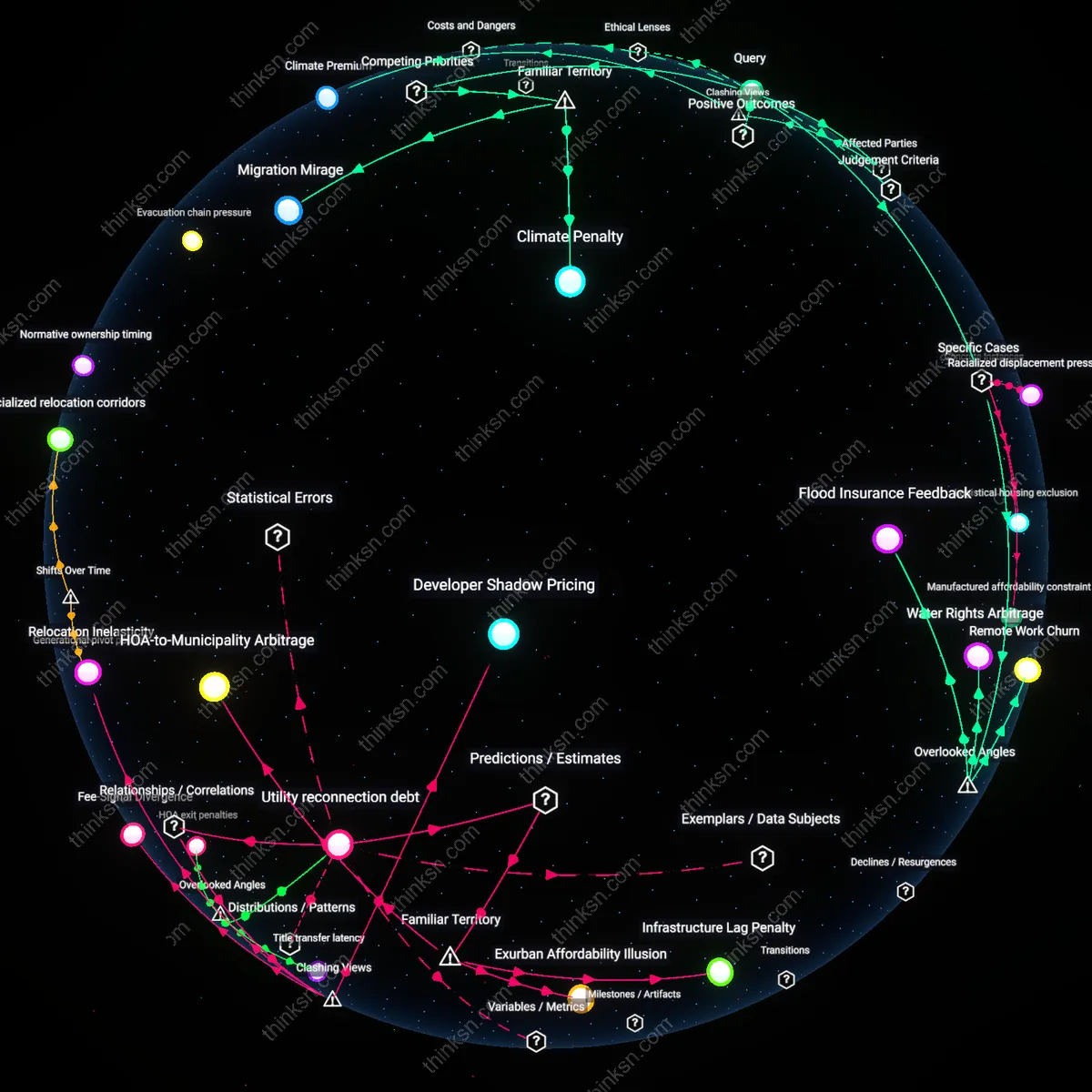
Analysis reveals 8 key thematic connections.
Key Findings
Housing Illusion
One should defer homebuying in Sun Belt markets because speculative demand inflates ownership as a universal milestone, when in reality it entrenches middle- and upper-middle-class households into volatile asset dependence while locking out younger or mobile workers who are structurally priced out despite stable incomes. Real estate developers, regional boosters, and mortgage finance institutions benefit from sustained migration narratives, leveraging low taxes and warm climates to mask underlying infrastructure strains and overbuilding risks, which disproportionately affect later-arriving, lower-wealth buyers when price corrections occur. This dynamic reveals that homeownership in these markets functions less as personal investment and more as a collective confidence scheme sustained by intergovernmental incentives and financialized land use.
Climate Premium
One should treat Sun Belt homebuying as a climate risk premium payment, not a housing decision, because insurers, utilities, and emergency management systems are already shifting costs onto individual property owners through rising premiums, deregulated construction, and underfunded public cooling infrastructure—benefiting private risk managers and energy providers who profit from distributed vulnerability. Municipalities in Phoenix, Austin, and Atlanta encourage expansion into heat-exposed and flood-prone tracts because state tax caps limit revenue tools, making land sales the primary fiscal engine, even as federal disaster aid incentivizes rebuilding over retreat. This reframes 'affordability' in the Midwest not as economic backwardness but as latent climate resilience, where lower price points reflect avoided cost-shifting rather than market failure.
Equity Anchor
One should buy a Sun Belt home only if the immediate equity accumulation outweighs future mobility costs, because homes in markets like Austin or Tampa have recently appreciated faster than Midwest rents depreciate, forcing households to treat real estate as forced savings despite relocation risk. This mechanism pits wealth security against geographic flexibility, where the discipline of mortgage amortization and price inflation compensates for low savings rates among middle-class buyers. Most assume rising prices guarantee profit, but fail to account for how correction risk and job lock-in can erase gains if a move becomes necessary, making the decision not about affordability but temporal mismatch between asset growth and life-stage needs.
Climate Penalty
Buying in the Sun Belt now means paying a premium for heat-adjacent living, where cities like Phoenix and Dallas see demand inflated by remote workers underestimating long-term climate costs, embedding future health and utility expenses into today’s purchase price. The cooling infrastructure required to sustain livability is publicly subsidized but privately borne through higher electricity bills and insurance, creating a hidden drag on household budgets that Midwest counterparts avoid. While most associate Sun Belt affordability with low taxes and purchase prices, the non-obvious reality is that climate-driven premiums act as a regressive tax, eroding savings that could otherwise fund future relocation.
Migration Mirage
Purchasing now based on Sun Belt growth projections confuses population inflow with personal economic alignment, because metro expansion in places like Atlanta or Charlotte serves corporate logistics and service-sector labor demands that do not match white-collar remote workers’ mobility timelines. The housing market’s responsiveness to transient demand creates a false sense of market permanence, where speculative buyers become de facto landlords simply by surviving inflation. Most believe moving later will be easier due to 'more homes everywhere,' but overlook how localized school districts and transportation dependency harden residential stickiness, transforming a financial choice into a de facto long-term commitment.
Flood Insurance Feedback
One should defer homebuying in Sun Belt markets like Fort Myers, Florida, when federally subsidized flood insurance distorts price signals by underpricing risk, because developers exploit this implicit subsidy to promote construction in high-risk zones, creating a feedback loop where post-disaster aid perpetuates development patterns that amplify future losses—this matters because most affordability analyses ignore how public risk underwriting inflates speculative valuations long-term, making homes simultaneously appear cheap and fundamentally unstable.
Water Rights Arbitrage
One should assess a home investment in Phoenix, Arizona, through the lens of unresolved interstate water compact liabilities, because real estate growth depends on legally precarious agricultural water rights transfers that may collapse under prolonged drought rulings, undermining long-term habitability—a dynamic most cost-of-living comparisons ignore, as population forecasts assume stable water access despite active legal challenges in the Colorado River Basin.
Remote Work Churn
One should treat Sun Belt home purchases like Austin, Texas, as short-duration bets conditioned on remote work persistence, because a silent majority of recent speculative buyers are transient tech workers whose unplanned relocation decisions fuel demand volatility, and corporate headquarters' policy reversals on hybrid work could trigger price corrections if Midwest cost differentials reignite migration reversals—this dimension is rarely modeled in affordability calculators, which assume static employment geography.