Are Rising Utility Rates Worth More Than Solar Panels Upfront Cost?
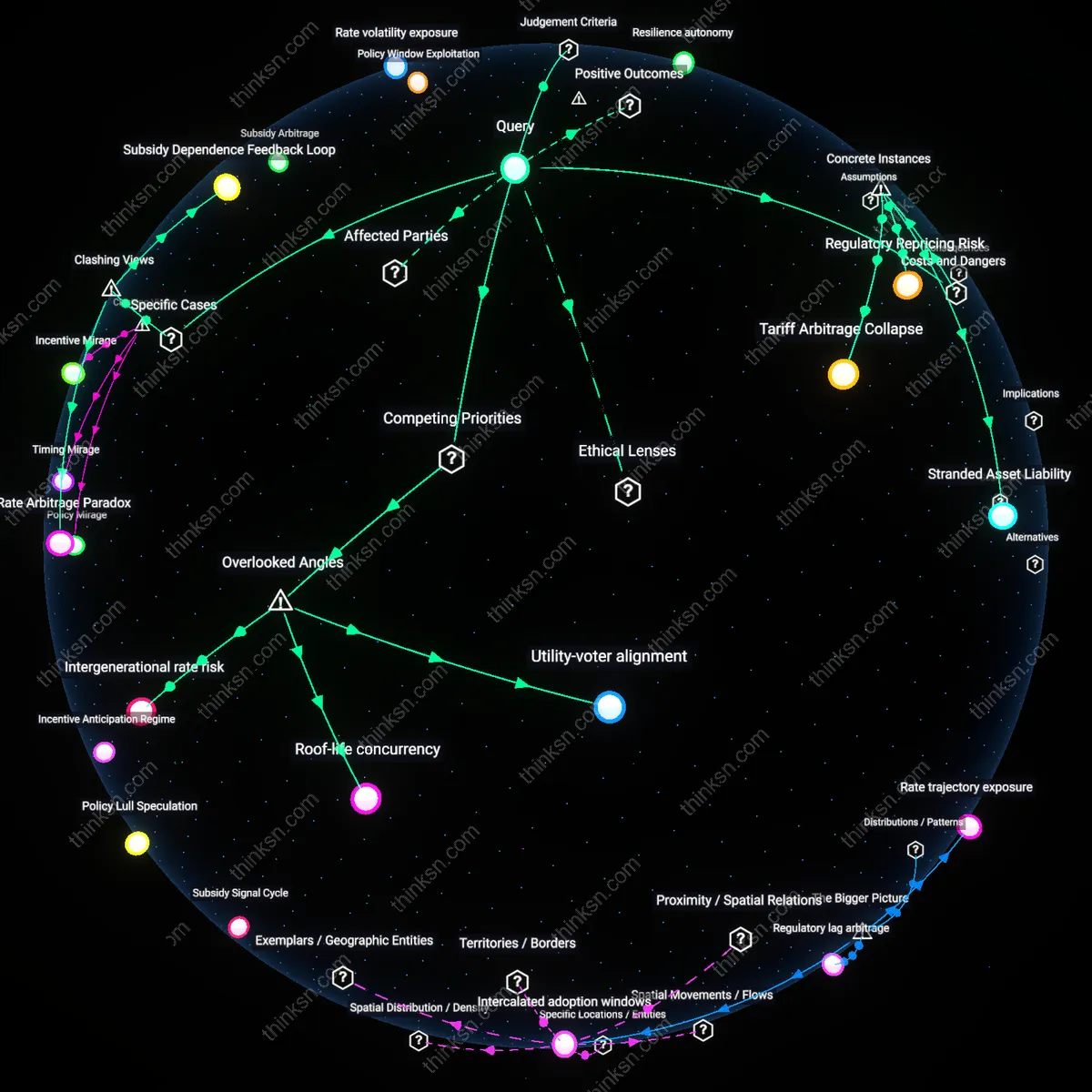
Analysis reveals 11 key thematic connections.
Key Findings
Rate volatility exposure
Homeowners should compare the fixed cost of solar ownership against projected utility rate uncertainty by modeling regional electricity price trends. This calculation involves utility regulatory structures—like precedent in California's tiered rate hikes or Texas’s deregulated spikes—which determine how much homeowners are unknowingly paying in future risk premiums. While most assume solar savings are static, the non-obvious insight is that solar acts as a hedge against regulatory and infrastructural instability, a function more valuable in grids with a history of volatility.
Resilience autonomy
Homeowners gain decisional control over energy supply by internalizing generation, reducing dependence on utility-operated grids shaped by political lobbying and centralized failure points. This shift matters most in areas like Florida or Puerto Rico, where hurricane-driven outages have redefined electricity as a security issue, not just an expense. The underappreciated truth is that solar paired with storage reframes cost-benefit analysis around personal agency rather than mere dollar savings, transforming panels into anchors of household continuity.
Subsidy arbitrage path
Homeowners must treat federal tax credits, state rebates, and net metering rules as dynamic financial instruments that alter payback periods more significantly than utility rate projections. In states like New York or Nevada, where policy shifts rapidly revalue solar ROI, success depends on timing installation to capture expiring incentives before regulation adjusts. The non-obvious reality is that policy cycles—not sunlight or electricity prices—often dominate the investment calculus, turning homeowners into de facto policy traders.
Regulatory Repricing Risk
Homeowners in Nevada faced a 70% reduction in solar buyback rates after NV Energy successfully lobbied the Public Utilities Commission to restructure net metering in 2015, demonstrating that retroactive utility rate adjustments can erase projected savings. The mechanism—regulatory capture by incumbent utilities—transforms long-term solar contracts into financially unstable propositions despite initial cost-benefit models. This reveals the underappreciated danger that political utility dependence, not technical inefficiency, constitutes the dominant financial risk in residential solar investments.
Stranded Asset Liability
In Puerto Rico, after Hurricane Maria destroyed much of the island’s grid infrastructure in 2017, homeowners with newly installed solar panels discovered their systems were rendered non-functional due to lack of compatible inverters and battery storage—exposing how physical grid collapse can turn solar investments into stranded assets. The systemic flaw lies in the assumption that solar independence follows panel installation, whereas real-world viability depends on ancillary components vulnerable to disruption. This instance uncovers the overlooked operational dependency on resilient peripheral technology, not just panel longevity or utility rates.
Tariff Arbitrage Collapse
In Hawaii, rooftop solar adopters on Kauai experienced diminishing returns after widespread installations drove daytime overgeneration on the island’s isolated grid, prompting the utility KIUC to cap buyback rates and shift to lower daytime compensation by 2020. The dynamic—self-inflicted market saturation due to coordinated consumer action—led to a collapse in tariff arbitrage that no individual homeowner could foresee, undermining individual cost-benefit calculations. This case exposes a systemic risk where collective success in solar adoption directly erodes the financial model, an outcome invisible in isolated financial projections.
Utility-voter alignment
Homeowners can evaluate the solar investment trade-off by recognizing how their municipal utility governance structure determines rate volatility, because where utility rate decisions are subject to direct voter influence—such as in municipalities with public power agencies—future rate hikes are politically constrained and thus more predictable, making long-term solar savings easier to model; this dynamic is overlooked because most financial calculators assume utility rates rise steadily regardless of governance, failing to account for the dampening effect of electoral accountability on utility pricing behavior, which means installations in voter-controlled utility districts offer more stable payback periods despite identical sunlight and upfront costs as elsewhere.
Roof-life concurrency
Homeowners must factor in the remaining useful life of their roof as a hidden cost amplifier, because if a roof will need replacement within 10–15 years, the solar panel removal and reinstallation expense—often unaccounted for—can erase up to 40% of projected net savings; this dependency is routinely omitted in standard ROI models that focus only on energy generation and electricity rates, but matters profoundly in regions like the Midwest where asphalt shingle degradation from freeze-thaw cycles forces mid-lifespan re-roofing, making the 'right' time to go solar contingent on roofing, not just tariffs or tax credits.
Intergenerational rate risk
The financial trade-off hinges on whether the homeowner anticipates transferring property to younger family members, because if so, the long-term benefit of solar accrues not to the initial investor but to future occupants who inherit lower operating costs while the original purchaser bears full upfront risk; this creates a temporal misalignment largely absent from solar marketing, where payback calculations pretend ownership is perpetual and indivisible, yet in places like multigenerational suburban households in California’s Central Valley, installing solar becomes less about personal payback and more about intergenerational equity—altering the incentive from individual savings to legacy planning.
Rate Arbitrage Paradox
Homeowners should treat solar panels not as a cost-saving upgrade but as a speculative hedge against future utility rate volatility, a strategy best observed in communities like Austin, Texas, where municipally-owned utility Austin Energy’s fluctuating time-of-use pricing has turned rooftop solar into a de facto financial instrument. Under this dynamic, early adopters in high-volatility zones gain disproportionate value not through energy production alone but by locking in fixed-price generation amid erratic grid tariffs, undermining the conventional payback-period model. This reframes solar not as an energy decision but as a regulatory asymmetry play—where foresight into bureaucratic tariff-setting cycles becomes more valuable than efficiency metrics. The non-obvious insight is that the most financially rational adopters are not those with high electricity bills but those who anticipate regulatory uncertainty.
Subsidy Dependence Feedback Loop
Solar adoption should be evaluated as a function of political risk rather than energy economics, evidenced by Nevada’s rollback of net metering after homeowners, lobbied by rooftop solar advocates, had already invested heavily in panel installations under earlier incentives. When regulators reversed course following pressure from NV Energy and utility-backed groups, the anticipated savings evaporated for thousands of homeowners, exposing that long-term returns are often hostages to utility lobbying power and legislative capture rather than technical performance. This flips the dominant narrative of solar as a 'safe' investment, showing instead that financial outcomes are tethered to the political durability of subsidy frameworks, revealing homeowners as unintentional stakeholders in energy governance battles.