Tech Wealth Strains Sun Belt Suburbs: Housing vs. Character?
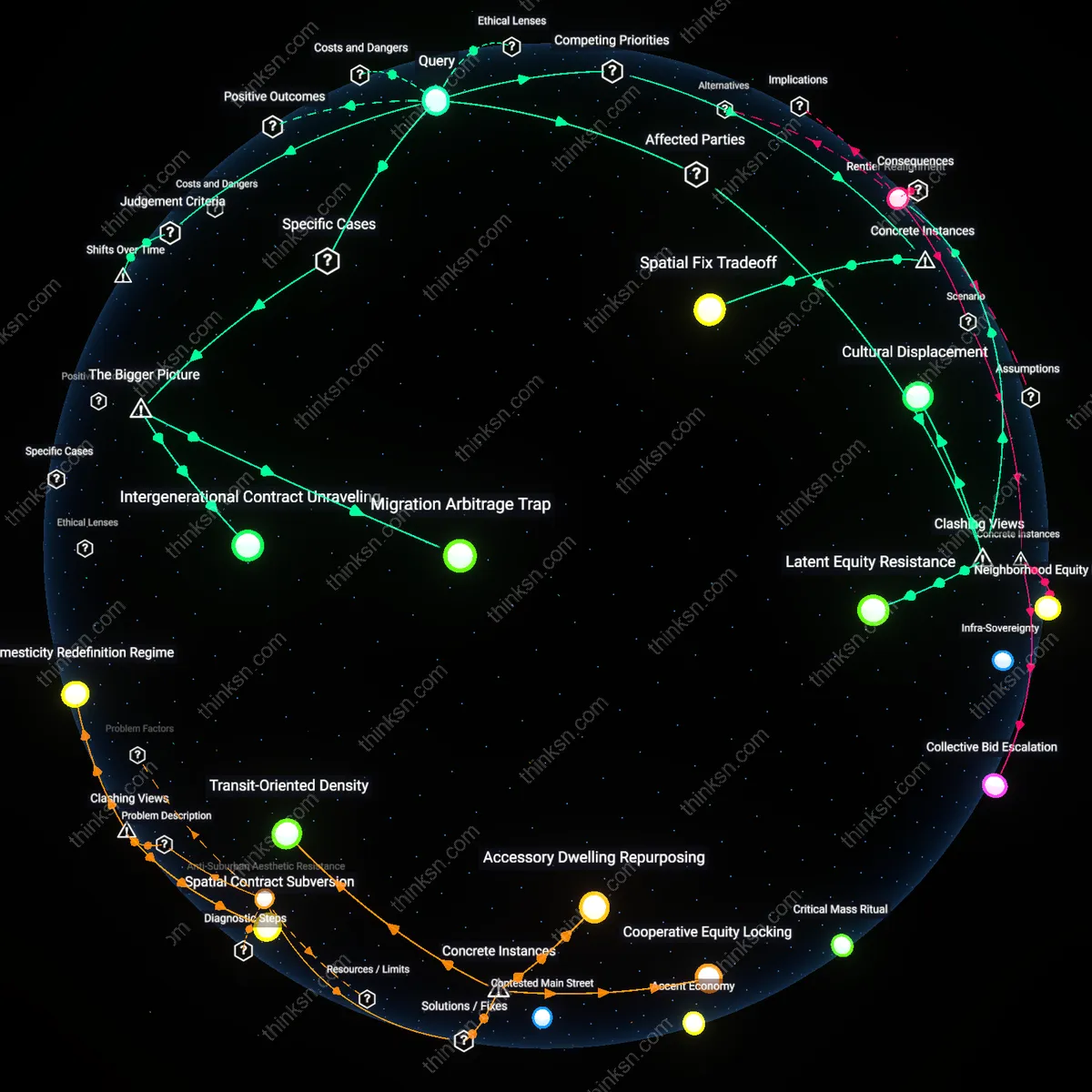
Analysis reveals 12 key thematic connections.
Key Findings
Wage-geography misalignment
The rapid migration of high-earning tech workers into Austin, Texas, between 2020 and 2023 directly intensified housing competition by inflating demand in low-density zip codes historically reserved for middle-income residents, revealing that wage premiums from remote tech employment do not align with existing municipal land-use capacity. This mechanism operates through capital mobility outpacing zoning adaptability, where Silicon Valley–level salaries enable remote employees to outbid local earners in cities without proportionate housing supply growth. The non-obvious insight is that income inflow, not population size alone, recalibrates housing markets in ways that destabilize suburban affordability equilibria.
Political inertia premium
In Raleigh, North Carolina, the influx of high-earning tech workers via Amazon’s and Apple’s expansion announcements after 2021 amplified pressure on housing, yet municipal resistance to upzoning in Wake County suburbs like Cary persisted due to homeowner-dominated city councils protecting single-family districts. This dynamic functions through local governance captured by incumbent property owners who leverage zoning as wealth defense, slowing infill development despite rising regional need. The underappreciated consequence is that high earners amplify not just demand but also the political economy of exclusion, where new elites align with established ones to maintain low-density norms.
Speculative suburbanization
In Phoenix, Arizona, the relocation of thousands of tech workers from California between 2019 and 2022 coincided with a surge in investor purchases of single-family homes in peripheral areas like Queen Creek, where new constructions were flipped before occupancy to capitalize on rising rents driven by tech remote work. This operates through financialized housing markets treating suburban land as appreciating assets rather than dwellings, accelerating sprawl while bypassing affordability mandates. The critical insight is that high-wage migration legitimizes outward expansion not through direct occupancy but via asset accumulation, decoupling housing production from household formation.
Wage Premium Pressure
High-earning tech workers directly raise residential land values in Sun Belt cities by outbidding existing residents for single-family homes. This bidding dynamic operates through localized real estate markets in neighborhoods zoned exclusively for low-density housing, where supply constraints amplify price competition. The non-obvious consequence is that wage-driven demand, not speculative investment, becomes the primary escalator of housing unaffordability in these areas—despite widespread public focus on investor activity.
Zoning Lock-in Effect
Affluent tech employees reinforce political resistance to multifamily zoning in suburban municipalities because they prioritize neighborhood aesthetics and school quality linked to large-lot homes. Their economic influence strengthens homeowner associations and local governance norms that equate density with decline. The underappreciated mechanism is how high-income newcomers—even those nominally supportive of housing reform—replicate exclusionary preferences once embedded in community institutions.
Commuting Range Distortion
Tech workers accepting remote or hybrid roles extend their housing search across wider geographies, converting previously rural or exurban Sun Belt tracts into bedroom communities. This sprawl occurs through private vehicle dependence and digital connectivity, bypassing urban cores where higher-density development could accommodate growth. The distortion lies in how 'flexible' work enables low-density expansion without triggering corresponding infrastructure or housing policy coordination at the regional level.
Municipal fiscal feedback loops
The influx of high-earning tech workers intensifies low-density development in Sun Belt metros because municipalities become more reliant on property tax revenues from single-family zoning, reinforcing exclusionary land-use patterns. As tech workers settle in edge cities like Austin’s western suburbs or Raleigh’s Research Triangle towns, local governments gain short-term fiscal benefits from high-value housing with minimal public service demand, which increases the political cost of upzoning. This dynamic is invisible in housing supply debates that focus on state mandates or construction costs, yet it entrenches sprawl by aligning municipal budget incentives with exclusion—what matters isn’t just who moves in, but how their tax contribution distorts long-term planning priorities.
Infrastructure timing arbitrage
High-earning tech migrants in Sun Belt metros delay the regional reckoning over housing scarcity by enabling cities to defer investments in multi-family infrastructure, thereby preserving low-density development longer than market pressures would otherwise allow. Because these workers often occupy newly built, car-dependent suburban enclaves—such as those in Nashville’s exurban Williamson County—municipalities postpone water, sewer, and transit upgrades needed to support denser housing, betting that continued sprawl can meet demand without systemic change. This arbitrage on infrastructure timing eludes most analyses focused on density mandates or zoning reform, yet it reveals how physical rollout lags become political tools that maintain suburban hegemony even amid housing crises.
Private homeowner association lobbying capacity
The arrival of affluent tech workers amplifies the political power of existing homeowner associations in Sun Belt suburbs, who use newly concentrated wealth to block infill projects and preserve low-density zoning. In places like Scottsdale’s outskirts or Fort Worth’s affluent suburbs, these associations—now bolstered by tech-employed homeowners—fund legal challenges, dominate city council meetings, and lobby against transit-oriented development under the guise of neighborhood character. This shift in lobbying capacity is rarely tracked in regional housing discussions, which tend to treat NIMBYism as a static cultural force rather than a dynamically resourced political machine fueled by incoming wealth concentration.
Fiscal dependency inversion
The rising concentration of high-earning tech workers in Sun Belt metros since the 2010s amplified municipal reliance on property tax revenue from single-family zoned areas, reinforcing low-density development even as housing shortages worsened. Local governments, particularly in Austin and Nashville, became increasingly dependent on tax receipts from high-value suburban parcels, which incentivized zoning inertia despite growing affordability pressures—a mechanism rooted in postwar fiscal federalism repurposed for tech-led growth. This created a structural preference for preserving low-density neighborhoods as revenue centers, not just residential enclaves. The non-obvious outcome, revealed through this post-2010 shift, is that fiscal survival, not just cultural preference, now underpins resistance to infill housing.
Infrastructure time-lag friction
Between 2000 and 2015, Sun Belt cities expanded road networks and zoning frameworks optimized for car-dependent sprawl just as tech firms began relocating en masse, creating a path-dependent lock-in that now impedes adaptive urban densification. The infrastructure built during the peak suburbanization era—such as Orlando’s peripheral highway corridors and cul-de-sac subdivisions—now functions as a de facto governance constraint, where retrofitting for density requires costs and political capital that scale nonlinearly with built form. This friction is not merely physical but institutional, as development review processes remain calibrated to low-intensity land use. The historical transition from 20th-century master-planned expansion to 21st-century housing scarcity reveals how prior investments in decentralized infrastructure now actively mediate and slow responses to shifting demographic demands.
Amenity capital revaluation
Starting in the late 2010s, the arrival of high-compensation tech employees in cities like Raleigh and Atlanta triggered a redefinition of neighborhood desirability, where proximity to preserved green space and low-density character became newly monetized attributes rather than default defaults. Real estate markets began pricing in 'suburban tranquility' as a premium good, driven by remote-work flexibility and high savings power among new arrivals—this revaluation occurred not through zoning changes but through market perception shifts following the platforms economy’s spatial dispersion. The transformation marks a departure from mid-20th century suburbanism as mass aspiration toward a late-capitalist variant where exclusivity is quietly restored through consumption patterns rather than explicit racial or class covenants. The latent outcome is that housing scarcity is being perpetuated not by lack of supply alone but by the quiet capitalization of underdeveloped space as lifestyle amenity.