Are Developers Betting on Higher Rents with No-Renewal Clauses?
Analysis reveals 8 key thematic connections.
Key Findings
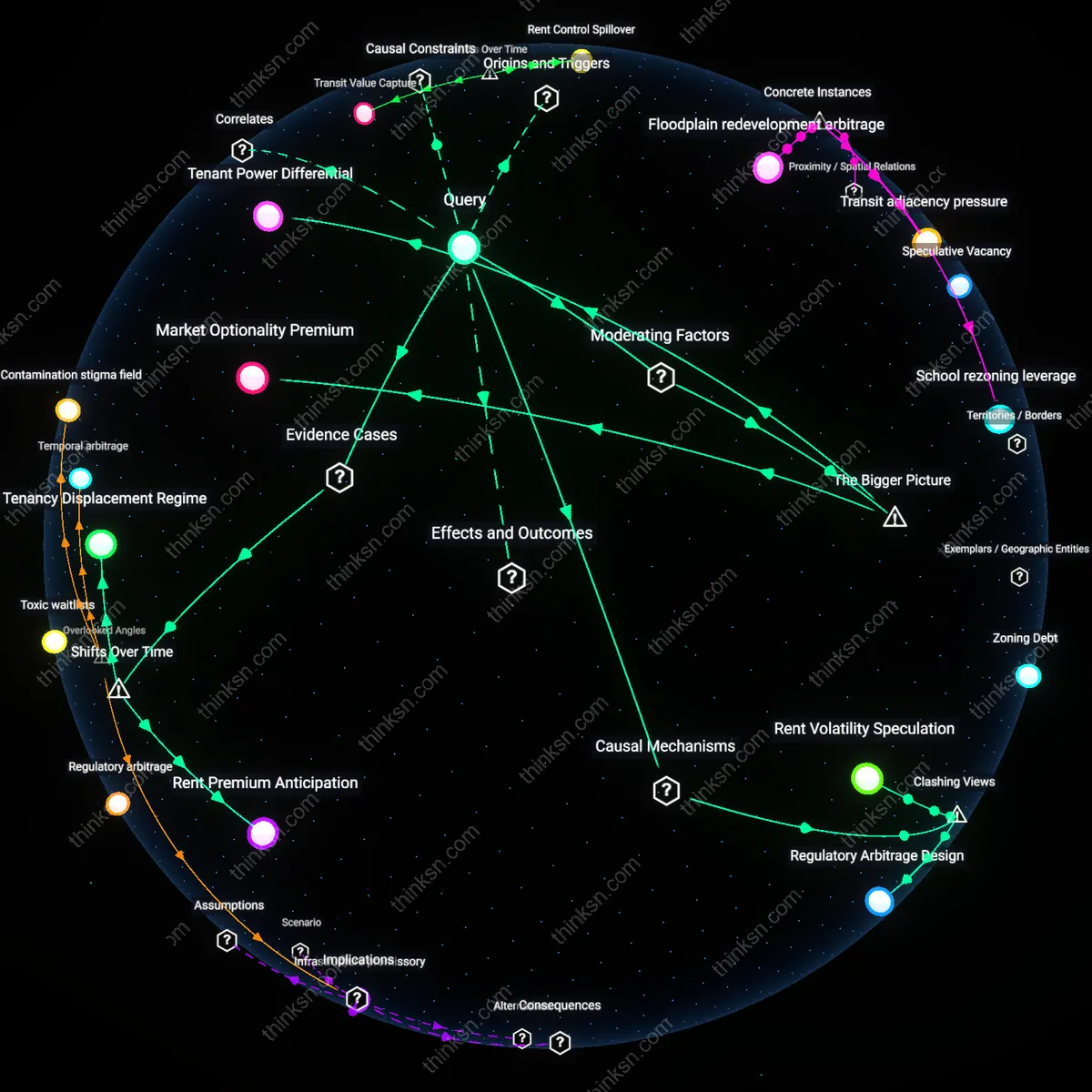
Rent Volatility Speculation
Developers embed no-renewal clauses in new construction leases to legally secure future discretion in rent resets, anticipating sharp upward volatility in market rates driven by neighborhood gentrification and constrained housing supply; this mechanism operates through asset positioning rather than tenant exclusion, exploiting time-limited regulatory gaps before rent stabilization expansions take effect. The non-obvious element is that these clauses are less about distrust of tenants and more about speculative calibration—developers treat lease expiration as a timing mechanism to capture policy-induced price dislocations, particularly in cities like Berlin or Brooklyn where rezoning lags market shifts.
Tenurial Asymmetry Engineering
No-renewal clauses are leveraged by developers not to bet against rent growth, but to institutionalize a power imbalance that pressures tenants into self-eviction ahead of redevelopment cycles, thereby avoiding direct confrontation with rent control laws; this functions through psychological precarity rather than immediate economic force, as seen in London’s Build-to-Rent sector where ‘break clauses’ align with estate regeneration timelines. The dissonance lies in reframing the clause not as a market signal but as a behavioral nudge—developers expect rents to rise, yet choose to engineer displacement inertia rather than rely on market-clearing mechanisms, revealing a preference for social friction over pure price competition.
Regulatory Arbitrage Design
Frequent no-renewal terms indicate developers are designing lease structures to preemptively bypass emerging tenant protections by locking in temporary occupancy models that mimic short-term rentals while retaining legal classification as residential tenancies; this occurs through deliberate misalignment of lease duration with investment horizons, allowing operators like Starcity or Common to treat urban buildings as flexible land use proxies. The underappreciated reality is that these clauses are not market rent forecasts but loopholes in zoning-time coupling—developers anticipate protection frameworks will lag behind occupancy format innovations, making tenure instability a feature, not a bug, of compliance avoidance.
Market Optionality Premium
Frequent no-renewal clauses in new construction leases signal that developers prioritize future rent upside over long-term tenancy stability, treating lease expiration as a strategic inflection point rather than a risk. Developers, particularly in rapidly appreciating urban markets like Seattle or Austin, embed early exit options to capitalize on projected rent growth driven by zoning deregulation and tech-sector expansion, effectively converting real estate into a market-adjacent financial instrument. This shifts the function of leasing from tenancy governance to embedded speculation, where the contractual design anticipates and facilitates recommodification of space in rising markets—highlighting how real estate finance now internalizes option value as a core asset attribute rather than merely responding to it.
Regulatory Arbitrage Pathway
No-renewal clauses become more prevalent in new developments when local tenant protection laws exclude commercial tenants or offer weak post-occupancy safeguards, allowing developers to exploit jurisdictional asymmetries between residential and commercial code enforcement. In cities like Los Angeles, where stronger rent control applies only to residential units, developers concentrate mixed-use projects with short-term commercial leases to retain control over future redevelopment rights, particularly near transit-oriented developments anticipating upzoning. This contractual choice is less about rent forecasts than about exploiting a loophole that decouples physical longevity from tenancy guarantees, revealing how private actors reshape spatial control through deliberate alignment with regulatory gaps.
Tenant Power Differential
The recurrence of non-renewable construction leases reflects not just expectations of rent growth but the structural weakening of institutional tenants' bargaining power in high-demand corridors dominated by institutional capital. In gateway cities such as New York or San Francisco, private equity-backed developers target tenants in fragmented service sectors—like boutique retail or co-working spaces—whose limited relocation options and short planning horizons make them vulnerable to take-it-or-leave-it lease terms. This dynamic reinforces a feedback loop where capital concentration enables contractual standardization that erodes tenurial continuity, illustrating how rent expectations are not passively anticipated but actively manufactured through imbalanced negotiation ecosystems.
Rent Premium Anticipation
Developers include frequent no-renewal clauses in new construction leases to capture future rent increases unimpeded by tenant retention, a shift from the 1980s–90s norm of longer-term industrial leases in cities like Houston’s Energy Corridor, where renewal rights stabilized occupancy amid volatile oil markets. This reflects a post-2010 transformation in commercial real estate finance, particularly in tech-driven office developments such as those by Jamestown in San Francisco’s South of Market district, where short tenancy cycles are priced into pro forma models that prioritize repositioning for higher-tier tenants. The non-obvious implication is that these clauses are not primarily risk mitigation tools but forward-looking instruments designed to exploit anticipated upward market inflection, revealing a temporal gamble embedded in asset valuation.
Tenancy Displacement Regime
The spread of no-renewal clauses in urban mixed-use towers, such as Silverstein Properties’ post-2005 developments in Lower Manhattan, marks a structural break from mid-20th century zoning-based tenant protections that assumed commercial continuity. As city planning shifted after the 2010s toward incentivizing rapid redevelopment density—evident in NYC’s Hudson Yards rezoning—developers internalized the expectation that ground-floor retail and flexible office spaces would need turnover to align with speculative retail branding cycles. This regime normalizes displacement not through eviction but contractual design, making temporary tenancy a programmed feature rather than a market failure, thus exposing how developer expectations are shaped less by rent growth per se than by time-bound alignment with capital stacking strategies.