Higher Density Development: Tax Gain or Community Loss?
Analysis reveals 6 key thematic connections.
Key Findings
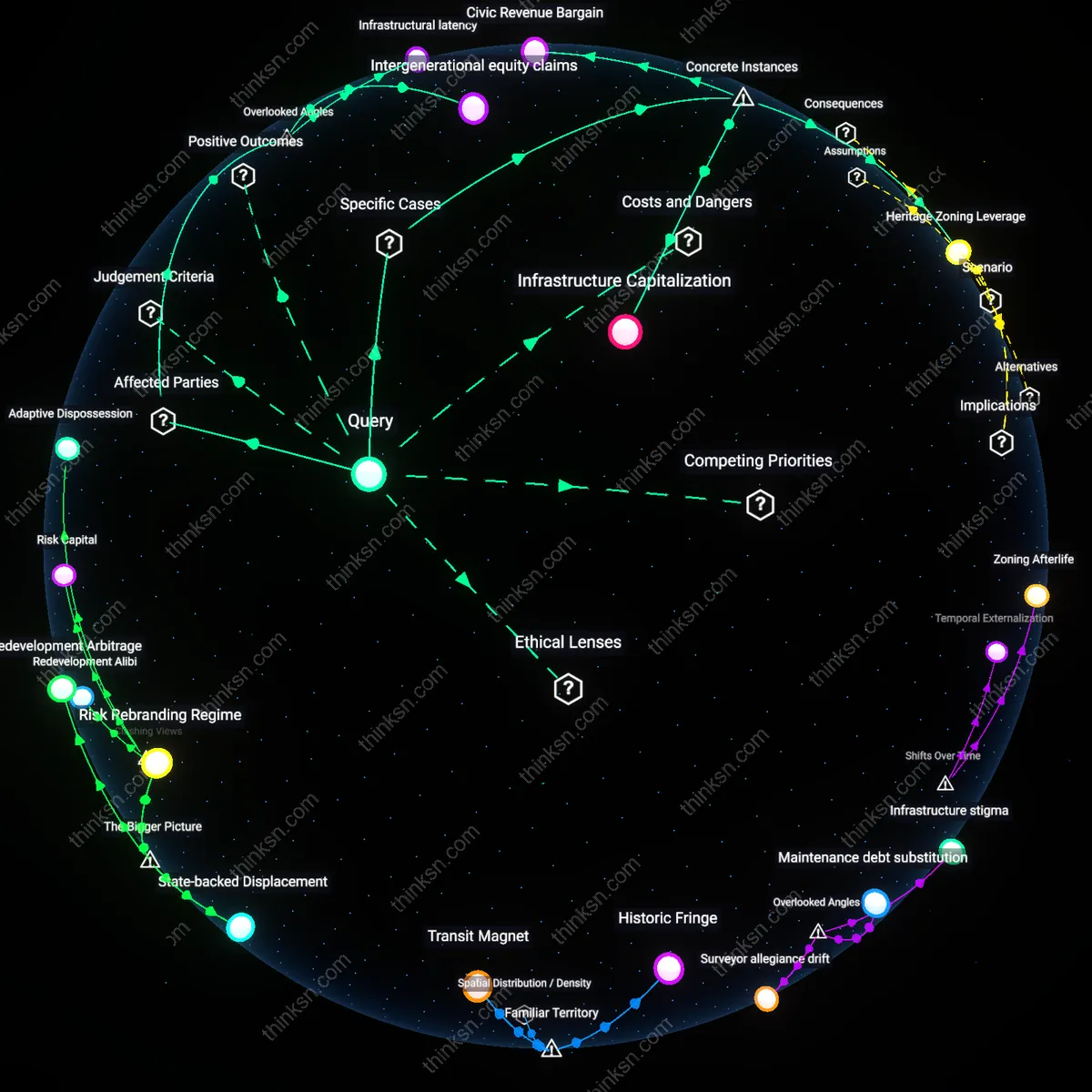
Infrastructural latency
The evaluation must prioritize the strain on legacy utility systems, such as century-old sewer lines in historic neighborhoods like those in Baltimore or Buffalo, where higher-density development accelerates the failure of under-dimensioned infrastructure not designed for increased load. Municipal engineers and public works departments—often excluded from zoning debates—become de facto arbitrators of development feasibility when wastewater capacity or electrical grid headroom determines what density is physically possible, not just politically acceptable. This shifts the trade-off from an abstract fiscal-versus-culture debate to a material constraint where deferred maintenance on invisible systems quietly caps urban growth, a factor almost never priced into revenue projections or community impact assessments.
Intergenerational equity claims
Long-time residents under age 30 in rapidly gentrifying areas, such as Oakland’s Temescal neighborhood, often face erasure when preservation discourse centers on architectural heritage rather than lived continuity of cultural practice, like neighborhood-specific youth mentorship networks or informal economies. These young stakeholders, especially in Black and Latino communities, value density that includes affordable units they can access, challenging the assumption that preservation always aligns with community interest. The overlooked dynamic is that 'community identity' is not static—and when youth are excluded from owning or shaping denser development, the identity being preserved becomes a museum exhibit, not a living tradition, fundamentally altering who holds authority over cultural continuity.
Municipal risk recalibration
City insurance pools and bond-rating agencies, such as those influencing Tulsa or Charlotte’s credit scores, increasingly assess the fiscal risk of concentrated development not just through revenue gains but via exposure to climate-related liabilities in newly dense floodplains or heat islands. When higher-density projects cluster populations in historically underserved, environmentally vulnerable zones, the expected tax uptick may be discounted by actuaries factoring in future disaster costs, effectively pricing in social vulnerability as a financial liability. This hidden dependency means that 'community preservation' may be indirectly incentivized not by nostalgia, but by risk-averse fiscal planning that treats cultural and ecological fragility as correlated threats to long-term revenue stability.
Infrastructure Capitalization
Portland, Oregon’s urban growth boundary directly redirects tax gains from density into public transit and green spaces, thereby preserving neighborhood character despite higher intensity development. By legally binding density-derived revenues to spatially equitable reinvestment, the city institutionalizes a feedback loop where tax increases do not erode identity but instead fund its material maintenance—the mechanism challenges the assumption that revenue extraction inherently degrades community fabric. This case reveals that the financial logic of density need not oppose cultural continuity when reinvestment is codified, a dynamic often overlooked in debates prioritizing either growth or preservation alone.
Heritage Zoning Leverage
In Charleston, South Carolina, strict historic district zoning enables property owners to trade development rights across parcels, generating tax value through transferable development rights (TDRs) without altering the historic urban form. The TDR market monetizes density potential while freezing physical change in core neighborhoods, meaning community identity is preserved not despite tax incentives but because of them—the economic mechanism converts preservation into a fiscal asset. This illustrates how identity itself can become a governable fiscal instrument when regulatory design aligns cultural and revenue goals, a nuance absent from zero-sum trade-off frameworks.
Civic Revenue Bargain
In the Bronx’s Via Verde housing project, community organizations negotiated with New York City and private developers to cap density increases in exchange for guaranteed affordable units and local hiring, ensuring tax gains from new construction were contingent on social continuity. The development’s approval hinged on a binding civic compact that treated community identity as a contractual condition of revenue generation, not an externality. This case uncovers a political mechanism—pre-development revenue bargaining—that transforms identity preservation into a co-equal term in fiscal negotiations, a departure from post-hoc mitigation models dominant in urban policy.