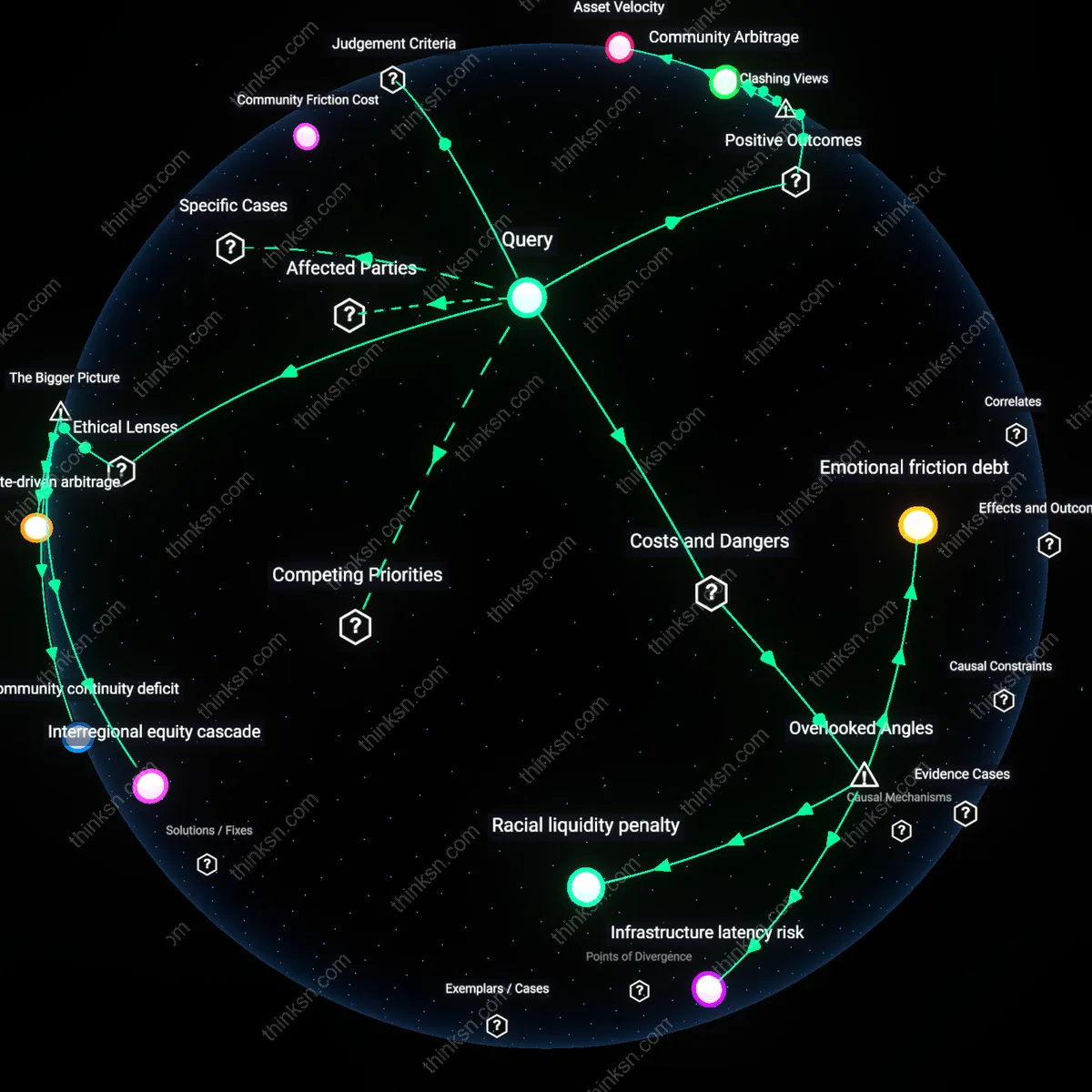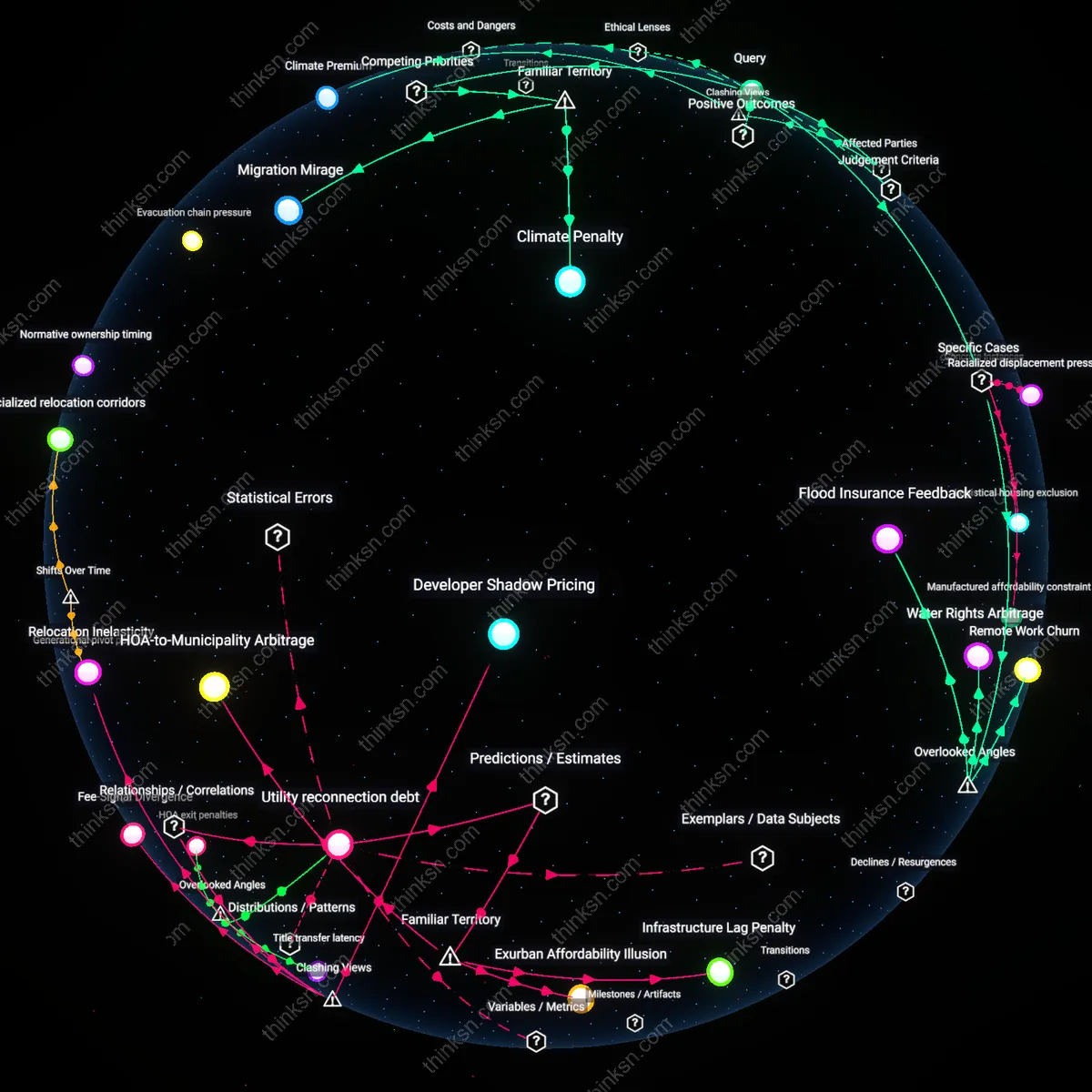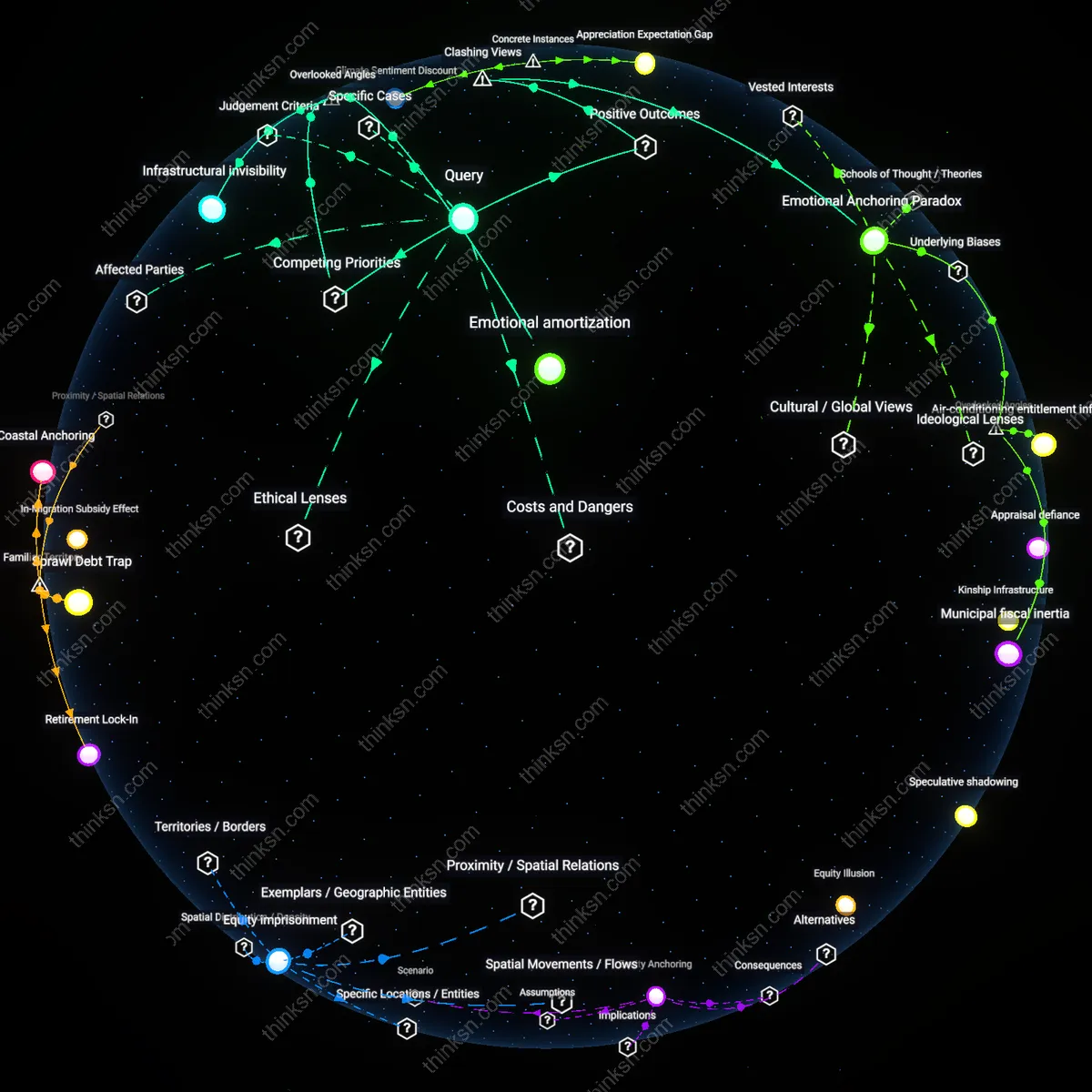
Increased Property Value or Affordable Housing? The Sun Belt Dilemma
Analysis reveals 7 key thematic connections.
Key Findings
Value-Capture Leverage
Homeowners should cede control over infill density limits in exchange for direct participation in municipal land-value recapture mechanisms that convert rising property values into community-controlled housing trusts. This shift treats homeowners not as passive gatekeepers of scarcity but as equity stakeholders in regional affordability, where rising prices in high-demand Sun Belt corridors like Austin or Atlanta trigger automatic transfer of a percentage of annual appreciation into pooled funds for below-market construction—bypassing traditional exclusionary zoning battles by aligning individual wealth preservation with collective supply expansion. The non-obvious insight is that limiting infill is not inherently NIMBYist; it becomes socially regressive only when appreciation flows entirely to private owners, whereas a mandatory appreciation-sharing regime transforms property rights into engines of inclusion.
Tenure Diversification
Shifting the unit of housing policy from structure type to household autonomy reveals that mid-rise infill opponents are not defending property values per se but rather a cultural hegemony of single-family ownership, yet Sun Belt demographic shifts—especially growth in multi-generational and non-nuclear households—favor mixed-tenure buildings that combine rental, co-op, and purchase units within single developments such as those emerging in Nashville's gentrifying corridors. By redefining 'value' as access to stable, multi-option residential ecosystems rather than as lot-line exclusivity, municipalities can satisfy both affordability mandates and homeowner equity interests through vertically integrated buildings that appreciate as a whole while distributing risk across tenure types. The dissonance lies in reframing infill conflict not as density versus sprawl but as a lag between property finance models and evolving kinship-based housing demand.
Housing Apartheid Path
The shift from overtly racial covenants banned in 1948 toward design-based exclusion in Sun Belt cities after the 1970s—using height limits, floor-area ratios, and parking mandates to achieve similar segregation—has reproduced spatial inequity under a neutral legal guise, such that resistance to mid-rise infill now functions as a continuation of earlier exclusion by other means; this regulatory refinement, deployed through municipal planning boards dominated by single-family homeowners, exposes how the housing apartheid path evolved from explicit racism to coded spatial control, normalizing affordability exclusion as policy.
Climate Backdraft
Since the 1990s, as Sun Belt metro growth accelerated amid rising climate vulnerability, the preference for low-density, single-family zones reinforced car dependency and increased per-capita emissions, while limiting mid-rise infill in transit-accessible corridors undercut resilience investments; this lock-in effect—where homeownership as a financialized asset class resists density that could mitigate heat islands and lower energy loads—produces a climate backdraft in which localized property defense intensifies regional environmental risk, a cost invisibilized in zoning debates but increasingly material in utility failures and insurance withdrawals.
Future tax abatement risk
Homeowners should accept targeted mid-rise infill because the long-term erosion of municipal revenue stability from stagnant tax rolls poses a greater threat to property values than near-term aesthetic or traffic concerns. As Sun Belt cities expand without denser development, they increasingly rely on tax abatements to attract commercial projects in saturated peripheral zones, which depresses overall tax yield and forces service cuts that degrade neighborhood desirability—this fiscal feedback loop, driven by underutilized land-value capture in residential zones, is rarely factored into NIMBY calculations but systematically undermines the very property security residents seek to protect. The overlooked dynamic is that resisting infill shifts risk from individual homeowners to public finance solvency, making resistance a form of deferred fiscal vulnerability.
Infrastructure leverage threshold
A homeowner maximizes long-term equity resilience by supporting infill just beyond the point where new density triggers utility-scale infrastructure upgrades, because existing homeowners then capture disproportionate benefit from expanded water, broadband, and transit capacity without bearing construction costs. In fast-growing Sun Belt municipalities like Austin or Raleigh, clustered infill can push localized demand past the 'leveraging threshold' where capital improvements become eligible for state or federal matching funds—a shift that internalizes externalities while upgrading the entire service zone, including single-family parcels. This threshold effect is functionally invisible in zoning debates, where density is treated as linearly burdensome rather than episodically transformative to shared systems.
Renter voter alignment
Homeowners can preserve neighborhood influence by conceding infill density in exchange for anchoring tenant representation in local governance, because disenfranchised renters create political vacuums that ultimately empower external developers and county-level overrides. Where long-term tenants gain participatory standing—through renters' councils with advisory zoning power—their interest in neighborhood stability aligns with legacy owners against speculative teardowns and hyper-gentrification, forming a coalition that blocks destabilizing overdevelopment more effectively than exclusionary zoning. This co-governance dynamic subverts the usual tradeoff because it treats political legitimacy, not just physical form, as a scarce shared resource that both groups lose if not jointly defended.